
 Promos
 Save The Food


César Nieto
César Nieto Sliced Shoulder Cebo Iberica 50% race Iberica
100 gDelivery within 60 minutes
AI Summary
Every day, we source locally for the freshest groceries you can trust.
- Description
- Composition
- Similar products
- More from this brand
- Recipes

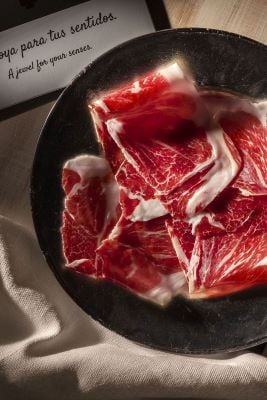
100 g Cebo Iberico Shoulder sliced
Each pack of sliced César Nieto Paleta de Cebo 50% Raza Ibérica offers the same quality as the Paleta de Cebo 50% Raza Ibérica, but has its own character. Its curing time is proportionally shorter, so its flavour and aromas are very intense, perhaps even more intense than that of the ham itself, with a subtly different range of nuances that many customers prefer.
The breed:
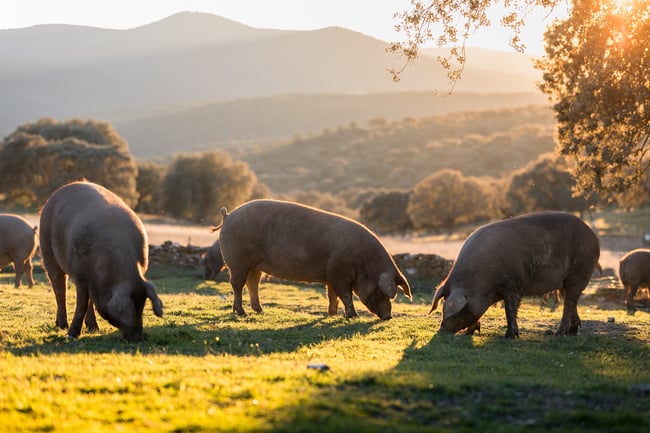
The Iberian pig is descended from the wild boar and the domestic pig and has a history of over 2000 years. They have always been bred under holm oaks and cork oaks, known as "Dehesas", and live there "semi-wild". Because of their black claws they are often called "Pata Negra".
The name Iberian pig (Cerdo Iberico) can be used for several breeds. The Black Pig has the highest fat content, the Colorado Pig has the largest muscle content of the Iberian pigs and the Torbiscal is a cross between Spanish and Portuguese breeds and is very robust and reproduces well.
All names are in turn divided into different breeds and their crosses.
Habitat:
The Iberian pig is closely linked to the wooded Dehesa pastures. It is kept extensively. The Iberian pig breed has its origin in the Mediterranean pig of African origin.
The pastures where the pig lives are mostly areas with Mediterranean forest, where oak trees (Quercus) grow, which produce acorns, especially holm oaks, cork oaks and Portuguese oaks (Quercus faginea). In between, there are also chestnut and carob trees. In rainy seasons, pastures are created where the pigs feed.
Feeding:
Within the ecosystem of the Dehesa, grasses grow, which are the ideal food for pigs in spring and summer, while in autumn and winter acorns form the basis of the diet during the fattening period.
The pigs are additionally fattened with cereals, wheat, soya, maize and barley. The pigs are slaughtered throughout the year from at least 10 months and 155 kg minimum weight.
Quality and taste:
The meat is characterised by an intense, nutty flavour. This comes mainly from the fat, which is strongly influenced by the acorn fattening. The meat is somewhat darker in colour than conventional pork and heavily marbled with white fat, the intensive marbling is comparable to that of Wagyu beef.
About the manufacturer
The beginnings can be traced back to 1943. At that time there were only a handful of traders who dealt with the then still unknown Iberian pig. One of them was Alonso Nieto Manzano. At the age of only 20, the present namesake of the company "Cesar Nieto Martin" had to take over the company in 1967 and quickly became the most important driving force for the years to come.
Together with other companies, Cesar Nieto built his own slaughterhouse in 1985 and was one of the founding fathers of the "Guijuelo" designation of origin in 1986, which is now internationally known and recognised. In 1997, the two eldest sons César Nieto and Jorge Nieto joined the company and became production and sales managers.
Packaging:
Vacuum-packed
Kitchen hygiene:
Kitchen hygiene is important: Keep refrigerated, store separately from other products, work cleanly
Storage conditions:
Store at room temperature in a cool, dry place
Manufacturer:
Cesar Nieto Group S.L.
Polígono Agroalimentario,
C. Sierra Ventosa, 66M,
37770, Salamanca - Spain
Durability
Iberische Schweineschulter, Salz, Dextrose, Zucker, Konservierungsmittel (E-252) und Antioxidationsmittel (E-316)
Nutritional values per 100 g
| Energy value | 1357 kJ/326 kCal |
| Fats | 21 g |
| including saturated fatty acids | 8 g |
| Carbohydrates | 0.5 g |
| including sugars | 0 g |
| Protein | 33 g |
| Salt | 5.7 g |
| Fibre | 0 g |