Papillon
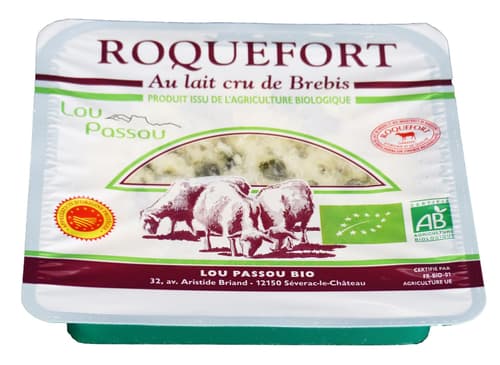
Papillon Organic Roquefort AOP
100 g8 DAYS AVERAGE FRESHNESS
Delivery within 60 minutes
AI Summary
Xtra price:
€5.12
Every day, we source locally for the freshest groceries you can trust.
- Description
- Composition
- Similar products
- More from this brand
- Recipes
Papillon Bio Roquefort
Roquefort is one of the oldest cheeses for which written records exist. Sheep's milk cheese was imported from Rome even before the Common Era, and is mentioned in the writings of Pliny. According to tradition, the origin of this famous cheese can be traced back to a love story. A young shepherd is said to have forgotten his bread and his sheep's milk cheese in a cave on Mount Combalou when he followed a passing shepherdess. Some time later, he returned and discovered his cheese, which had ripened with green-blue veins of mold, naturally inoculated by the mold on the bread. The shepherd tasted it and found it delicious.

Roquefort, the alchemy between the natural ventilation of a cellar, rye bread and sheep's cheese, was born. Roquefort is not called l'Empereur des Fromages - Emperor of Cheeses - for nothing. The first written mention of the name Roquefort was in 1070 in the books of the monastery of Conques, which recorded an annual levy of two cheeses from each of the cellars in Roquefort. In 1407, the French king Charles VI granted the inhabitants of the village of Roquefort the privilege that only cheese ripened in these caves may bear the name Roquefort. A charter from Charles VI in April 1411 contains the first protective provisions for Roquefort production. In 1666, a decree of the Parliament of Toulouse confirmed the monopoly of the inhabitants of Roquefort-sur-Soulzon for the ripening of Roquefort. On July 26, 1925, Parliament passed a law making "Roquefort" the first cheese with a designation of origin. The milk for Roquefort may only be obtained from specified municipalities in the départements of Tarn, Lozere, l'Herault, Gard, Aveyron and l'Aude in southern France. Every Roquefort is produced according to strict AOP regulations and matured for at least three months in the Combalou mountain.
The Papillon cheese dairy is particularly well-known among Roquefort producers because the company cultivates its Penicillium strain on rye bread. Papillon has its own bread oven, in which rye bread is produced from organic rye flour during the full moon in September. Once the bread has become moldy, the crust is removed and the bread dough is crushed to a powder. This powder is finally added to the fresh milk before coagulation. The consistency of Roquefort is tender and melting, but crumbly when cut.
2°C to 6° C

Importer:
Vallée Verte Handelsgesellschaft f. Naturprodukte mbH, Freiburger Straße 2a, 77694 Kehl
Durability
Composition
| SCHAFMILCH |
| ROHMILCH |
| Siedesalz |
| Milchsäurekulturen |
| Tierisches Lab |
| Reifungskulturen |
| Blaue Edelschimmelkulturen |
| Penicillium Roqueforti |
Nutritional values per 100 g
| Energy value | 1572 kJ/379 kCal |
| Fats | 32 g |
| including saturated fatty acids | 20 g |
| Carbohydrates | 1.8 g |
| including sugars | 0 g |
| Protein | 21 g |
| Salt | 3.6 g |
| Fibre | g |
Allergens
| Milch |