
Produkt aus:
Preussen
3451€
Nur noch wenige Stück verfügbar
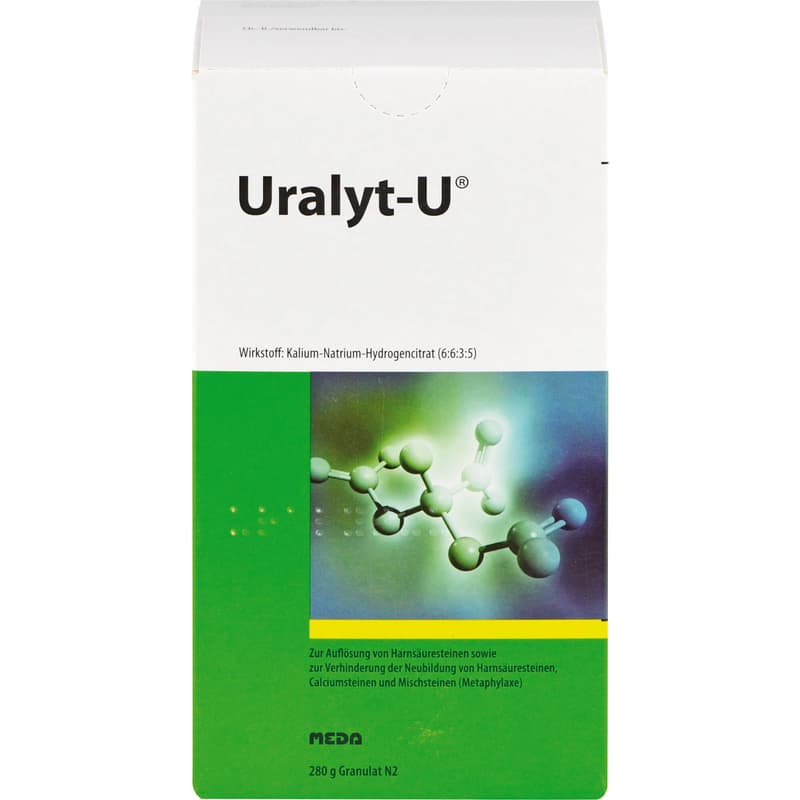
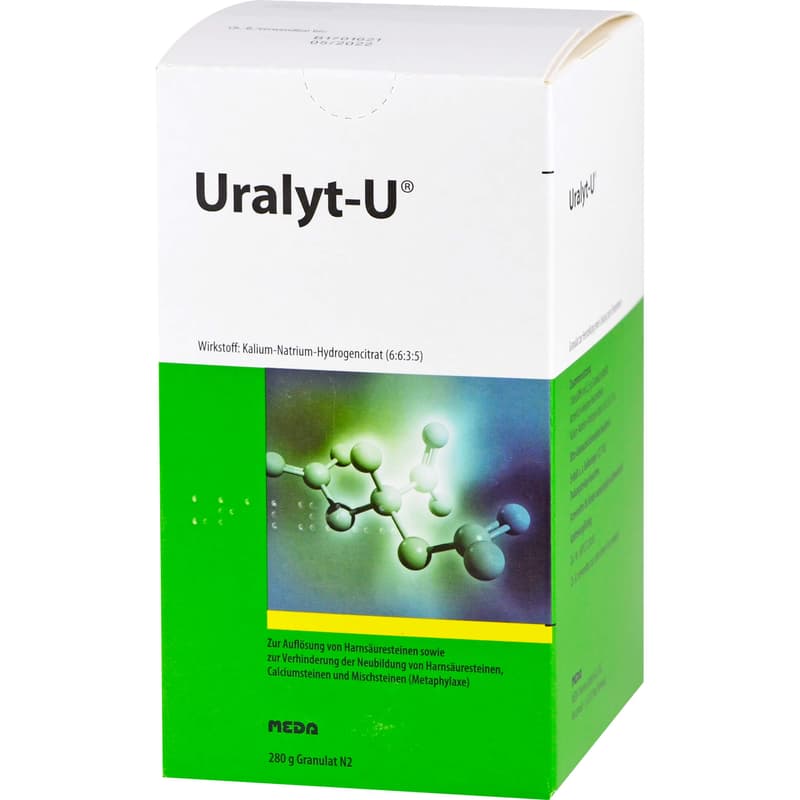
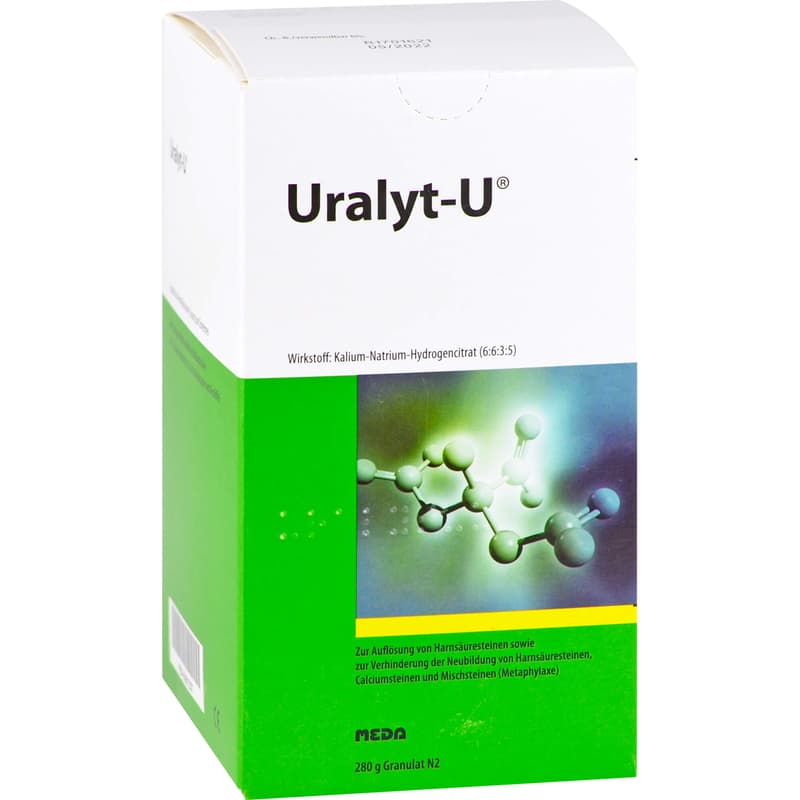
Das URALYT-U Granulat ist ein hochwertiges Arzneimittel zur Auflösung von Harnsäuresteinen sowie zur Vorbeugung von Calcium- und Harnsäuresteinen. Das hellorangefarbene Granulat mit frischem Zitronenöl-Aroma wird einfach in Wasser aufgelöst. Die praktische 280 g Packung enthält bereits einen passenden Messlöffel und Indikatorpapier zur einfachen pH-Wert-Messung direkt bei Ihnen zu Hause.
Zu Risiken und Nebenwirkungen lesen Sie die Packungsbeilage und fragen Sie Ihre Ärztin, Ihren Arzt oder in Ihrer Apotheke.



Beschreibung
Wichtige Hinweise (Pflichtangaben)
Uralyt-U Granulat. Wirkstoff: Kalium-Natrium-Hydrogencitrat (6:6:3:5). Anwendungsgebiete: zur Auflösung von Harnsäuresteinen und zur Metaphylaxe (Verhinderung einer erneuten Bildung) von Calcium- und Harnsäuresteinen, bzw. Mischsteinen aus Calciumoxalat/Harnsäure oder Calciumoxalat/Calciumphosphat.Zu Risiken und Nebenwirkungen lesen Sie die Packungsbeilage und fragen Sie Ihre Ärztin, Ihren Arzt oder in Ihrer Apotheke.
GEBRAUCHSINFORMATION: INFORMATION FÜR DEN ANWENDER
Uralyt-U Granulat zur Herstellung einer Lösung zum Einnehmen
Wirkstoff: Kalium-Natrium-Hydrogencitrat (6:6:3:5)
Lesen Sie die gesamte Packungsbeilage sorgfältig durch, bevor Sie mit der Einnahme dieses Arzneimittels beginnen, denn sie enthält wichtige Informationen. Nehmen Sie dieses Arzneimittel immer genau wie in dieser Packungsbeilage beschrieben bzw. genau nach Anweisung Ihres Arztes oder Apothekers ein.
- Heben Sie die Packungsbeilage auf. Vielleicht möchten Sie diese später nochmals lesen.
- Fragen Sie Ihren Apotheker, wenn Sie weitere Informationen oder einen Rat benötigen.
- Wenn Sie Nebenwirkungen bemerken, wenden Sie sich an Ihren Arzt oder Apotheker. Dies gilt auch für Nebenwirkungen, die nicht in dieser Packungsbeilage angegeben sind. Siehe Abschnitt 4.
- Wenn Sie sich nicht besser oder gar schlechter fühlen, wenden Sie sich an Ihren Arzt.
Was in dieser Packungsbeilage steht
- WAS IST URALYT–U UND WOFÜR WIRD ES ANGEWENDET?
- WAS SOLLTEN SIE VOR DER EINNAHME VON URALYT–U BEACHTEN?
- WIE IST URALYT–U EINZUNEHMEN?
- WELCHE NEBENWIRKUNGEN SIND MÖGLICH?
- WIE IST URALYT–U AUFZUBEWAHREN?
- INHALT DER PACKUNG UND WEITERE INFORMATIONEN
Uralyt-U ist ein Alkalicitrat, Urolithiasismittel.
Anwendungsgebiete:
- zur Auflösung von Harnsäuresteinen.
- zur Metaphylaxe (Verhinderung einer erneuten Bildung) von Calcium– und Harnsäuresteinen, bzw. Mischsteinen aus Calciumoxalat/Harnsäure oder Calciumoxalat/Calciumphosphat.
Hinweis
Die Anwendung des Präparates sollte nur im Rahmen eines Gesamtkonzeptes der Metaphylaxe (z.B. Diät, vermehrte Flüssigkeitsaufnahme usw.) erfolgen.2. WAS SOLLTEN SIE VOR DER EINNAHME VON URALYT-U BEACHTEN?
Uralyt-U soll nicht angewendet werden bei akutem oder chronischem Nierenversagen, vom Arzt angeordneter kochsalzarmer Diät, schweren Störungen des Säure-Basen-Haushalts (z.B. metabolische Alkalose, überhöhte Blut-Kalium-Werte (Hyperkaliämie)) sowie bei Harnwegsinfekten mit harnstoffspaltenden Bakterien. Uralyt-U darf nicht eingenommen werden, wenn Sie überempfindlich (allergisch) gegenüber KaliumNatrium-Hydrogencitrat, Gelborange S (E 110) oder einen der sonstigen Bestandteile von Uralyt-U sind.
Warnhinweise und Vorsichtsmaßnahmen:
- Vor Therapiebeginn sollten Zustände bzw. Erkrankungen, die das Auftreten von Harnsteinen begünstigen können und die einer gezielten Behandlung zugänglich sind (z.B. Adenome der Nebenschilddrüsen, Malignome bei Harnsäuresteinen usw.), ausgeschlossen werden.
- Vor der ersten Anwendung sind die Elektrolyte im Serum zu bestimmen und die Nierenfunktion zu kontrollieren. Bei Verdacht auf renal–tubuläre Acidose (RTA) ist zusätzlich der Säure–Basen–Status zu kontrollieren.
- Insbesondere bei älteren Patienten, oder bei Patienten mit eingeschränkter Nierenfunktion oder bei gleichzeitiger Therapie mit manchen Arzneimitteln gegen Bluthochdruck (z.B. Aldosteronantagonisten, Angiotensinrezeptorantagonisten (Sartane), kaliumsparenden Diuretika, ACE–Hemmern) oder gegen chronischen Schmerz (nichtsteroidale Antiphlogistika und periphere Analgetika) sollte berücksichtigt werden, dass die maximal empfohlene Tagesdosis 11,25 g Granulat (4,5 gestrichene Messlöffel) beträgt. Dies entspricht 1,86 g Kalium und 1,09 g Natrium, d.h. 47,5 mmol Kalium und 47,5 mmol Natrium. Durch Interaktion mit den hier genannten Arzneimitteln, kann es zu einer Hyperkaliämie kommen.
- Uralyt–U soll bei Patienten mit schwerer Leberfunktionsstörung nur mit Vorsicht angewendet werden.
- Gelborange S (E 110) kann allergische Reaktionen hervorrufen. Dieses Arzneimittel enthält Gelborange S (E 110), das bei Personen, die gegen diesen Stoff besonders empfindlich sind, allergieartige Reaktionen hervorrufen kann.
Kinder und Jugendliche
Die Behandlung von Kindern unter 12 Jahren wird nicht empfohlen, da keine ausreichenden Erfahrungen für diese Altersgruppe vorliegen.Bei Einnahme von Uralyt-U mit anderen Arzneimitteln
Eine Erhöhung der extrazellulären Kaliumkonzentration vermindert die Wirkung von Herzglykosiden, eine Erniedrigung begünstigt die Entstehung von Herzrhythmusstörungen unter Herzglykosiden. Manche Arzneimittel gegen Bluthochdruck (z.B. Aldosteronantagonisten, Angiotensinrezeptorantagonisten (Sartane), kaliumsparende Diuretika, ACE-Hemmer) oder gegen chronischen Schmerz (nichtsteroidale Antiphlogistika und periphere Analgetika) vermindern die Kaliumausscheidung im Urin. Es ist zu beachten, dass 10 g Uralyt-U (mittlere Tagesdosis) 1,72 g, entsprechend 44 mmol Kalium, enthalten. Bei Verordnung einer natriumarmen Diät ist zu beachten, dass 10 g Uralyt-U (mittlere Tagesdosis) 1 g, entsprechend 44 mmol Natrium beziehungsweise 2,6 g Kochsalz enthalten. Eine gleichzeitige Gabe von citrat- und aluminiumhaltigen Substanzen (z.B. gegen Sodbrennen) kann zu einer erhöhten Aluminiumresorption führen; daher sollte bei erforderlicher Einnahme solcher Präparate eine zeitversetzte Verabreichung von mindestens 2 Stunden erfolgen. Beachten Sie bitte, dass diese Angaben auch für vor kurzem angewandte Arzneimittel gelten können. Informieren Sie Ihren Arzt oder Apotheker wenn Sie andere Arzneimittel einnehmen/anwenden, kürzlich andere Arzneimittel eingenommen/angewendet haben oder beabsichtigen andere Arzneimittel einzunehmen/anzuwenden.Schwangerschaft und Stillzeit
Es liegen keine ausreichenden Daten über eine Anwendung an Schwangeren oder stillenden Frauen vor. Tierstudien erbrachten keinen Hinweis auf eine fruchtschädigende Wirkung. Wenn Sie schwanger sind oder stillen, fragen Sie vor der Einnahme von Uralyt-U bitte Ihren behandelnden Arzt.Verkehrstüchtigkeit und das Bedienen von Maschinen
Es sind keine besonderen Vorsichtsmaßnahmen erforderlich.Wichtige Informationen über bestimmte sonstige Bestandteile von Uralyt-U
Dieses Arzneimittel enthält den Farbstoff Gelborange S (E 110), der bei Personen, die gegen diesen Stoff besonders empfindlich sind, allergieartige Reaktionen einschließlich Asthma hervorrufen kann. Die Allergie tritt häufiger bei Personen auf, die gegen 2-Acetoxybenzoesäure (Acetylsalicylsäure) allergisch sind.3. WIE IST URALYT-U EINZUNEHMEN?
Nehmen Sie dieses Arzneimittel immer genau wie in dieser Packungsbeilage beschrieben bzw. genau nach der mit Ihrem Arzt getroffenen Absprache ein. Fragen Sie bei Ihrem Arzt oder Apotheker nach, wenn Sie sich nicht sicher sind.
Zur Auflösung und Verhinderung der Neubildung von Harnsäuresteinen
Die empfohlene Dosis beträgt: Täglich 4 gestrichene Messlöffel (= 10 g Granulat) in 3 Einzelgaben nach den Mahlzeiten einnehmen. Morgens und mittags jeweils 1 gestrichenen Messlöffel und abends 2 gestrichene Messlöffel nach den Mahlzeiten. Der pH-Wert des frischen Harns sollte in folgendem pH-Bereich liegen: Harnsäuresteine: 6,2 - 6,8. Bei pH-Werten unterhalb des angegebenen Bereichs ist die Tagesdosis um einen halben gestrichenen Messlöffel abends zu erhöhen. Bei pH-Werten oberhalb des angegebenen Bereichs ist die Tagesdosis um einen halben gestrichenen Messlöffel abends zu verringern. Die richtige Dosis ist dann gefunden, wenn der pH-Wert des frischen Harns vor der Einnahme von Uralyt-U stets innerhalb des angegebenen Bereichs liegt. Zur Metaphylaxe von Harnsäuresteinen ist eine regelmäßige Kontrolle des Urin-pH-Wertes zu empfehlen.Zur Verhinderung der Neubildung von calciumhaltigen Nierensteinen
Die empfohlene Dosis beträgt: Die Tagesdosis beträgt 2 - 3 gestrichene Messlöffel (= 5 - 7,5 g Granulat) und soll als einmalige abendliche Dosis eingenommen werden. Bei zu niedriger pH-Wert-Lage sind täglich 3 - 4,5 gestrichene Messlöffel (= 7,5 - 11,25 g Granulat) in 2 - 3 über den Tag verteilten Dosen nach den Mahlzeiten einzunehmen. Es sollte ein pH-Wert von 7,0 angestrebt werden. Der pH-Wert sollte 6,2 nicht unterschreiten und 7,4 nicht überschreiten. Die Citrat- und/oder Harn-pH-Werte sollten regelmäßig kontrolliert werden und die individuelle Dosis (siehe oben) entsprechend angepasst werden.Art der Anwendung
Das Granulat wird in einem Glas Wasser aufgelöst und getrunken.Messung des pH-Wertes im Urin
Unmittelbar vor jeder Einnahme wird ein Teststreifen des beiliegenden Indikatorpapiers unter Verwendung der beiliegenden Klammer mit frischem Urin benetzt. Der Farbton des feuchtenTeststreifens wird dann mit der Farbtafel verglichen und der entsprechende pH-Wert unter der übereinstimmenden Farbe abgelesen. Der so gefundene pH-Wert und die Zahl der jeweils eingenommenen Messlöffel Granulat sind in den Kontrollkalender einzutragen. Der Kontrollkalender ist zu jedem Arztbesuch mitzubringen.Dauer der Anwendung
Über die Dauer der Einnahme entscheidet der behandelnde Arzt. Sollten trotz der Einnahme von Uralyt-U die Beschwerden fortbestehen, sollte der Arzt aufgesucht werden.Bitte sprechen Sie mit Ihrem Arzt oder Apotheker, wenn Sie den Eindruck haben, dass die Wirkung von Uralyt-U zu stark oder zu schwach ist.
Wenn Sie eine größere Menge Uralyt-U eingenommen haben,
als Sie sollten
Eine unerwünschte Beeinflussung stoffwechselphysiologischer Parameter ist auch bei höherer als der empfohlenen Dosierung bei ausreichender Nierenfunktion nicht zu erwarten. Bei Überdosierung kann es zu Hyperkaliämie (Kalium-Plasmaspiegel >5 mmol/l) kommen, insbesondere bei gleichzeitiger Übersäuerung (Azidose) oder eingeschränkter Nierenfunktion. Eine eventuelle Überdosierung kann jederzeit durch Kontrolle des Urin-pH-Bereiches erkannt und durch Dosisverringerung korrigiert werden. Gegebenenfalls ist ärztlicher Rat einzuholen.Wenn Sie weitere Fragen zur Anwendung des Arzneimittels haben, fragen Sie Ihren Arzt oder Apotheker.
4. WELCHE NEBENWIRKUNGEN SIND MÖGLICH?
Wie alle Arzneimittel kann auch dieses Arzneimittel Nebenwirkungen haben, die aber nicht bei jedem auftreten müssen.
| Bei der Bewertung von Nebenwirkungen werden folgende Häufigkeitsangaben zu Grunde gelegt: | |
| Sehr häufig: | mehr als 1 Behandelter von 10 |
| Häufig: | 1 bis 10 Behandelte von 100 |
| Gelegentlich: | 1 bis 10 Behandelte von 1 000 |
| Selten: | 1 bis 10 Behandelte von 10 000 |
| Sehr selten: | weniger als 1 Behandelter von 10 000 |
| Nicht bekannt: | Häufigkeit auf Grundlage der verfügbaren Daten nicht abschätzbar. |
Mögliche Nebenwirkungen
Erkrankungen des Magen-Darm-Trakts
Häufig kommt es zu meist leichten Magen- bzw. Bauchschmerzen. Selten tritt milder Durchfall oder Übelkeit auf.Andere mögliche Nebenwirkungen
Gelborange S (E 110) kann allergische Reaktionen hervorrufen.Meldung von Nebenwirkungen
Wenn Sie Nebenwirkungen bemerken, wenden Sie sich an Ihren Arzt oder Apotheker. Dies gilt auch für Nebenwirkungen, die nicht in dieser Packungsbeilage angegeben sind. Sie können Nebenwirkungen auch direkt dem Bundesinstitut für Arzneimittel und Medizinprodukte, Abt. Pharmakovigilanz, Kurt-Georg-Kiesinger Allee 3, D-53175 Bonn, Website: www.bfarm.de anzeigen. Indem Sie Nebenwirkungen melden, können Sie dazu beitragen, dass mehr Informationen über die Sicherheit dieses Arzneimittels zur Verfügung gestellt werden.5. WIE IST URALYT-U AUFZUBEWAHREN?
Bewahren Sie dieses Arzneimittel für Kinder unzugänglich auf. Bewahren Sie dieses Arzneimittel für Kinder unzugänglich auf. Sie dürfen das Arzneimittel nach dem auf der Faltschachtel und der Dose angegebenen Verfalldatum nicht mehr verwenden.
Aufbewahrungsbedingungen
Für die Haltbarkeit nach Öffnung des Behältnisses bestehen keine besonderen Einschränkungen. Die gebrauchsfertige Lösung sollte umgehend getrunken werden.6. WEITERE INFORMATIONEN
Was Uralyt-U enthält
Der Wirkstoff ist: Kalium-Natrium-Hydrogencitrat. 1 Messlöffel mit 2,5 g enthält: Arzneilich wirksame Bestandteile: Kalium-Natrium-Hydrogencitrat (6:6:3:5) 2,4 g. Die sonstigen Bestandteile sind: Aromastoff: Citronenöl, Farbstoff: Gelborange S (E 110).Wie Uralyt-U aussieht und Inhalt der Packung
Originalpackungen mit 280 g hellorangefarbenenem Granulat. Die Packung enthält einen Messlöffel und Indikatorpapier.Pharmazeutischer Unternehmer
MEDA Pharma GmbH & Co. KGBenzstraße 1
61352 Bad Homburg
Telefon: (06172) 888-01
Telefax: (06172) 888-27 40
E-Mail: medinfo@medapharma.de
Hersteller
Madaus GmbH51101 Köln
Diese Gebrauchsinformation wurde zuletzt überarbeitet im April 2015.
Quelle: Angaben der Packungsbeilage
Stand: 06/2020
Wirkstoff: Kalium-Natrium-Hydrogencitrat (6:6:3:5). Anwendungsgebiete: zur Auflösung von Harnsäuresteinen und zur Metaphylaxe (Verhinderung einer erneuten Bildung) von Calcium- und Harnsäuresteinen, bzw. Mischsteinen aus Calciumoxalat/Harnsäure oder Calciumoxalat/Calciumphosphat.
Info-Broschüre
Info-Broschüre herunterladenZusammensetzung & Allergene
Zusammensetzung
Wirkstoff: Kalium-Natrium-Hydrogencitrat (6:6:3:5)