
Produkt aus:
Preussen
3645€
Nur noch wenige Stück verfügbar
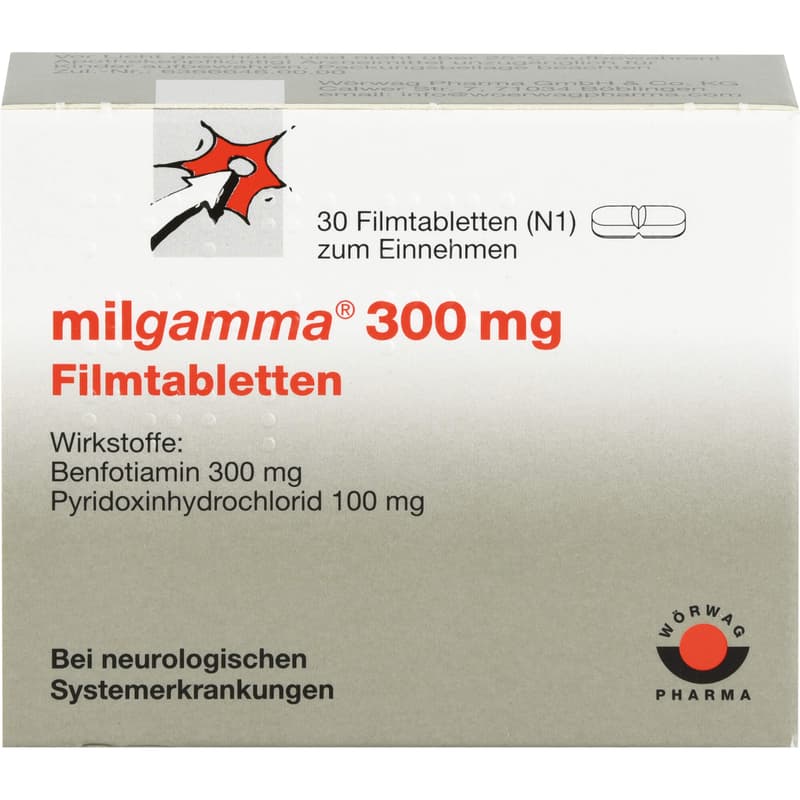
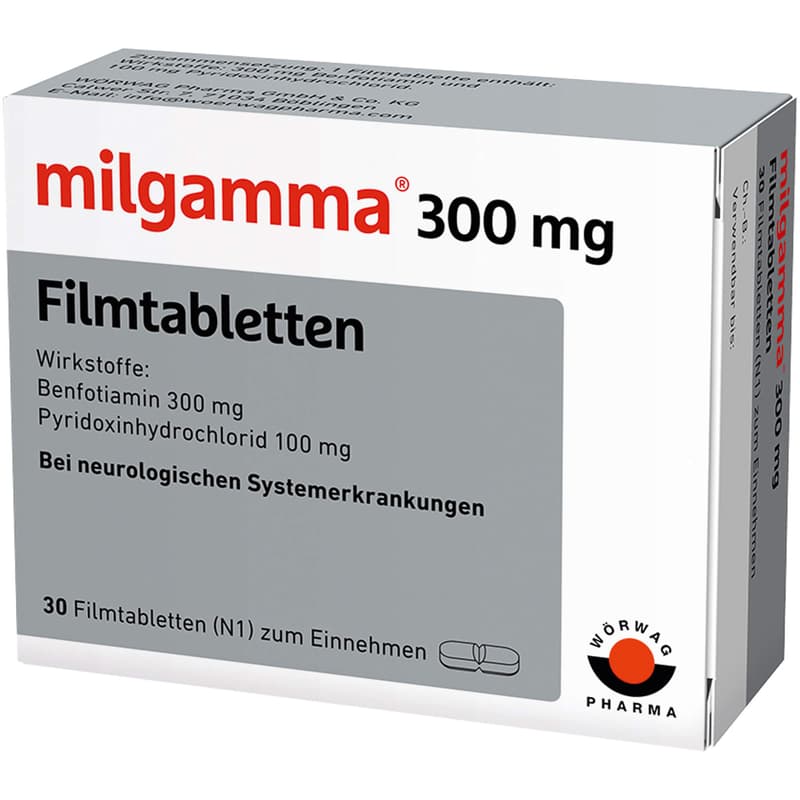
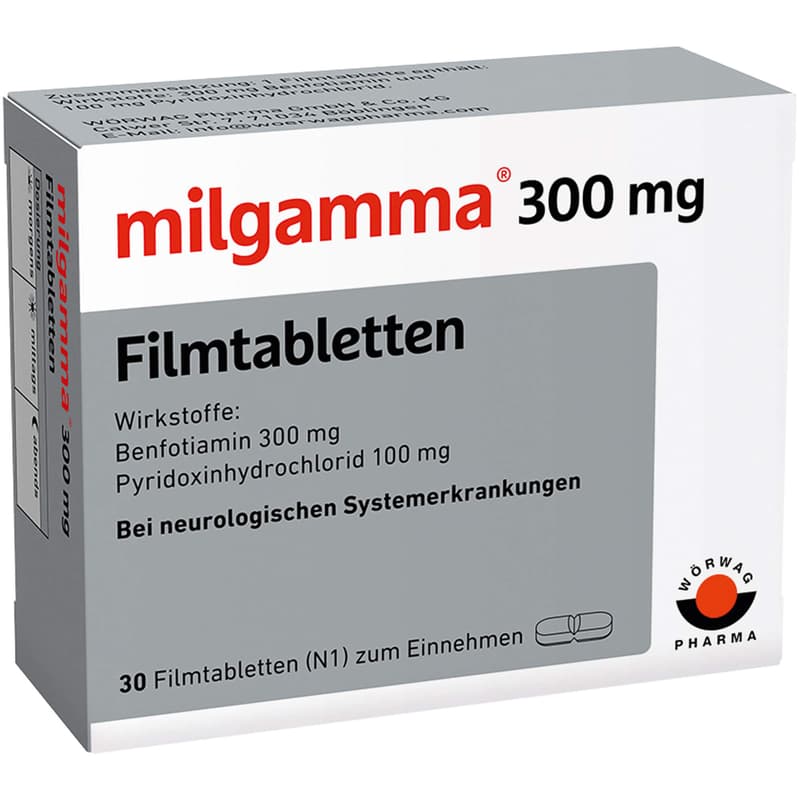
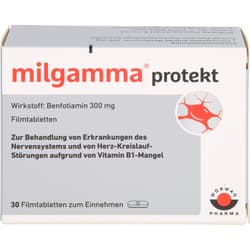
Die MILGAMMA 300 mg Filmtabletten sind ein hochwertiges Neuropathiepräparat zur gezielten Behandlung von neurologischen Systemerkrankungen, die durch einen nachgewiesenen Mangel der Vitamine B1 und B6 verursacht werden. Jede Filmtablette enthält die Wirkstoffe Benfotiamin und Pyridoxinhydrochlorid. Das gluten- und lactosefreie Präparat ist in einer praktischen Packung mit 30 Stück erhältlich und lässt sich dank der beidseitigen Bruchkerbe leicht teilen.
Zu Risiken und Nebenwirkungen lesen Sie die Packungsbeilage und fragen Sie Ihre Ärztin, Ihren Arzt oder in Ihrer Apotheke!







Beschreibung
Wichtige Hinweise (Pflichtangaben)
milgamma 300 mg Filmtabletten. Anwendungsgebiete: bei neurologischen Systemerkrankungen durch nachgewiesenen Mangel der Vitamine B1 und B6.Zu Risiken und Nebenwirkungen lesen Sie die Packungsbeilage und fragen Sie Ihre Ärztin, Ihren Arzt oder in Ihrer Apotheke!
GEBRAUCHSINFORMATION: INFORMATION FÜR DEN ANWENDER
milgamma 300 mg Filmtabletten
Wirkstoffe: Benfotiamin 300 mg, Pyridoxinhydrochlorid 100 mg
Lesen Sie die gesamte Packungsbeilage sorgfältig durch, denn sie enthält wichtige Informationen für Sie. Dieses Arzneimittel ist ohne Verschreibung erhältlich. Um einen bestmöglichen Behandlungserfolg zu erzielen, muss milgamma 300 mg Filmtabletten jedoch vorschriftsmäßig angewendet werden.
- Heben Sie die Packungsbeilage auf. Vielleicht möchten Sie diese später nochmals lesen.
- Fragen Sie Ihren Apotheker, wenn Sie weitere Informationen oder einen Rat benötigen.
- Wenn sich Ihre Symptome verschlimmern oder nach 14 Tagen keine Besserung eintritt, müssen Sie auf jeden Fall einen Arzt aufsuchen.
- Wenn eine der aufgeführten Nebenwirkungen Sie erheblich beeinträchtigt oder Sie Nebenwirkungen bemerken, die nicht in dieser Gebrauchsinformation angegeben sind, informieren Sie bitte Ihren Arzt oder Apotheker. Siehe Abschnitt 4.
Diese Packungsbeilage beinhaltet
- WAS IST MILGAMMA 300 MG FILMTABLETTEN UND WOFÜR WIRD ES ANGEWENDET?
- WAS MÜSSEN SIE VOR DER EINNAHME VON MILGAMMA 300 MG FILMTABLETTEN BEACHTEN?
- WIE IST MILGAMMA 300 MG FILMTABLETTEN EINZUNEHMEN?
- WELCHE NEBENWIRKUNGEN SIND MÖGLICH?
- WIE IST MILGAMMA 300 MG FILMTABLETTEN AUFZUBEWAHREN?
- WEITERE INFORMATIONEN
Stoff- oder Indikationsgruppe oder Wirkungsweise milgamma 300 mg Filmtabletten ist ein Neuropathiepräparat.
Anwendungsgebiet
milgamma 300 mg Filmtabletten wird angewendet bei neurologischen Systemerkrankungen durch nachgewiesenen Mangel der Vitamine B1 und B6.2. WAS MÜSSEN SIE VOR DER EINNAHME VON MILGAMMA 300 MG FILMTABLETTEN BEACHTEN?
Bei bekannter Benfotiamin- bzw. Thiaminüberempfindlichkeit und/oder Überempfindlichkeit gegen Pyridoxinhydrochlorid oder einen der sonstigen Bestandteile von milgamma 300 mg Filmtabletten sollte das Präparat nicht oder nur unter ärztlicher Aufsicht eingenommen werden.
Besondere Vorsicht bei der Einnahme von milgamma 300 mg Filmtabletten ist erforderlich
milgamma 300 mg Filmtabletten kann bei einer Einnahme über einen Zeitraum von 6 Monaten hinaus Neuropathien hervorrufen.Hinweis
Bei der Anwendung von milgamma 300 mg Filmtabletten bei Kindern und älteren Menschen liegen uns keine Erkenntnisse vor.Bei Einnahme von milgamma 300 mg Filmtabletten mit anderen Arzneimitteln
Bitte informieren Sie Ihren Arzt oder Apotheker, wenn Sie andere Arzneimittel einnehmen/anwenden bzw. vor kurzem eingenommen/angewendet haben, auch wenn es sich um nicht verschreibungspflichtige Arzneimittel handelt. Thiamin wird durch 5-Fluoruracil (Mittel zur Chemotherapie) inaktiviert. Die gleichzeitige Gabe von Pyridoxinantagonisten (z.B. Hydralazin, Isoniazid (INH), Cycloserin, D-Penicillamin), Alkohol sowie die langfristige Anwendung östrogenhaltiger oraler Kontrazeptiva kann den Bedarf an Vitamin B1 erhöhen. milgamma 300 mg Filmtabletten kann die Wirkung von L-Dopa herabsetzen.Schwangerschaft und
Stillzeit
Schwangerschaft
Wenn Sie schwanger sind, ist dieses Arzneimittel aufgrund seiner Wirkstoffmenge nur zur Behandlung eines nachgewiesenen Vitamin B1- und B6-Mangels sinnvoll. Daher dürfen Sie milgamma 300 mg Filmtabletten nur anwenden, wenn Ihr behandelnder Arzt dies für unbedingt erforderlich hält. In der Schwangerschaft beträgt die empfohlene tägliche Zufuhr für Vitamin B1 1,2 mg im 2. Trimester und 1,3 mg im 3. Trimester und für Vitamin B6 1,9 mg (ab dem 4. Monat). Die Sicherheit einer Anwendung höherer als der täglich empfohlenen Dosen ist bislang nicht belegt.Stillzeit
Wenn Sie stillen, ist dieses Arzneimittel aufgrund seiner Wirkstoffmenge nur zur Behandlung eines nachgewiesenen Vitamin B1- und B6-Mangels sinnvoll. Daher dürfen Sie milgamma 300 mg Filmtabletten nur anwenden, wenn Ihr behandelnder Arzt dies für unbedingt erforderlich hält. In der Stillzeit beträgt die empfohlene tägliche Zufuhr für Vitamin B1 1,3 mg und für Vitamin B6 1,9 mg. Die Sicherheit einer Anwendung höherer als der täglich empfohlenen Dosen ist bislang nicht belegt. Vitamin B1 und B6 gehen in die Muttermilch über. Hohe Dosen von Vitamin B6 können die Milchproduktion hemmen.Verkehrstüchtigkeit und das Bedienen von Maschinen
Es sind keine besonderen Vorsichtsmaßnahmen erforderlich.3. WIE IST MILGAMMA 300 MG FILMTABLETTEN EINZUNEHMEN?
Nehmen Sie milgamma 300 mg Filmtabletten immer genau nach der Anweisung in dieser Packungsbeilage ein. Bitte fragen Sie bei Ihrem Arzt oder Apotheker nach, wenn Sie sich nicht ganz sicher sind. Die folgenden Angaben gelten, soweit Ihnen Ihr Arzt milgamma 300 mg Filmtabletten nicht anders verordnet hat. Bitte halten Sie sich an die Einnahmevorschriften, da milgamma 300 mg Filmtabletten sonst nicht richtig wirken kann! Soweit nicht anders verordnet, nehmen Erwachsene 1 x täglich 1 Filmtablette milgamma 300 mg Filmtabletten ein. In akuten Fällen kann nach Rücksprache mit dem behandelnden Arzt die Dosis auf bis zu 3 x täglich 1 Filmtablette erhöht werden.
Art der Anwendung
Sie sollten die Filmtabletten mit ausreichend Flüssigkeit einnehmen. Der Einnahmezeitpunkt kann beliebig gewählt werden.Dauer der Anwendung
Nach Ablauf von spätestens 4 Wochen sollte der behandelnde Arzt entscheiden, ob die Gabe von Vitamin B6 und Vitamin B1 in der erhöhten Dosierung (3 x 1 Filmtablette täglich) weiter indiziert ist. Gegebenenfalls sollte auf 1 x tägliche Gabe umgestellt werden, um das mit Vitamin B6 assoziierte Neuropathierisiko zu senken.Bitte sprechen Sie mit Ihrem Arzt oder Apotheker, wenn Sie den Eindruck haben, dass die Wirkung von milgamma 300 mg Filmtabletten zu stark oder zu schwach ist.
Wenn Sie eine größere Menge milgamma 300 mg Filmtabletten eingenommen haben,
als Sie sollten
Hohe Dosen von Vitamin B1 können bei kurzfristiger Einnahme (Dosen über 1 g/Tag) zu neurotoxischen Wirkungen führen. Bei auftretenden Symptomen ist der behandelnde Arzt aufzusuchen.Wenn Sie die Einnahme von milgamma 300 mg Filmtabletten vergessen haben
Nehmen Sie nicht die doppelte Dosis, wenn Sie die vorherige Einnahme vergessen haben. Nehmen Sie milgamma 300 mg Filmtabletten wie vorher zu den gewohnten Zeiten weiter ein und denken Sie zukünftig an die regelmäßige Einnahme.Wenn Sie die Einnahme von milgamma 300 mg Filmtabletten abbrechen
Bei einer Unterbrechung der Behandlung gefährden Sie den Behandlungserfolg!Sollten bei Ihnen unangenehme Nebenwirkungen auftreten, sprechen Sie bitte mit Ihrem Arzt über die weitere Behandlung.
4. WELCHE NEBENWIRKUNGEN SIND MÖGLICH?
Wie alle Arzneimittel kann milgamma 300 mg Filmtabletten Nebenwirkungen haben, die aber nicht bei jedem auftreten müssen.
| Bei der Bewertung von Nebenwirkungen werden folgende Häufigkeitsangaben zu Grunde gelegt: | |
| Sehr häufig: | mehr als 1 Behandelter von 10 |
| Häufig: | 1 bis 10 Behandelte von 100 |
| Gelegentlich: | 1 bis 10 Behandelte von 1 000 |
| Selten: | 1 bis 10 Behandelte von 10 000 |
| Sehr selten: | weniger als 1 Behandelter von 10 000 |
| Nicht bekannt: | Häufigkeit auf Grundlage der verfügbaren Daten nicht abschätzbar. |
Informieren Sie bitte Ihren Arzt oder Apotheker, wenn eine der aufgeführten Nebenwirkungen Sie erheblich beeinträchtigt oder Sie Nebenwirkungen bemerken, die nicht in dieser Gebrauchsinformation angegeben sind.
Bedeutsame Nebenwirkungen oder Zeichen, auf die Sie achten sollten, und Maßnahmen,
wenn Sie betroffen sind
In Einzelfällen kann es zu Überempfindlichkeitsreaktionen mit Hautreaktionen (Urtikaria, Exanthem) und Schockzuständen kommen. Bei systemischen Überempfindlichkeitsreaktionen sind ggf. Notfallmaßnahmen einzuleiten. In klinischen Studien wurden Einzelfälle von gastrointestinalen Störungen wie z.B. Übelkeit oder andere Beschwerden dokumentiert. Ein kausaler Zusammenhang mit den Vitaminen Bi und/oder Bt sowie eine mögliche Dosisabhängigkeit sind noch nicht ausreichend geklärt. milgamma 300 mg Filmtabletten kann bei einer Einnahme über einen Zeitraum von mehr als 6 Monaten hinaus Neuropathien hervorrufen.Meldung von Nebenwirkungen
Wenn Sie Nebenwirkungen bemerken, wenden Sie sich an Ihren Arzt oder Apotheker. Dies gilt auch für Nebenwirkungen, die nicht in dieser Packungsbeilage angegeben sind. Sie können Nebenwirkungen auch direkt dem Bundesinstitut für Arzneimittel und Medizinprodukte, Abt. Pharmakovigilanz, Kurt-Georg-Kiesinger Allee 3, D-53175 Bonn, Website: www.bfarm.de anzeigen. Indem Sie Nebenwirkungen melden, können Sie dazu beitragen, dass mehr Informationen über die Sicherheit dieses Arzneimittels zur Verfügung gestellt werden.5. WIE IST MILGAMMA 300 MG FILMTABLETTEN AUFZUBEWAHREN?
Bewahren Sie dieses Arzneimittel bitte sorgfältig und für Kinder unzugänglich auf.
Das Verfalldatum ist auf dieser Packung aufgedruckt. Verwenden Sie das Arzneimittel nicht mehr nach diesem Datum!
Aufbewahrungsbedingungen
Vor Licht geschützt und nicht über 25 °C aufbewahren!6. WEITERE INFORMATIONEN
Was milgamma 300 mg Filmtabletten enthält
Die Wirkstoffe sind: Benfotiamin und Pyridoxinhydrochlorid. 1 Filmtablette mit beidseitiger Bruchkerbe enthält 300 mg Benfotiamin und 100 mg Pyridoxinhydrochlorid. Die sonstigen Bestandteile sind: Mikrokristalline Cellulose, Cellulosepulver, Maisstärke, Gelatine, Magnesiumstearat (Ph. Eur.), Hypromellose, Propylenglycol, Titandioxid (E171), Eisen(III)-hydroxid-oxid x H2O (E 172), Talkum, Macrogol 6000. Glutenfrei, enthält keine Lactose.Inhalt der Packung
milgamma 300 mg Filmtabletten ist in Packungen mit 30 (N1), 60 (N2) und 90 (N3) Filmtabletten erhältlich.Pharmazeutischer Unternehmer und Hersteller
Wörwag Pharma GmbH & Co KGCalwer Straße 7
71034 Böblingen
Telefon: 07031/6204-0
Telefax: 07031/6204-31
E-Mail: info@woerwagpharma.com
Hersteller
Artesan Pharma GmbH & Co. KGWendlandstraße 1
29439 Lüchow
Diese Gebrauchsinformation wurde zuletzt überarbeitet im März 2016.
Quelle: Angaben der Packungsbeilage
Stand: 07/2020
Anwendungsgebiete: bei neurologischen Systemerkrankungen durch nachgewiesenen Mangel der Vitamine B1 und B6.
Info-Broschüre
Info-Broschüre herunterladenZusammensetzung & Allergene
Zusammensetzung
Wirkstoff: Benfotiamin 300 mg, Pyridoxinhydrochlorid 100 mg