

Produkt aus:
Preussen
1219€
Nur noch wenige Stück verfügbar
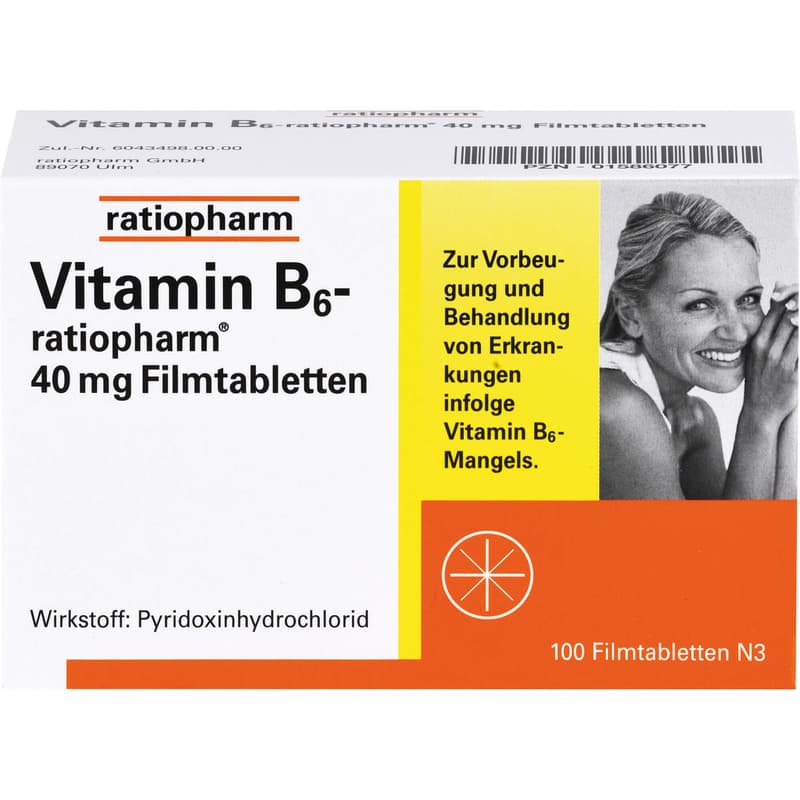
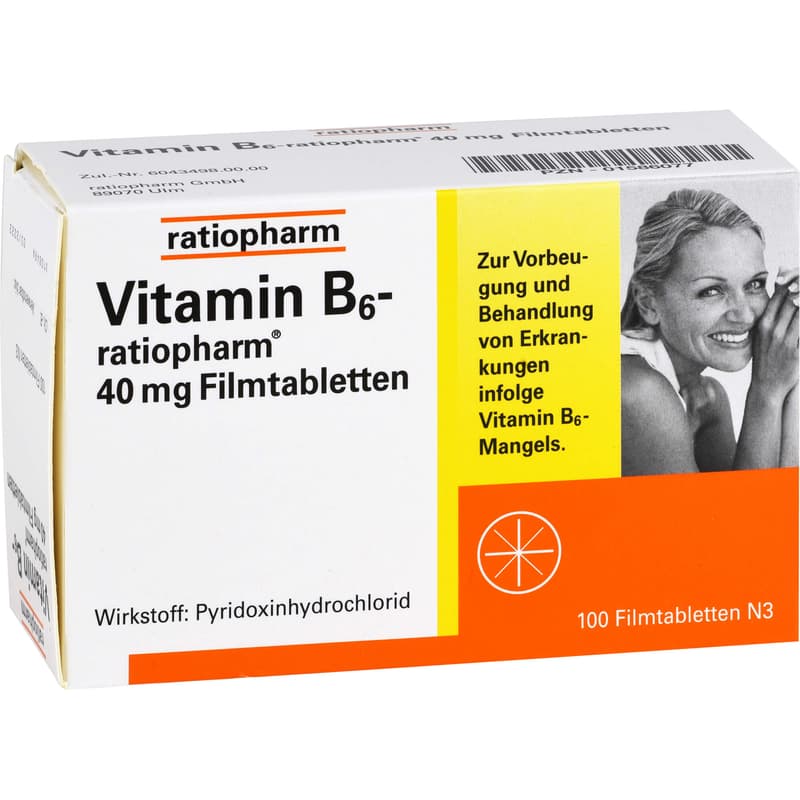
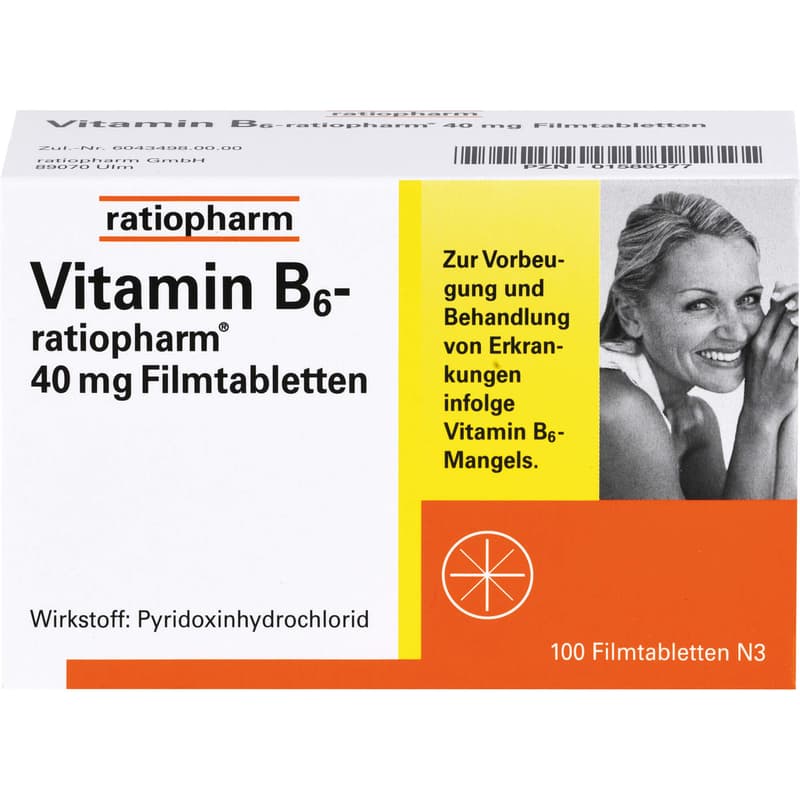
Die Vitamin B6-ratiopharm 40 mg Filmtabletten von ratiopharm unterstützen Sie gezielt bei einem Mangel an Vitamin B6. Jede der rosafarbenen, runden Filmtabletten enthält 40 mg des Wirkstoffs Pyridoxinhydrochlorid. Sie eignen sich hervorragend zur Vorbeugung und Behandlung von Nervenentzündungen sowie pyridoxinabhängigen Störungen bei Erwachsenen und Kindern. Die praktische Packung enthält 100 Filmtabletten zur einfachen Einnahme mit etwas Flüssigkeit.
Zu Risiken und Nebenwirkungen lesen Sie die Packungsbeilage und fragen Sie Ihre Ärztin, Ihren Arzt oder in Ihrer Apotheke.























Beschreibung
Wichtige Hinweise (Pflichtangaben)
Vitamin B6-ratiopharm 40 mg Filmtabletten. Wirkstoff: Pyridoxinhydrochlorid. Anwendungsgebiete: Vitamin B6-ratiopharm 40 mg wird angewendet zur: Erwachsene: Vorbeugung einer peripheren Neuropathie (Nervenentzündung) infolge eines durch Arzneimitteleinnahme verursachten Vitamin-B6-Mangels (Arzneimittel mit Wirkstoffen wie Isoniazid, D-Penicillamin, Cycloserin), Behandlung einer peripheren Neuropathie (Nervenentzündung) infolge eines durch Arzneimitteleinnahme verursachten Vitamin-B6-Mangels (Arzneimittel mit Wirkstoffen wie Isoniazid, D-Penicillamin, Cycloserin), Behandlung von pyridoxinabhängigen Störungen (seltene Erkrankungen, die teilweise durch erhöhte Vitamin-B6-Gaben behandelt werden können: Primäre Hyperoxalurie Typ I, Homocystinurie, Cystathioninurie, Xanthurensäureurie, sideroblastische Anämie (ab 200 mg), Vitamin-B6-Mangel bedingte hypochrome mikrozytäre Anämie). Kinder und Jugendliche: Behandlung einer peripheren Neuropathie (Nervenentzündung) infolge eines durch Arzneimitteleinnahme verursachten Vitamin-B6-Mangels (Arzneimittel mit Wirkstoffen wie Isoniazid, D-Penicillamin, Cycloserin), Erhaltungstherapie nach Vitamin-B6-Mangel bedingten Krämpfen bei Neugeborenen und Säuglingen, Behandlung von pyridoxinabhängigen Störungen bei Kindern über 1 Jahr (seltene Erkrankungen, die teilweise durch erhöhte Vitamin-B6-Gaben behandelt werden können: Primäre Hyperoxalurie Typ I, Homocystinurie, Cystathioninurie, Xanthurensäureurie, sideroblastische Anämie, Vitamin-B6-Mangel bedingte hypochrome mikrozytäre Anämie).Zu Risiken und Nebenwirkungen lesen Sie die Packungsbeilage und fragen Sie Ihre Ärztin, Ihren Arzt oder in Ihrer Apotheke.
GEBRAUCHSINFORMATION: INFORMATION FÜR DEN ANWENDER
Vitamin B6-ratiopharm 40 mg Filmtabletten
Wirkstoff: Pyridoxinhydrochlorid
Lesen Sie die gesamte Packungsbeilage sorgfältig durch, bevor Sie mit der Einnahme dieses Arzneimittels beginnen, denn sie enthält wichtige Informationen. Nehmen Sie dieses Arzneimittel immer genau wie in dieser Packungsbeilage beschrieben bzw. genau nach Anweisung Ihres Arztes oder Apothekers ein.
- Heben Sie die Packungsbeilage auf. Vielleicht möchten Sie diese später nochmals lesen.
- Fragen Sie Ihren Apotheker, wenn Sie weitere Informationen oder einen Rat benötigen.
- Wenn Sie Nebenwirkungen bemerken, wenden Sie sich an Ihren Arzt oder Apotheker. Dies gilt auch für Nebenwirkungen, die nicht in dieser Packungsbeilage angegeben sind. Siehe Abschnitt 4.
- Wenn Sie sich nicht besser oder gar schlechter fühlen, wenden Sie sich an Ihren Arzt.
- WAS IST VITAMIN B6-RATIOPHARM 40 MG UND WOFÜR WIRD ES ANGEWENDET?
- WAS SOLLTEN SIE VOR DER EINNAHME VON VITAMIN B6-RATIOPHARM 40 MG BEACHTEN?
- WIE IST VITAMIN B6-RATIOPHARM 40 MG EINZUNEHMEN?
- WELCHE NEBENWIRKUNGEN SIND MÖGLICH?
- WIE IST VITAMIN B6-RATIOPHARM 40 MG AUFZUBEWAHREN?
- INHALT DER PACKUNG UND WEITERE INFORMATIONEN
Vitamin B6-ratiopharm 40 mg ist ein Vitamin-Präparat. Vitamin B6-ratiopharm 40 mg wird angewendet zur: Erwachsene: Vorbeugung einer peripheren Neuropathie (Nervenentzündung) infolge eines durch Arzneimitteleinnahme verursachten Vitamin-B6-Mangels (Arzneimittel mit Wirkstoffen wie Isoniazid, D-Penicillamin, Cycloserin), Behandlung einer peripheren Neuropathie (Nervenentzündung) infolge eines durch Arzneimitteleinnahme verursachten Vitamin-B6-Mangels (Arzneimittel mit Wirkstoffen wie Isoniazid, D-Penicillamin, Cycloserin), Behandlung von pyridoxinabhängigen Störungen (seltene Erkrankungen, die teilweise durch erhöhte Vitamin-B6-Gaben behandelt werden können: Primäre Hyperoxalurie Typ I, Homocystinurie, Cystathioninurie, Xanthurensäureurie, sideroblastische Anämie (ab 200 mg), Vitamin-B6-Mangel bedingte hypochrome mikrozytäre Anämie). Kinder und Jugendliche: Behandlung einer peripheren Neuropathie (Nervenentzündung) infolge eines durch Arzneimitteleinnahme verursachten Vitamin-B6-Mangels (Arzneimittel mit Wirkstoffen wie Isoniazid, D-Penicillamin, Cycloserin), Erhaltungstherapie nach Vitamin-B6-Mangel bedingten Krämpfen bei Neugeborenen und Säuglingen, Behandlung von pyridoxinabhängigen Störungen bei Kindern über 1 Jahr (seltene Erkrankungen, die teilweise durch erhöhte Vitamin-B6-Gaben behandelt werden können: Primäre Hyperoxalurie Typ I, Homocystinurie, Cystathioninurie, Xanthurensäureurie, sideroblastische Anämie, Vitamin-B6-Mangel bedingte hypochrome mikrozytäre Anämie).
2. WAS SOLLTEN SIE VOR DER EINNAHME VON VITAMIN B6-RATIOPHARM 40 MG BEACHTEN?
Vitamin B6-ratiopharm 40 mg darf nicht eingenommen werden, wenn Sie allergisch gegen Pyridoxinhydrochlorid oder einen der in Abschnitt 6. genannten sonstigen Bestandteile dieses Arzneimittels sind.
Warnhinweise und Vorsichtsmaßnahmen
Bitte sprechen Sie mit Ihrem Arzt oder Apotheker, bevor Sie Vitamin B6-ratiopharm 40 mg einnehmen. Bei langfristiger Einnahme von Tagesdosen über 50 mg sowie bei kurzfristiger Einnahme von Dosen im Grammbereich wurden Kribbeln und Ameisenlaufen an Händen und Füßen (Anzeichen einer peripheren sensorischen Neuropathie, bzw. Parästhesien) beobachtet. Wenn Sie Kribbeln und Ameisenlaufen bei sich beobachten, wenden Sie sich bitte an Ihren behandelnden Arzt. Dieser wird die Einnahmemenge überprüfen und wenn nötig das Medikament absetzen.Einnahme von Vitamin B6-ratiopharm 40 mg zusammen mit anderen Arzneimitteln
Informieren Sie Ihren Arzt oder Apotheker, wenn Sie andere Arzneimittel einnehmen/anwenden, kürzlich andere Arzneimittel eingenommen/angewendet haben oder beabsichtigen andere Arzneimittel einzunehmen/anzuwenden. Die gleichzeitige Gabe von sog. Pyridoxinantagonisten (Arzneimittel mit Wirkstoffen, die u.a. eine gegen Vitamin B6 gerichtete Wirkung haben, wie z.B. Hydralazin, Isoniazid (INH), Cycloserin, D-Penicillamin oder orale Kontrazeptiva [die "Pille"]) kann den Bedarf an Vitamin B6 erhöhen.Arzneimittel,
deren Wirkung von Vitamin B6-ratiopharm 40 mg beeinflusst wird
Vitamin B6 kann die Wirkung von L-Dopa (Arzneimittel zur Behandlung der Parkinson-Krankheit) herab setzen.Schwangerschaft und Stillzeit
In der Schwangerschaft (ab dem 4. Monat) und Stillzeit beträgt die empfohlene tägliche Zufuhr an Vitamin B6 1,9 mg. Bisher sind keine Risiken bei der Anwendung von Vitamin B6 in den für Vitamin B6-ratiopharm 40 mg empfohlenen Dosierungen bekannt geworden. Systematische Untersuchungen zur Anwendung von Vitamin B6 in Dosierungen oberhalb des angegebenen Tagesbedarfs liegen nicht vor. Eine Anwendung dieses Präparates während der Schwangerschaft und Stillzeit sollte daher nur nach sorgfältiger Nutzen-Risiko-Abwägung durch den behandelnden Arzt entschieden werden. Hohe Dosen von Vitamin B6 können die Milchproduktion hemmen. Vitamin B6 geht in die Muttermilch über.Verkehrstüchtigkeit und Fähigkeit zum Bedienen von Maschinen
Es sind keine besonderen Vorsichtsmaßnahmen erforderlich.Vitamin B6-ratiopharm 40 mg enthält Lactose
Bitte nehmen Sie Vitamin B6-ratiopharm 40 mg daher erst nach Rücksprache mit Ihrem Arzt ein, wenn Ihnen bekannt ist, dass Sie unter einer Unverträglichkeit gegenüber bestimmten Zuckern leiden.3. WIE IST VITAMIN B6-RATIOPHARM 40 MG EINZUNEHMEN?
Nehmen Sie dieses Arzneimittel immer genau wie in dieser Packungsbeilage beschrieben bzw. genau nach der mit Ihrem Arzt oder Apotheker getroffenen Absprache ein. Fragen Sie bei Ihrem Arzt oder Apotheker nach, wenn Sie sich nicht sicher sind. Falls vom Arzt nicht anders verordnet,
ist die übliche Dosis
Erwachsene:- Vorbeugung einer peripheren Neuropathie infolge eines durch Arzneimitteleinnahme verursachten Vitamin—B6—Mangels: Die Dosierung ist individuell durch den behandelnden Arzt festzulegen. In der Regel werden 25 bis 50 mg Vitamin B6 pro Tag empfohlen (1 Filmtablette Vitamin B6—ratiopharm 40 mg enthält 40 mg Vitamin B6).
- Behandlung einer peripheren Neuropathie infolge eines durch Arzneimitteleinnahme verursachten Vitamin—B6—Mangels: Die Dosierung ist individuell durch den behandelnden Arzt festzulegen. In der Regel werden 50 bis 300 mg Vitamin B6 pro Tag empfohlen (1 Filmtablette Vitamin B6—ratiopharm 40 mg enthält 40 mg Vitamin B6).
- Behandlung von pyridoxinabhängigen Störungen (primäre Hyperoxalurie Typ I, Homocystinurie, Cystathioninurie, Xanthurensäureurie, Vitamin—B6—Mangel bedingte hypochrome mikrozytäre Anämie): Die Dosierung ist individuell durch den behandelnden Arzt festzulegen. In der Regel werden 10 bis 250 mg, in Einzelfällen auch bis 600 mg und mehr Vitamin B6 pro Tag empfohlen (1 Filmtablette Vitamin B6—ratiopharm 40 mg enthält 40 mg Vitamin B6).
- Behandlung von pyridoxinabhängigen Störungen (sideroblastische Anämie): Die Dosierung ist individuell durch den behandelnden Arzt festzulegen. In der Regel werden Dosierungen ab 200 mg Vitamin B6 pro Tag empfohlen (1 Filmtablette Vitamin B6—ratiopharm 40 mg enthält 40 mg Vitamin B6).
- Behandlung einer peripheren Neuropathie infolge eines durch Arzneimitteleinnahme verursachten Vitamin—B6—Mangels: Die Dosierung ist individuell durch den behandelnden Arzt festzulegen. In der Regel werden 50 bis 200 mg Vitamin B6 pro Tag empfohlen (1 Filmtablette Vitamin B6—ratiopharm 40 mg enthält 40 mg Vitamin B6).
- Erhaltungstherapie nach Vitamin—B6—Mangel bedingten Krämpfen bei Neugeborenen und Säuglingen: Die Dosierung ist individuell durch den behandelnden Arzt festzulegen. In der Regel werden Dosierungen von 2 bis 200 mg Vitamin B6 pro Tag empfohlen. Der Bedarf steigt abhängig vom Alter und eventuellen weiteren Erkrankungen (1 Filmtablette Vitamin B6—ratiopharm 40 mg enthält 40 mg Vitamin B6).
- Behandlung von pyridoxinabhängigen Störungen bei Kindern über 1 Jahr: Die Dosierung ist individuell durch den behandelnden Arzt festzulegen. In der Regel werden 10 bis 250 mg (im ersten Lebensjahr 2 bis 15 mg) Vitamin B6 pro Tag empfohlen (1 Filmtablette Vitamin B6—ratiopharm 40 mg enthält 40 mg Vitamin B6). Hinweis: Zur Behandlung einfacher Vitamin—B6—Mangelzustände sind 25 mg Pyridoxinhydrochlorid (Vitamin B6) ausreichend.
Art der Anwendung
Zum Einnehmen. Die Filmtabletten werden unzerkaut mit ausreichend Flüssigkeit eingenommen.Dauer der Anwendung
Die Dauer der Anwendung richtet sich nach Art und Schwere der Grunderkrankung. Befragen Sie hierzu bitte Ihren behandelnden Arzt. Bitte sprechen Sie mit Ihrem Arzt oder Apotheker, wenn Sie den Eindruck haben, dass die Wirkung von Vitamin B6-ratiopharm 40 mg zu stark oder zu schwach ist.Wenn Sie eine größere Menge von Vitamin B6-ratiopharm 40 mg eingenommen haben,
als Sie sollten
Die maximale Tagesdosis sollte nicht überschritten werden. Die langfristige Einnahme (Monate bis Jahre) von Vitamin B6 in Dosen über 50 mg pro Tag sowie die kurzfristige Einnahme (2 Monate) von Dosen über 1 g pro Tag können zu neurotoxischen Wirkungen (Nervenschädigungen) führen (siehe Abschnitt 2. "Warnhinweise und Vorsichtsmaßnahmen"). Hohe Dosen von Vitamin B6 über lange Zeit können zur Entwicklung einer schweren peripheren Neuropathie (Empfindungsstörungen insbesondere an Händen und Füßen), ggf. mit Ataxie (Bewegungsstörungen) führen. Extrem hohe Dosen können sich in Krämpfen äußern. Wenn akut Dosen über 150 mg/kg Körpergewicht eingenommen wurden, werden künstlich verursachtes Erbrechen und die Gabe von Aktivkohle empfohlen. Ein Erbrechen ist am effektivsten in den ersten 30 Minuten nach Einnahme. Gegebenenfalls sind intensivmedizinische Maßnahmen erforderlich.Wenn Sie die Einnahme von Vitamin B6-ratiopharm 40 mg vergessen haben
Nehmen Sie nicht die doppelte Menge ein, wenn Sie die vorherige Einnahme vergessen haben. Fahren Sie mit der Anwendung fort, so wie es in der Dosierungsanleitung beschrieben ist.Wenn Sie die Einnahme von Vitamin B6-ratiopharm 40 mg abbrechen
Wenden Sie sich bitte an Ihren behandelnden Arzt.Wenn Sie weitere Fragen zur Einnahme dieses Arzneimittels haben, wenden Sie sich an Ihren Arzt oder Apotheker.
4. WELCHE NEBENWIRKUNGEN SIND MÖGLICH?
Wie alle Arzneimittel kann auch dieses Arzneimittel Nebenwirkungen haben, die aber nicht bei jedem auftreten müssen.
Nicht bekannt (Häufigkeit auf Grundlage der verfügbaren Daten nicht abschätzbar)
Überempfindlichkeitsreaktionen. Bei höheren Einnahmemengen wurden Fälle von Vitamin-B6-Abhängigkeit beschrieben. Bei langfristiger Einnahme von Tagesdosen über 50 mg Vitamin B6 sowie bei kurzfristiger Einnahme von Dosen im Grammbereich wurden periphere sensorische Neuropathien (Erkrankungen der Nerven mit Kribbeln und Ameisenlaufen) beobachtet (siehe Abschnitt 2. "Warnhinweise und Vorsichtsmaßnahmen"). Bei höheren Einnahmemengen wurden Magen-Darm-Störungen beschrieben. Eine Überempfindlichkeit gegenüber Sonnenlicht wurde bei sehr hohen Tagesdosen beschrieben.Meldung von Nebenwirkungen
Wenn Sie Nebenwirkungen bemerken, wenden Sie sich an Ihren Arzt oder Apotheker. Dies gilt auch für Nebenwirkungen, die nicht in dieser Packungsbeilage angegeben sind. Sie können Nebenwirkungen auch direkt dem Bundesinstitut für Arzneimittel und Medizinprodukte, Abt. Pharmakovigilanz, Kurt-Georg-Kiesinger Allee 3, D-53175 Bonn, Website: www.bfarm.de anzeigen. Indem Sie Nebenwirkungen melden, können Sie dazu beitragen, dass mehr Informationen über die Sicherheit dieses Arzneimittels zur Verfügung gestellt werden.5. WIE IST VITAMIN B6-RATIOPHARM 40 MG AUFZUBEWAHREN?
Bewahren Sie dieses Arzneimittel für Kinder unzugänglich auf. Sie dürfen dieses Arzneimittel nach dem auf dem Umkarton und den Blisterpackungen nach "Verwendbar bis" angegebenen Verfalldatum nicht mehr verwenden. Das Verfalldatum bezieht sich auf den letzten Tag des angegebenen Monats. In der Originalverpackung aufbewahren, um den Inhalt vor Licht zu schützen.
6. INHALT DER PACKUNG UND WEITERE INFORMATIONEN
Was Vitamin B6-ratiopharm 40 mg enthält
Der Wirkstoff ist Pyridoxinhydrochlorid. Jede Filmtablette enthält 40 mg Pyridoxinhydrochlorid. Die sonstigen Bestandteile sind: Cellulosepulver, Lactose-Monohydrat, Maisstärke, Macrogol 8000, Copovidon, Talkum, Hochdisperses Siliciumdioxid, Magnesiumstearat, Hypromellose, Glycerol 85%, Titandioxid, Eisen(III)-oxid.Wie Vitamin B6-ratiopharm 40 mg aussieht und Inhalt der Packung
Rosafarbene, runde Filmtablette mit Kreuzbruchkerbe auf einer Seite. Vitamin B6-ratiopharm 40 mg ist in Packungen mit 100 Filmtabletten erhältlich.Pharmazeutischer Unternehmer
ratiopharm GmbHGraf-Arco-Str. 3
89079 Ulm
Hersteller
Merckle GmbHLudwig-Merckle-Str. 3
89143 Blaubeuren
Diese Gebrauchsinformation wurde zuletzt überarbeitet im Juli 2013.
Quelle: Angaben der Packungsbeilage
Stand: 05/2018
Wirkstoff: Pyridoxinhydrochlorid. Anwendungsgebiete: Vitamin B6-ratiopharm 40 mg wird angewendet zur: Erwachsene: Vorbeugung einer peripheren Neuropathie (Nervenentzündung) infolge eines durch Arzneimitteleinnahme verursachten Vitamin-B6-Mangels (Arzneimittel mit Wirkstoffen wie Isoniazid, D-Penicillamin, Cycloserin), Behandlung einer peripheren Neuropathie (Nervenentzündung) infolge eines durch Arzneimitteleinnahme verursachten Vitamin-B6-Mangels (Arzneimittel mit Wirkstoffen wie Isoniazid, D-Penicillamin, Cycloserin), Behandlung von pyridoxinabhängigen Störungen (seltene Erkrankungen, die teilweise durch erhöhte Vitamin-B6-Gaben behandelt werden können: Primäre Hyperoxalurie Typ I, Homocystinurie, Cystathioninurie, Xanthurensäureurie, sideroblastische Anämie (ab 200 mg), Vitamin-B6-Mangel bedingte hypochrome mikrozytäre Anämie). Kinder und Jugendliche: Behandlung einer peripheren Neuropathie (Nervenentzündung) infolge eines durch Arzneimitteleinnahme verursachten Vitamin-B6-Mangels (Arzneimittel mit Wirkstoffen wie Isoniazid, D-Penicillamin, Cycloserin), Erhaltungstherapie nach Vitamin-B6-Mangel bedingten Krämpfen bei Neugeborenen und Säuglingen, Behandlung von pyridoxinabhängigen Störungen bei Kindern über 1 Jahr (seltene Erkrankungen, die teilweise durch erhöhte Vitamin-B6-Gaben behandelt werden können: Primäre Hyperoxalurie Typ I, Homocystinurie, Cystathioninurie, Xanthurensäureurie, sideroblastische Anämie, Vitamin-B6-Mangel bedingte hypochrome mikrozytäre Anämie).
Info-Broschüre
Info-Broschüre herunterladenZusammensetzung & Allergene
Zusammensetzung
Wirkstoff: Pyridoxinhydrochlorid