
Produkt aus:
Preussen
996€
Nur noch wenige Stück verfügbar
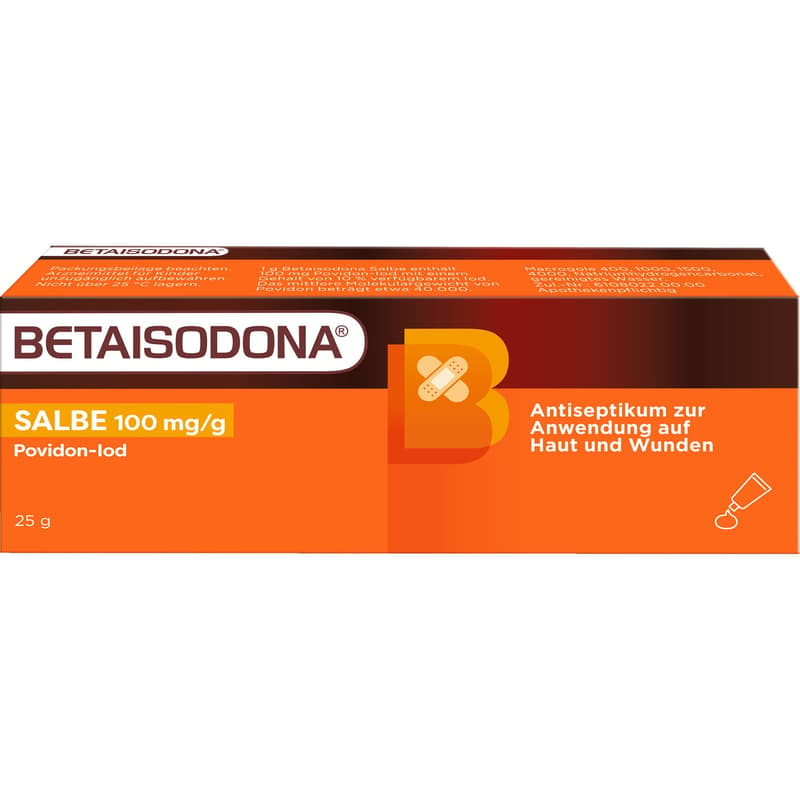
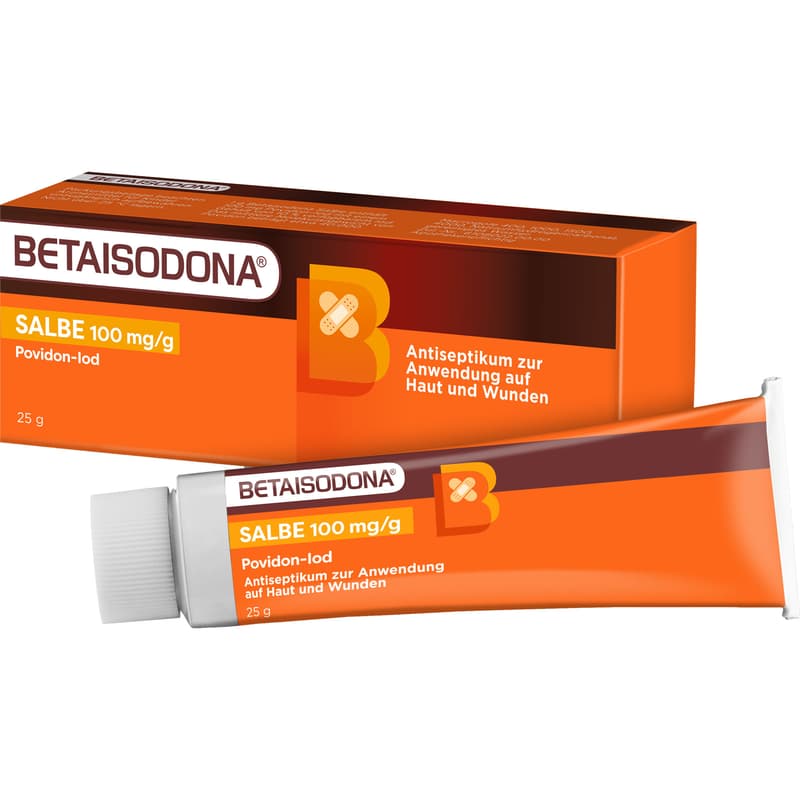
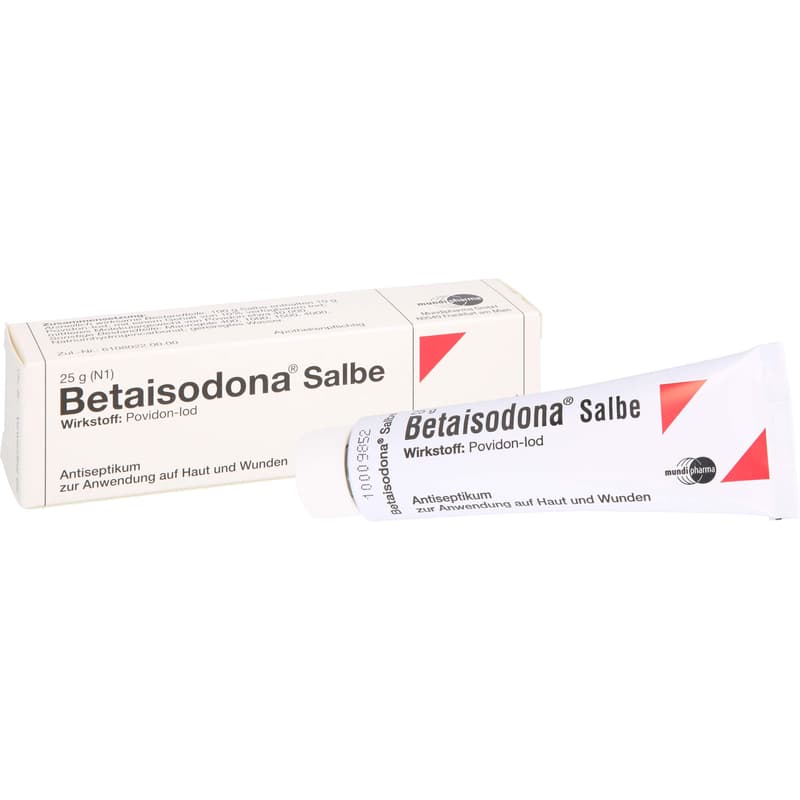
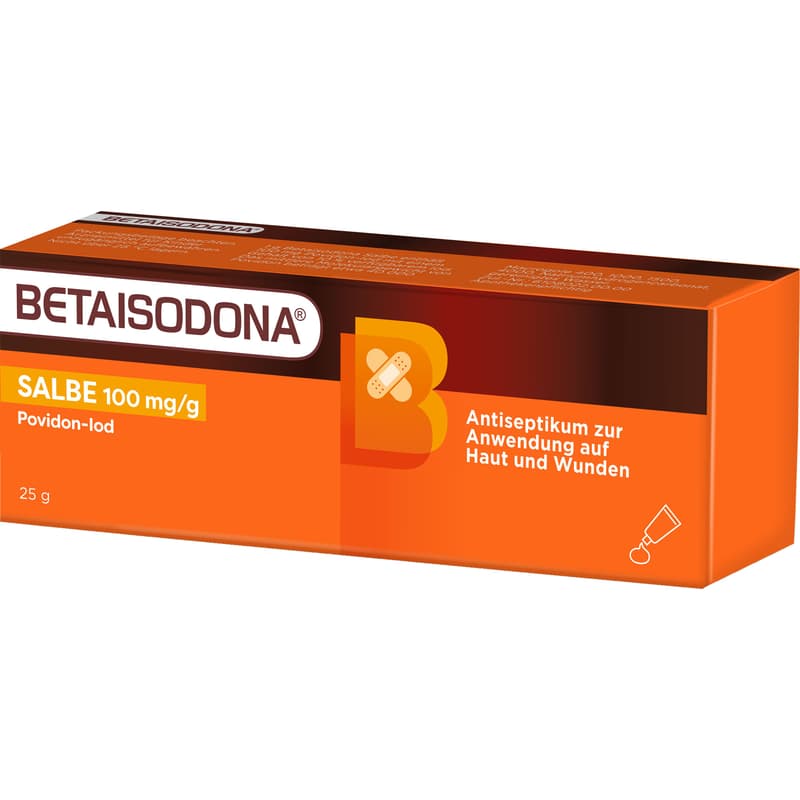
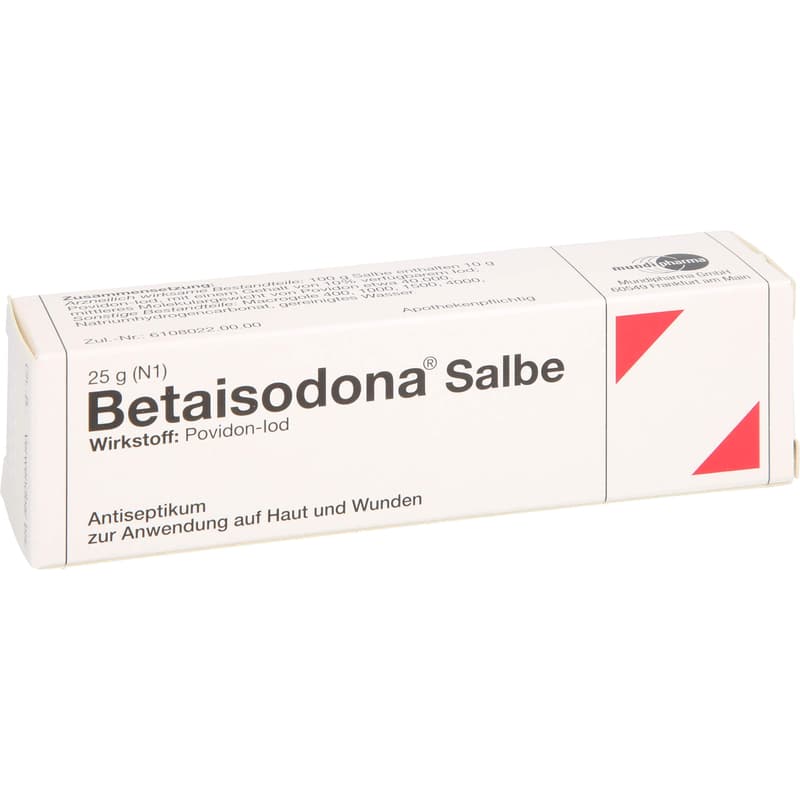
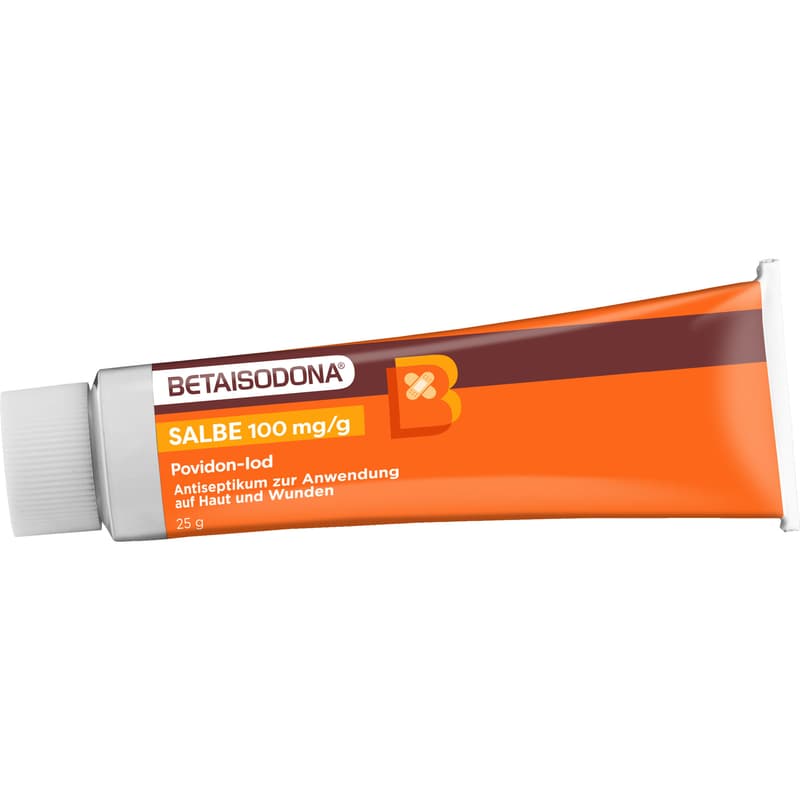
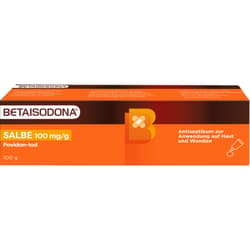
Die BETAISODONA Salbe ist ein zuverlässiges Antiseptikum zur gezielten Wundbehandlung. Mit dem bewährten Wirkstoff Povidon-Iod eignet sich die rotbraune Salbe ideal für die antiseptische Versorgung von geschädigter Haut, oberflächlichen Wunden, Verbrennungen sowie infizierten Hauterkrankungen. Die praktische 25g-Tube ist nach dem ersten Öffnen bis zu 3 Jahre haltbar und gehört in jede gut sortierte Hausapotheke.
Zu Risiken und Nebenwirkungen lesen Sie die Packungsbeilage und fragen Sie Ihre Ärztin, Ihren Arzt oder in Ihrer Apotheke.
Ähnliche Produkte
Weitere Produkte dieser Marke
Beschreibung
Wichtige Hinweise (Pflichtangaben)
Betaisodona Salbe. Wirkstoff: 100 mg/g Povidon-Iod. Anwendungsgebiete: wird wiederholt, zeitlich begrenzt angewendet zur antiseptischen Wundbehandlung bei geschädigter Haut, (z.B. Druckgeschwüre, Unterschenkelgeschwüre), oberflächlichen Wunden, Verbrennungen, infizierten und superinfizierten Hauterkrankungen.Zu Risiken und Nebenwirkungen lesen Sie die Packungsbeilage und fragen Sie Ihre Ärztin, Ihren Arzt oder in Ihrer Apotheke.
GEBRAUCHSINFORMATION: INFORMATION FÜR ANWENDER
Betaisodona Salbe
Wirkstoff: 100 mg/g Povidon-Iod
Lesen Sie die gesamte Packungsbeilage sorgfältig durch, bevor Sie mit der Anwendung dieses Arzneimittels beginnen, denn sie enthält wichtige Informationen für Sie. Wenden Sie dieses Arzneimittel immer genau wie in dieser Packungsbeilage beschrieben bzw. genau nach Anweisung Ihres Arztes oder Apothekers an.
- Heben Sie die Packungsbeilage auf. Vielleicht möchten Sie diese später nochmals lesen.
- Fragen Sie Ihren Apotheker, wenn Sie weitere Informationen oder einen Rat benötigen.
- Wenn Sie Nebenwirkungen bemerken, wenden Sie sich an Ihren Arzt oder Apotheker. Dies gilt auch für Nebenwirkungen, die nicht in dieser Packungsbeilage angegeben sind. Siehe Abschnitt 4.
- Wenn Sie sich nach 2 - 5 Tagen nicht besser oder gar schlechter fühlen, wenden Sie sich an Ihren Arzt.
Was in dieser Packungsbeilage steht
- WAS IST BETAISODONA SALBE UND WOFÜR WIRD ES ANGEWENDET?
- WAS MÜSSEN SIE VOR DER ANWENDUNG VON BETAISODONA SALBE BEACHTEN?
- WIE IST BETAISODONA SALBE ANZUWENDEN?
- WELCHE NEBENWIRKUNGEN SIND MÖGLICH?
- WIE IST BETAISODONA SALBE AUFZUBEWAHREN?
- INHALT DER PACKUNG UND WEITERE INFORMATIONEN
Betaisodona Salbe ist ein keimtötendes Mittel (Antiseptikum) zur Anwendung auf Haut und Wunden. Betaisodona Salbe wird wiederholt, zeitlich begrenzt angewendet zur antiseptischen Wundbehandlung bei geschädigter Haut, (z.B. Druckgeschwüre, Unterschenkelgeschwüre), oberflächlichen Wunden, Verbrennungen, infizierten und superinfizierten Hauterkrankungen.
2. WAS SOLLTEN SIE VOR DER ANWENDUNG VON BETAISODONA SALBE BEACHTEN?
Betaisodona Salbe darf nicht angewendet werden:
- wenn Sie allergisch gegen Povidon-Iod oder einen der in Abschnitt 6. genannten sonstigen Bestandteile dieses Arzneimittels sind.
- wenn bei Ihnen eine Schilddrüsenüberfunktion (Hyperthyreose) oder eine andere bestehende (manifeste) Schilddrüsenerkrankung vorliegt.
- wenn bei Ihnen die sehr seltene chronische Hautentzündung Dermatitis herpetiformis Duhring besteht.
- vor, während und nach einer Anwendung von Radio-Iod im Rahmen einer Strahlentherapie oder einer diagnostischen Untersuchung (siehe Abschnitt "Anwendung von Betaisodona Salbe mit anderen Arzneimitteln").
- wenn Sie gleichzeitig quecksilberhaltige Präparate anwenden (siehe Abschnitt "Anwendung von Betaisodona Salbe mit anderen Arzneimitteln").
- bei Neugeborenen, Säuglingen und Kleinkindern unter einem Jahr.
Warnhinweise und Vorsichtsmaßnahmen
Bitte sprechen Sie mit Ihrem Arzt oder Apotheker, bevor Sie Betaisodona Salbe anwenden. Falls Sie an Schilddrüsenerkrankungen leiden oder bei Ihnen ein Kropf besteht, sollten Sie Betaisodona Salbe nur auf ausdrückliche Anweisung des Arztes über längere Zeit und großflächig anwenden (z.B. über 10% der Körperoberfläche und länger als 14 Tage). Auch nach Beendigung der Therapie (bis zu 3 Monate) ist auf Frühsymptome einer möglichen Schilddrüsenüberfunktion (siehe Abschnitt 4) zu achten. Ihr Arzt wird gegebenenfalls die Schilddrüsenfunktion überwachen.Ältere Menschen
Da ältere Menschen häufiger an Funktionsstörungen der Schilddrüse leiden, sollte bei älteren Menschen (ab 65 Jahren) eine großflächige und längerfristige Anwendung von Betaisodona Salbe nur nach ausdrücklicher Anweisung des Arztes erfolgen. Gegebenenfalls wird Ihr Arzt die Schilddrüsenfunktion überwachen.Patienten mit eingeschränkter Nierenfunktion
Eine längerfristige Anwendung bei Patienten mit eingeschränkter Nierenfunktion sollte vermieden werden. Eine Überwachung der Schilddrüsenfunktion sollte in Erwägung gezogen werden.Kinder
Nach Anwendung von Betaisodona Salbe wird der Arzt eine Kontrolle der Schilddrüsenfunktion durchführen.Anwendung von BetaisodonaSalbe mit anderen Arzneimitteln
Informieren Sie Ihren Arzt oder Apotheker, wenn Sie andere Arzneimittel einnehmen/anwenden, kürzlich eingenommen/angewendet haben oder beabsichtigen andere Arzneimittel einzunehmen/anzuwenden. Povidon-Iod kann mit Eiweiß und verschiedenen anderen organischen Substanzen wie z.B. Blut-und Eiterbestandteilen reagieren, wodurch seine Wirksamkeit beeinträchtigt werden kann. Die Wirkung beider Arzneimittel wird abgeschwächt bei gleichzeitiger Anwendung von:- enzymatischen Wundbehandlungsmitteln,
- Wasserstoffperoxid,
- Taurolidin,
- silberhaltigen Desinfektionsmitteln oder silberhaltigen Wundauflagen.
Beeinflussung diagnostischer Untersuchungen oder einer Radio-Iod-Therapie
Betaisodona Salbe kann bei verschiedenen Diagnostika falsch-positive Ergebnisse liefern (u.a. Toluidin und Guajakharz zur Hämoglobin-oder Glucosebestimmung im Stuhl oder Urin). Betaisodona Salbe kann zu Störungen von diagnostischen Untersuchungen der Schilddrüse (Schilddrüsenszintigraphie, PBI-Bestimmung, Radio-Iod-Diagnostik) führen und eine geplante Radio-Iod-Therapie unmöglich machen. Bis zur Aufnahme eines neuen Szintigramms sollten Sie einen Abstand von 4 Wochen nach Absetzen der Behandlung mit Betaisodona Salbe einhalten.Schwangerschaft und Stillzeit
Wenn Sie schwanger sind oder stillen, oder wenn Sie vermuten, schwanger zu sein oder beabsichtigen, schwanger zu werden, fragen Sie vor der Anwendung dieses Arzneimittels Ihren Arzt oder Apotheker um Rat. Während der Schwangerschaft und Stillzeit ist Betaisodona Salbe nur auf ausdrückliche Anweisung des Arztes und äußerst beschränkt anzuwenden. In diesem Fall ist eine Kontrolle der Schilddrüsenfunktion beim Kind erforderlich. Eine Aufnahme von Betaisodona Salbe durch den Säugling über den Mund durch Kontakt mit der behandelten Körperstelle der stillenden Mutter muss vermieden werden.Verkehrstüchtigkeit und das Bedienen von Maschinen
Betaisodona Salbe hat keinen Einfluss auf die Verkehrstüchtigkeit und das Bedienen von Maschinen.3. WIE IST BETAISODONA SALBE ANZUWENDEN?
Wenden Sie dieses Arzneimittel immer genau wie in dieser Packungsbeilage beschrieben bzw. genau nach der mit Ihrem Arzt oder Apotheker getroffenen Absprache an. Fragen Sie bei Ihrem Arzt oder Apotheker nach, wenn Sie sich nicht ganz sicher sind. Betaisodona Salbe ist ausschließlich zur äußerlichen Anwendung bestimmt.
Die empfohlene Dosis beträgt (falls vom Arzt nicht anders verordnet)
Tragen Sie Betaisodona Salbe ein- bis mehrmals täglich auf die geschädigte Stelle gleichmäßig auf. Falls erforderlich, kann anschließend ein Verband angelegt werden.Die Braunfärbung von Betaisodona Salbe ist eine Eigenschaft des Präparates und zeigt seine Wirksamkeit an. Eine zunehmende Entfärbung weist auf ein Nachlassen der Wirksamkeit des Präparates hin. Bei vollständiger Entfärbung ist keine Wirksamkeit mehr gegeben. Wenn Sie eine weitgehende Entfärbung der Salbe bemerken, sollten Sie Betaisodona Salbe erneut auftragen. Die Anwendung von Betaisodona Salbe sollte so lange fortgeführt werden, wie noch Anzeichen einer Entzündung bestehen. Sollten sich Ihre Beschwerden nach regelmäßiger Anwendung über 2 bis 5 Tage nicht gebessert haben oder sollten nach Abschluss der Behandlung erneut Beschwerden auftreten, suchen Sie bitte Ihren Arzt auf.
Hinweis
Betaisodona Salbe ist fettfrei und auswaschbar. Im Allgemeinen lässt sie sich aus Textilien und anderen Materialien mit warmem Wasser und Seife entfernen. In hartnäckigen Fällen helfen Ammoniak (Salmiakgeist) oder Fixiersalz (Natriumthiosulfat). Beides ist in Apotheken oder Drogerien erhältlich.Wenn Sie eine größere Menge von Betaisodona Salbe angewendet haben,
als Sie sollten
Wenden Sie sich bitte an Ihren Arzt, insbesondere wenn Sie eine der in Abschnitt 4 angegebenen Symptome bemerken. Betaisodona Salbe ist nur zur äußerlichen Anwendung bestimmt. Wenn Sie versehentlich eine größere Menge Betaisodona Salbe verschluckt haben, setzen Sie sich bitte umgehend mit Ihrem Arzt in Verbindung. Es können in diesem Fall die folgenden Symptome einer akuten Iod-Vergiftung auftreten: Bauchschmerzen und -krämpfe, Übelkeit, Erbrechen, Durchfall, Austrocknung, Blutdruckabfall, Kreislaufkollaps, Herzrasen, Blutungsneigung, Sauerstoffmangel (blaurote Verfärbung der Haut und der Schleimhäute), Nierenfunktionsstörungen, Harnverhalten, Empfindlichkeitsstörungen der Nerven, Krampfanfälle, Fieber, Kehlkopfschwellung und Lungenödem.Wenn Sie weitere Fragen zur Anwendung dieses Arzneimittels haben, wenden Sie sich an Ihren Arzt oder Apotheker.
4. WELCHE NEBENWIRKUNGEN SIND MÖGLICH?
Wie alle Arzneimittel kann auch dieses Arzneimittel Nebenwirkungen haben, die aber nicht bei jedem auftreten müssen.
Schwerwiegende Nebenwirkungen
Informieren Sie sofort Ihren Arzt oder das medizinische Fachpersonal,wenn bei Ihnen eines der folgenden Symptome auftritt
Schwere allergische Reaktion: Symptome sind Schwierigkeiten beim Atmen und/oder Schwellung des Gesichts.Andere mögliche Nebenwirkungen
Selten (kann bis zu 1 von 1.000 Behandelten betreffen)
Überempfindlichkeitsreaktionen; Entzündung der Haut nach Kontakt (Kontaktdermatitis, mit Symptomen wie Rötungen, kleinen Bläschen und Juckreiz).Sehr selten (kann bis zu 1 von 10.
000 Behandelten betreffen)
Akute allergische Allgemeinreaktionen, ggf. mit Blutdruckabfall und/oder Luftnot (anaphylaktische Reaktionen); Schilddrüsenüberfunktion (Iod-induzierte Hyperthyreose), ggf. mit Symptomen wie z.B. Pulsbeschleunigung oder innere Unruhe bei Patienten mit Schilddrüsenerkrankungen*; akute Haut- oder Schleimhautschwellungen (Angioödem).Nicht bekannt (Häufigkeit auf Grundlage der verfügbaren Daten nicht abschätzbar)
Schilddrüsenunterfunktion*; ElektrolytUngleichgewicht (auch mit Störungen der Serumosmolarität)*, stoffwechselbedingte Übersäuerung des Blutes (metabolische Azidose)*; Beeinträchtigung der Nierenfunktion (akute Nieren-Insuffizienz)*, ungewöhnliche BlutOsmolarität*.* Nach nennenswerter Iod-Aufnahme bei längerfristiger Anwendung von Betaisodona Salbe auf ausgedehnten Haut-, Wund- oder Verbrennungsflächen.
Meldung von Nebenwirkungen
Wenn Sie Nebenwirkungen bemerken, wenden Sie sich an Ihren Arzt oder Apotheker. Dies gilt auch für Nebenwirkungen, die nicht in dieser Packungsbeilage angegeben sind. Sie können Nebenwirkungen auch direkt dem Bundesinstitut für Arzneimittel und Medizinprodukte, Abt. Pharmakovigilanz, Kurt-Georg-Kiesinger-Allee 3, D-53175 Bonn, Website: www.bfarm.de, anzeigen. Indem Sie Nebenwirkungen melden, können Sie dazu beitragen, dass mehr Informationen über die Sicherheit dieses Arzneimittels zur Verfügung gestellt werden.5. WIE IST BETAISODONA SALBE AUFZUBEWAHREN?
Bewahren Sie dieses Arzneimittel für Kinder unzugänglich auf. Sie dürfen dieses Arzneimittel nach dem auf der Tube und der Faltschachtel bzw. dem Tiegel nach "Verwendbar bis:" angegebenen Verfalldatum nicht mehr verwenden. Das Verfalldatum bezieht sich auf den letzten Tag des angegebenen Monats. Nicht über 25°C lagern. Nach dem ersten Öffnen können Sie Betaisodona Salbe bis zu 3 Jahre verwenden. Sie dürfen dieses Arzneimittel nicht verwenden, wenn Sie Folgendes bemerken: Wenn Sie eine weitgehende Entfärbung des Präparates bemerken, ist das Arzneimittel zu entsorgen. Entsorgen Sie Arzneimittel niemals über das Abwasser (z.B. nicht über die Toilette oder das Waschbecken). Fragen Sie in Ihrer Apotheke, wie das Arzneimittel zu entsorgen ist, wenn Sie es nicht mehr verwenden. Sie tragen damit zum Schutz der Umwelt bei. Weitere Informationen finden Sie unter www.bfarm.de/arzneimittelentsorgung.
6. INHALT DER PACKUNG UND WEITERE INFORMATIONEN
Was Betaisodona Salbe enthält
Der Wirkstoff ist Povidon-Iod. 1 g Betaisodona Salbe enthält 100 mg Povidon-Iod mit einem Gehalt von 10% verfügbarem Iod. Das mittlere Molekulargewicht von Povidon beträgt etwa 40.000. Die sonstigen Bestandteile sind: Macrogole 400, 1000, 1500, 4000, Natriumhydrogencarbonat, gereinigtes Wasser.
Wie Betaisodona Salbe aussieht und Inhalt der Packung
Betaisodona ist eine rotbraune Salbe.Packungsgrößen
Tuben mit 25 g, 100 g oder als Bündelpackung 3 x 100 g oder ein Tiegel mit 300 g. Es werden möglicherweise nicht alle Packungsgrößen in den Verkehr gebracht.Pharmazeutischer Unternehmer und Hersteller
Pharmazeutischer Unternehmer
Mundipharma GmbHDe-Saint-Exupery-Straße 10
60549 Frankfurt am Main
Telefon: (0 69) 506029-000
Telefax: (0 69) 506029-201
Hersteller
Fidelio Healthcare Limburg GmbHMundipharmastraße 2
65549 Limburg
Diese Gebrauchsinformation wurde zuletzt überarbeitet im August 2021.
Quelle: Angaben der Packungsbeilage
Stand: 09/2024
Wirkstoff: 100 mg/g Povidon-Iod. Anwendungsgebiete: wird wiederholt, zeitlich begrenzt angewendet zur antiseptischen Wundbehandlung bei geschädigter Haut, (z.B. Druckgeschwüre, Unterschenkelgeschwüre), oberflächlichen Wunden, Verbrennungen, infizierten und superinfizierten Hauterkrankungen.
Info-Broschüre
Info-Broschüre herunterladenZusammensetzung & Allergene
Zusammensetzung
Wirkstoff: 100 mg/g Povidon-Iod