
Produkt aus:
Preussen
1495€
Nur noch wenige Stück verfügbar
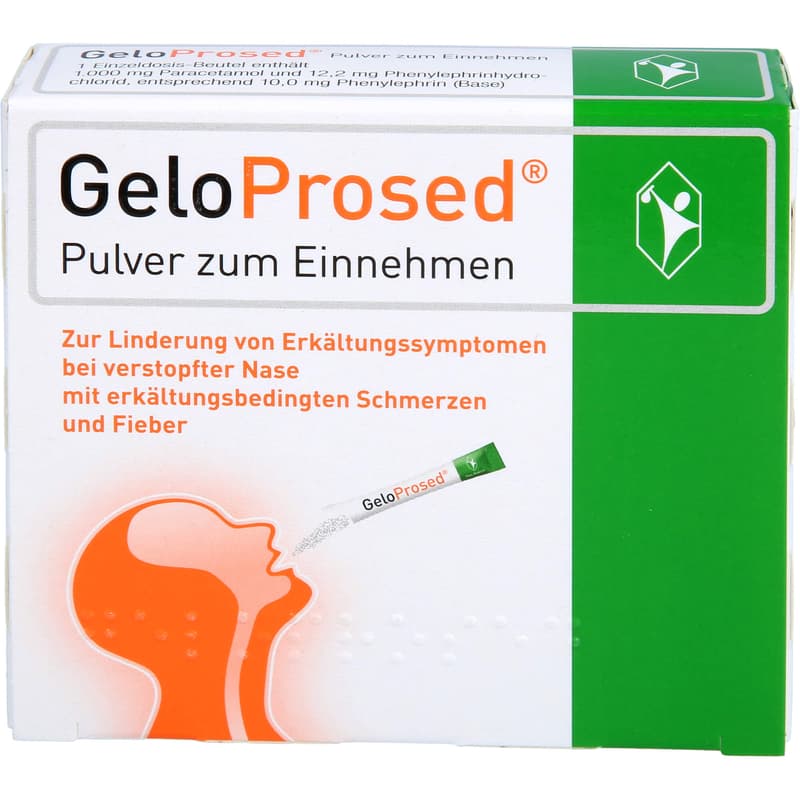
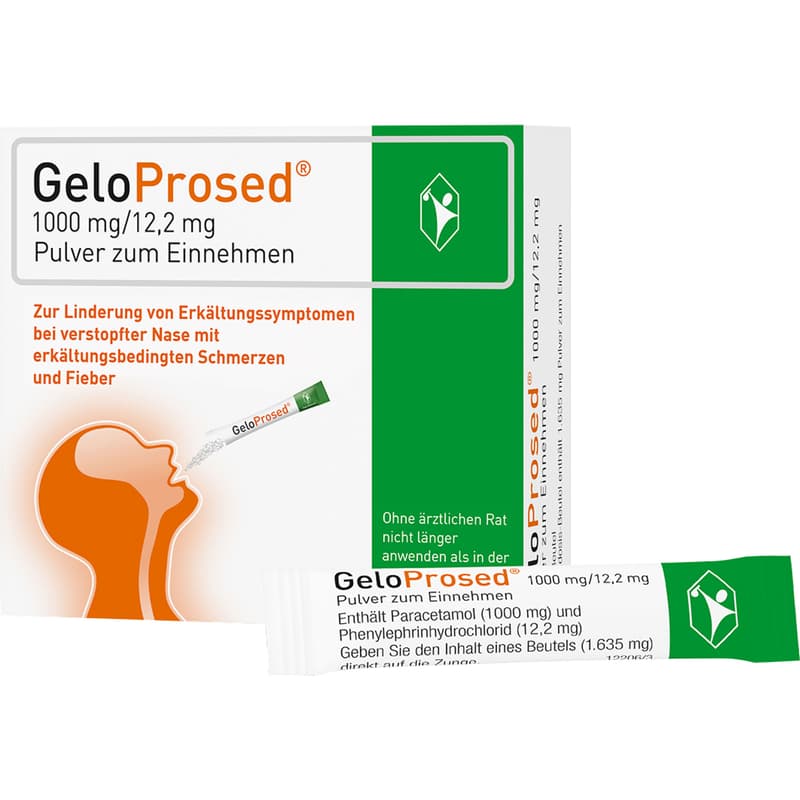
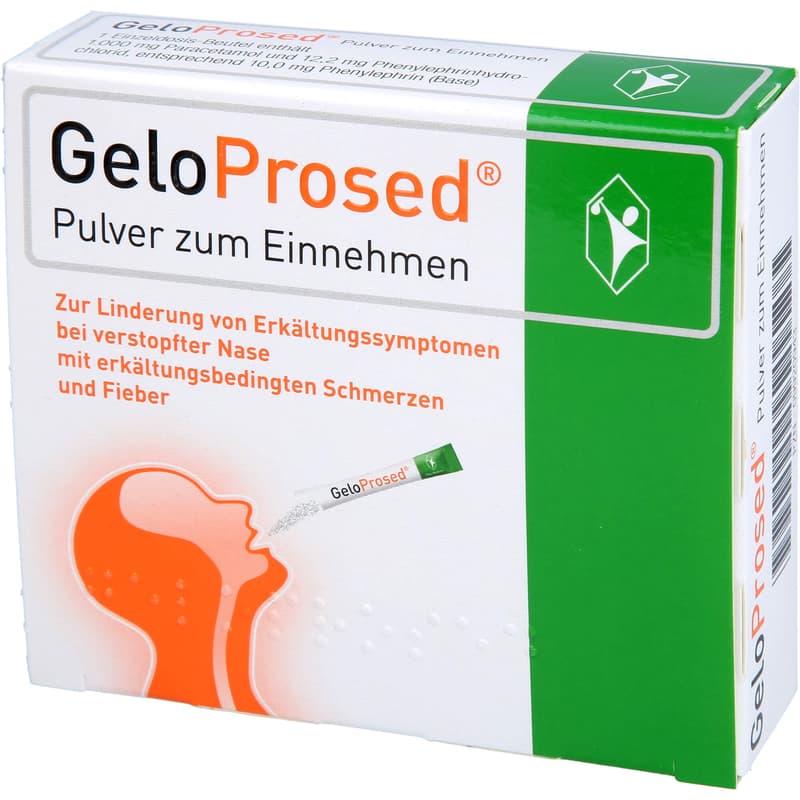
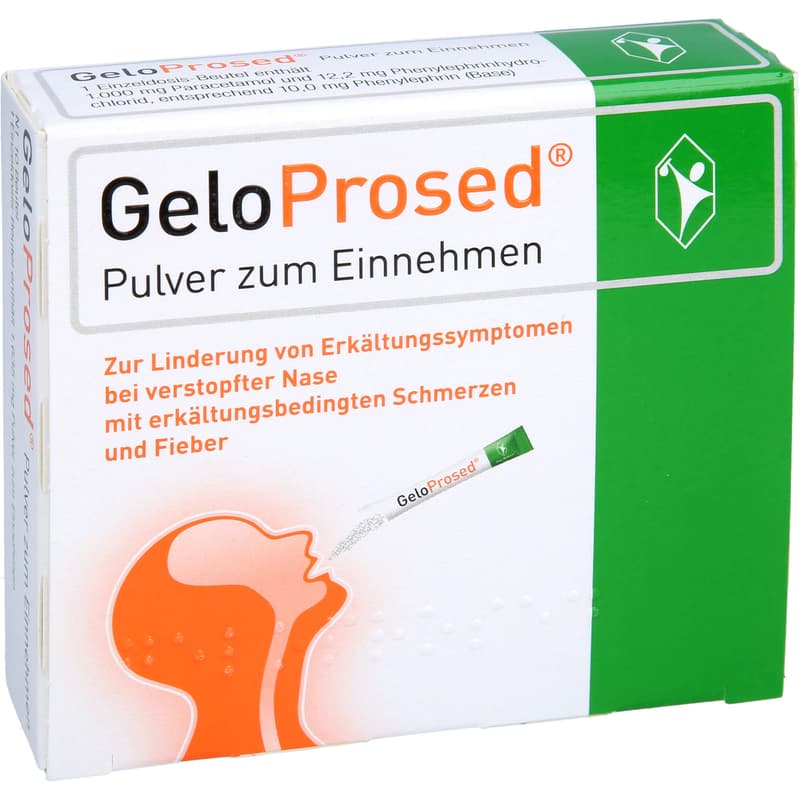
Das GeloProsed Pulver zum Einnehmen ist Ihr praktischer Begleiter bei Erkältungen und grippalen Infekten. Die bewährte Wirkstoffkombination aus Paracetamol und Phenylephrin lindert effektiv Schmerzen, Kopfschmerzen, Halsschmerzen sowie Fieber und lässt gleichzeitig die Nasenschleimhaut abschwellen. Das Pulver löst sich direkt auf der Zunge auf und kann ganz ohne Wasser eingenommen werden. Die Packung enthält 10 praktische Einzeldosis-Beutel für unterwegs.
Zu Risiken und Nebenwirkungen lesen Sie die Packungsbeilage und fragen Sie Ihre Ärztin, Ihren Arzt oder in Ihrer Apotheke.


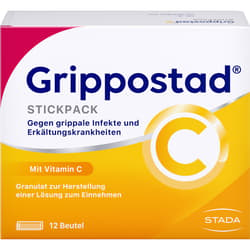
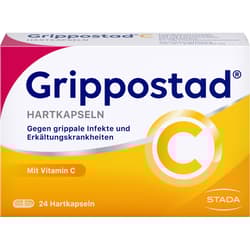
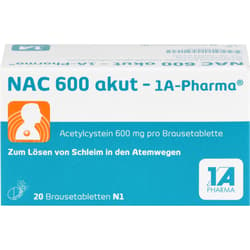
Beschreibung
Wichtige Hinweise (Pflichtangaben)
GeloProsed Pulver. Anwendungsgebiete: Zur Linderung der Symptome von Erkältungskrankheiten und grippalen Infekten, wie Schmerzen, Kopfschmerzen, Halsschmerzen und Fieber, wenn diese mit einer Anschwellung der Nasenschleimhaut einhergehen. Für Erwachsene, ältere Patienten und Jugendliche ab 12 Jahren. Warnhinweis: Enthält Aspartam und Natriumcarbonat. Ohne ärztlichen Rat nicht länger anwenden, als in der Packungsbeilage vorgegeben!Zu Risiken und Nebenwirkungen lesen Sie die Packungsbeilage und fragen Sie Ihre Ärztin, Ihren Arzt oder in Ihrer Apotheke.
GEBRAUCHSINFORMATION: INFORMATION FÜR DEN ANWENDER
GeloProsed Pulver zum Einnehmen
Wirkstoffe: Paracetamol (1.000 mg) und Phenylephrinhydrochlorid (12,2 mg)
Lesen Sie die gesamte Packungsbeilage sorgfältig durch, denn sie enthält wichtige Informationen für Sie. Dieses Arzneimittel ist ohne Verschreibung erhältlich. Um einen bestmöglichen Behandlungserfolg zu erzielen, muss GeloProsed jedoch vorschriftsgemäß eingenommen werden.
- Heben Sie die Packungsbeilage auf. Vielleicht möchten Sie diese später nochmals lesen.
- Fragen Sie Ihren Apotheker, wenn Sie weitere Informationen oder einen Rat benötigen.
- Wenn sich Ihre Beschwerden verschlimmern oder nach 3 Tagen keine Besserung eintritt, müssen Sie einen Arzt aufsuchen.
- Wenn eine der aufgeführten Nebenwirkungen Sie erheblich beeinträchtigt oder Sie Nebenwirkungen bemerken, die nicht in dieser Gebrauchsinformation angegeben sind, informieren Sie bitte Ihren Arzt oder Apotheker.
Diese Packungsbeilage beinhaltet
- WAS IST GELOPROSED UND WOFÜR WIRD ES ANGEWENDET?
- WAS SOLLTEN SIE VOR DER EINNAHME VON GELOPROSED BEACHTEN?
- WIE IST GELOPROSED EINZUNEHMEN?
- WELCHE NEBENWIRKUNGEN SIND MÖGLICH?
- WIE IST GELOPROSED AUFZUBEWAHREN?
- INHALT DER PACKUNG UND WEITERE INFORMATIONEN
GeloProsed ist ein Pulver zum Einnehmen und enthält eine Kombination von Wirkstoffen zur Linderung der Beschwerden von Erkältungskrankheiten und grippalen Infekten, wie Schmerzen, Kopfschmerzen, Halsschmerzen und Fieber, wenn diese mit einer Anschwellung der Nasenschleimhaut einhergehen. Paracetamol ist ein bekanntes Schmerzmittel (Analgetikum). Es ist wirksam gegen Schmerzen, einschließlich Kopfschmerzen, und kann auch Fieber senken (Antipyretikum). Phenylephrinhydrochlorid (abschwellendes Mittel) führt zum Abschwellen der Nasenschleimhaut.
2. WAS SOLLTEN SIE VOR DER EINNAHME VON GELOPROSED BEACHTEN?
GeloProsed darf nicht zusammen mit einem anderen Paracetamol-haltigen Arzneimittel eingenommen werden. Während der Anwendung dieses Arzneimittels sollten Sie auch auf den Konsum großer Mengen Alkohol verzichten.
GeloProsed darf nicht eingenommen werden:
- wenn Sie allergisch gegen Paracetamol oder Phenylephrinhydrochlorid oder einen der sonstigen Bestandteile von GeloProsed sind (weitere Informationen siehe Abschnitt 6).
- wenn Sie eine schwerwiegende Herzkrankheit haben.
- wenn Sie hohen Blutdruck (Hypertonie) oder einen seltenen Tumor des Nebennierenmarks (Phäochromozytom) haben.
- wenn Sie mit einem Arzneimittel aus der Gruppe der sogenannten Monoaminooxidase–Inhibitoren (MAOI) behandelt werden oder in den letzten 14 Tagen ein solches Arzneimittel eingenommen haben. Diese Arzneimittel werden gewöhnlich zur Behandlung von Depressionen eingesetzt.
- wenn Sie eine Überfunktion der Schilddrüse (Hyperthyreose) haben.
- wenn Ihre Leberfunktion stark eingeschränkt ist.
- wenn Sie viel Alkohol trinken oder in der Vergangenheit getrunken haben (Alkoholabusus).
Warnhinweise und Vorsichtsmaßnahmen
Besondere Vorsicht bei der Einnahme von GeloProsed ist erforderlich: Bitte fragen Sie Ihren Apotheker, bevor Sie GeloProsed anwenden:- wenn Sie an einem Raynaud–Syndrom leiden (Blässe und Taubheitsgefühl in Fingern und Zehen infolge schlechter Durchblutung).
- wenn Sie an Diabetes mellitus leiden.
- wenn Sie an Unterernährung leiden oder dehydriert sind.
- wenn Sie Nierenprobleme haben.
- wenn Sie eine Leberkrankheit haben, die nicht mit Strukturveränderungen der Leber verbunden ist (nicht–zirrhotische Leberkrankheit).
- wenn Sie gleichzeitig mit Arzneimitteln behandelt werden, die die Leberfunktion beeinträchtigen.
- wenn Sie an Blutarmut (hämolytischer Anämie) leiden.
- wenn Sie an Glutathionmangel leiden.
- wenn Sie an einer vergrößerten Prostata (Prostatahypertrophie) leiden.
Einnahme von GeloProsed mit anderen Arzneimitteln
Die Wirksamkeit bestimmter Behandlungen kann durch die gleichzeitige Anwendung von GeloProsed beeinträchtigt werden. Manche Arzneimittel können auch die Wirkung von GeloProsed beeinflussen. GeloProsed darf nicht eingenommen werden, wenn Sie mit einem Monoaminooxidase-Inhibitor (MAOI) behandelt werden oder eine solche Behandlung erst vor kurzem (weniger als 2 Wochen) beendet wurde. Es besteht sonst die Gefahr einer Bluthochdruckkrise.Fragen Sie Ihren Arzt oder Apotheker, bevor Sie GeloProsed einnehmen, wenn Sie die folgenden Arzneimittel anwenden:
- Blutdrucksenkende Mittel aus der Gruppe der Betablocker
- Arzneimittel zur Behandlung von hohem Blutdruck, Beinschmerzen infolge von Gefäßproblemen oder Raynaud–Syndrom (Vasodilatatoren)
- Mittel zur Behandlung von Depressionen aus einer bestimmten Arzneimittelklasse (trizyklische Antidepressiva)
- andere abschwellende Mittel
- Mittel zur Behandlung von Schlafstörungen oder Epilepsie (Barbiturate)
- Mittel zur Senkung der Cholesterinwerte im Blut (Cholestyramin)
- Mittel zur Behandlung von Übelkeit und Erbrechen (Metoclopramid und Domperidon)
- Blutverdünnende Mittel (Warfarin und andere Cumarine). Die blutverdünnende Wirkung kann durch Paracetamol verstärkt werden.
Schwangerschaft und
Stillzeit
Fragen Sie vor der Einnahme von Arzneimitteln Ihren Arzt oder Apotheker um Rat.Schwangerschaft
Die Anwendung dieses Arzneimittels während der Schwangerschaft wird nicht empfohlen; Phenylephrin kann die Durchblutung der Plazenta verringern. Wenn Sie eine Frau sind und bereits Präeklampsie hatten (eine Schwangerschaftskomplikation mit hohem Blutdruck und plötzlicher Bildung von Wassereinlagerungen (Ödemen)), sollten Sie GeloProsed mit Vorsicht anwenden.Stillzeit
Da zur Anwendung dieses Arzneimittels keine ausreichenden Daten vorliegen, sollte es während der Stillzeit nicht angewendet werden.Fertilität
Die Auswirkungen dieses Arzneimittels auf die Fertilität bei Männern und Frauen wurden nicht untersucht. Wenn Sie beabsichtigen, schwanger zu werden, sollten Sie mit Ihrem Arzt sprechen, bevor Sie dieses Arzneimittel anwenden.Verkehrstüchtigkeit und Fähigkeit zum Bedienen von Maschinen
Es sind keine Auswirkungen von GeloProsed auf die Verkehrstüchtigkeit und das Bedienen von Maschinen bekannt.Wichtige Informationen über bestimmte sonstige Bestandteile von GeloProsed
Wenn Sie an Phenylketonurie (einer erblichen genetischen Störung) leiden, beachten Sie bitte, dass dieses Arzneimittel die Phenylalaninquelle Aspartam enthält.Dieses Arzneimittel enthält 1 mmol (23,
8 mg) Natrium pro Dosis
Dies muss von Patienten berücksichtigt werden, die eine Diät mit kontrollierter Natriumzufuhr einhalten müssen.3. WIE IST GELOPROSED EINZUNEHMEN?
Lesen Sie diese Gebrauchsinformation sorgfältig durch. Bitte fragen Sie bei Ihrem Arzt oder Apotheker nach, wenn Sie sich nicht ganz sicher sind, wie viel von dem Arzneimittel und wann Sie es einnehmen sollen.
Anwendung bei Erwachsenen,
älteren Personen und Jugendlichen ab 12 Jahren
GeloProsed wird eingenommen. Geben Sie den Inhalt eines Einzeldosis-Beutels in den Mund direkt auf die Zunge. Dort löst sich das Pulver auf und kann dann ohne Wasser geschluckt werden. Nach 4 bis 6 Stunden kann eine weitere Einnahme erfolgen. Innerhalb von 24 Stunden dürfen nicht mehr als 3 Dosen (Inhalt von 3 Beuteln) eingenommen werden. Dieses Arzneimittel darf nicht länger als 3 Tage angewendet werden. Wenn die Symptome Ihrer Erkältung oder Ihres grippalen Infekts sich nach 3 Tagen nicht gebessert haben oder sich verschlimmern, wenden Sie sich an Ihren Arzt oder Apotheker.Anwendung bei Kindern
GeloProsed darf nicht bei Kindern unter 12 Jahren angewendet werden.Wenn Sie eine größere Menge von GeloProsed eingenommen haben,
als Sie sollten
Wenden Sie sich im Falle einer Überdosierung sofort an einen Arzt, auch wenn Sie keine Beschwerden haben. Die Gefahr einer verzögert einsetzenden schwerwiegenden Leberschädigung besteht auch dann, wenn Sie keine Beschwerden haben.Wenn Sie weitere Fragen zur Anwendung des Arzneimittels haben, fragen Sie Ihren Arzt oder Apotheker.
4. WELCHE NEBENWIRKUNGEN SIND MÖGLICH?
Wie alle Arzneimittel kann auch dieses Arzneimittel Nebenwirkungen haben, die aber nicht bei jedem auftreten müssen. GeloProsed enthält eine Kombination von zwei verschiedenen Bestandteilen. Im folgenden Abschnitt finden Sie Informationen zu den unerwünschten Wirkungen. Keine der schwerwiegenden unerwünschten Wirkungen von Phenylephrin oder Paracetamol ist besonders hervorzuheben. Sollten Sie eine schwerwiegende unerwünschte Wirkung bei sich beobachten und Hilfe oder weitere Informationen benötigen, fragen Sie Ihren Arzt oder Apotheker.
Mögliche Nebenwirkungen von Phenylephrin sind
Häufige Nebenwirkungen (können 1 von 10 Personen betreffen):- Gastrointestinale Störungen (Magen–Darm–Störungen): Appetitminderung, Übelkeit und Erbrechen.
- Herzerkrankungen: Schnellerer Herzschlag oder spürbares Herzklopfen.
- Gefäßerkrankungen: Blutdruckanstieg.
- Erkrankungen des Immunsystems: Allergische oder Überempfindlichkeitsreaktionen einschließlich Hautausschlag, Quaddeln, schwerer allergischer Reaktion, die zu Schwierigkeiten beim Atmen oder Schwindel und Bronchospasmus führt.
- Nervensystem: Schlafstörungen, Nervosität, Zittern, Angst, Ruhelosigkeit, Verwirrtheit, Reizbarkeit, Schwindel und Kopfschmerzen.
Mögliche Nebenwirkungen von Paracetamol sind
Seltene Nebenwirkungen (können bis zu 1 von 1.000 Personen betreffen):- Erkrankungen des Blutes und des lymphatischen Systems: Erkrankungen des Blutes, durch die die Neigung zu Blutungen, Blutergüssen, Fieber und Infektionen ansteigen kann (einschließlich Erkrankungen der Thrombozyten (Blutplättchen), Agranulozytose, Leukopenie, Thrombozytopenie, hämolytische Anämie, Panzytopenie).
- Erkrankungen der Haut: Überempfindlichkeitsreaktionen mit Hautausschlag und Quaddeln, Juckreiz, Schwitzen, dunkelrote Flecken auf der Haut, schwerwiegende allergische Reaktion, die zu Schwellungen von Gesicht oder Rachen führt (Angioödem).
- Erkrankungen des Immunsystems: Allergische oder Überempfindlichkeitsreaktionen mit Hautausschlag, Quaddeln, schwerwiegende allergische Reaktion, die zu Schwierigkeiten beim Atmen oder Schwindel und Bronchospasmus führt.
- Erkrankungen der Leber: Leberfunktionsstörungen (Anstieg der hepatischen Transaminasen), Leberversagen, Lebernekrose, Erkrankung der Leber mit Gelbfärbung der Augen und Haut (Gelbsucht).
- Erkrankungen der Nieren und Harnwege: Erkrankung der Nieren: interstitielle Nephritis nach längerer Anwendung höherer Dosen Paracetamol, trüber Urin (sterile Pyurie).
- Erkrankungen der Haut: Sehr selten wurden Fälle von schweren Hautreaktionen berichtet.
- Ansammlung von Flüssigkeit im Kehlkopf,
- anaphylaktischer Schock,
- Abnahme der Anzahl von roten Blutkörperchen, was zu Blässe der Haut und Schwäche oder Kurzatmigkeit führen kann (Anämie),
- Leberveränderung und Leberentzündung,
- Nierenveränderung (schwerwiegende Niereninsuffizienz), Blut im Urin (Hämaturie), Schwierigkeiten beim Wasserlassen (Anurie),
- Gastrointestinale Wirkungen,
- Schwindel und Drehschwindel.
Weitere Nebenwirkungen bei Kindern und Jugendlichen
Es ist davon auszugehen, dass Häufigkeit, Art und Schweregrad von Nebenwirkungen bei Kindern über 16 Jahren denen bei Erwachsenen entsprechen.Meldung von Nebenwirkungen
Wenn Sie Nebenwirkungen bemerken, wenden Sie sich an Ihren Arzt oder Apotheker. Dies gilt auch für Nebenwirkungen, die nicht in dieser Packungsbeilage angegeben sind. Sie können Nebenwirkungen auch direkt dem Bundesinstitut für Arzneimittel und Medizinprodukte, Abt. Pharmakovigilanz, Kurt-Georg-Kiesinger Allee 3, D-53175 Bonn, Website: www.bfarm.de anzeigen. Indem Sie Nebenwirkungen melden, können Sie dazu beitragen, dass mehr Informationen über die Sicherheit dieses Arzneimittels zur Verfügung gestellt werden.5. WIE IST GELOPROSED AUFZUBEWAHREN?
Arzneimittel für Kinder unzugänglich aufbewahren. Nicht über 25°C lagern. In der Originalpackung aufbewahren. Sie dürfen GeloProsed nach dem auf dem Beutel und der Faltschachtel nach "Verwendbar bis:" angegebenen Verfalldatum nicht mehr anwenden. Das Verfalldatum bezieht sich auf den letzten Tag des Monats. Entsorgen Sie Arzneimittel nicht im Abwasser oder Haushaltsabfall. Fragen Sie Ihren Apotheker, wie das Arzneimittel zu entsorgen ist, wenn Sie es nicht mehr verwenden. Sie tragen damit zum Schutz der Umwelt bei.
6. INHALT DER PACKUNG UND WEITERE INFORMATIONEN
Was GeloProsed enthält
Die Wirkstoffe sind: Paracetamol 1.000 mg und Phenylephrinhydrochlorid 12,2 mg. Die sonstigen Bestandteile sind: Ascorbinsäure, Xylitol, Ethylcellulose, Natriumcarbonat, Weinsäure, Magnesiumcitrat, Aspartam, Magnesiumstearat und Cassis-Aroma.Wie GeloProsed aussieht und Inhalt der Packung
GeloProsed ist ein weißes Pulver zum Einnehmen, abgepackt in Einzeldosis-Beuteln. Jede Packung enthält 10 Beutel (je 1.635 mg).Pharmazeutischer Unternehmer und Hersteller
G. Pohl-Boskamp GmbH & Co. KGKieler Straße 11
25551 Hohenlockstedt
Deutschland
Tel.: (+49) 4826 59-0
Fax: (+49) 4826 59-109
E-Mail: info@pohl-boskamp.de
Internet: www.pohl-boskamp.de
Diese Gebrauchsinformation wurde zuletzt überarbeitet im November 2014.
Quelle: Angaben der Packungsbeilage
Stand: 11/2017
Anwendungsgebiete: Zur Linderung der Symptome von Erkältungskrankheiten und grippalen Infekten, wie Schmerzen, Kopfschmerzen, Halsschmerzen und Fieber, wenn diese mit einer Anschwellung der Nasenschleimhaut einhergehen. Für Erwachsene, ältere Patienten und Jugendliche ab 12 Jahren. Warnhinweis: Enthält Aspartam und Natriumcarbonat. Ohne ärztlichen Rat nicht länger anwenden, als in der Packungsbeilage vorgegeben!
Info-Broschüre
Info-Broschüre herunterladenZusammensetzung & Allergene
Zusammensetzung
Wirkstoff: Paracetamol (1.000 mg) und Phenylephrinhydrochlorid (12,2 mg)