

Produkt aus:
Preussen
383€
Nur noch wenige Stück verfügbar
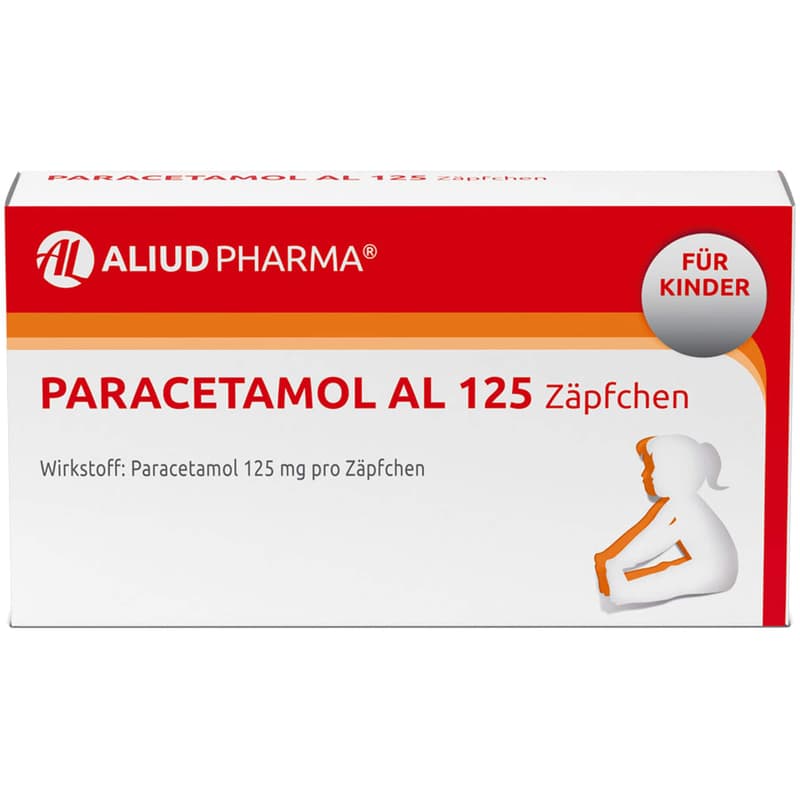
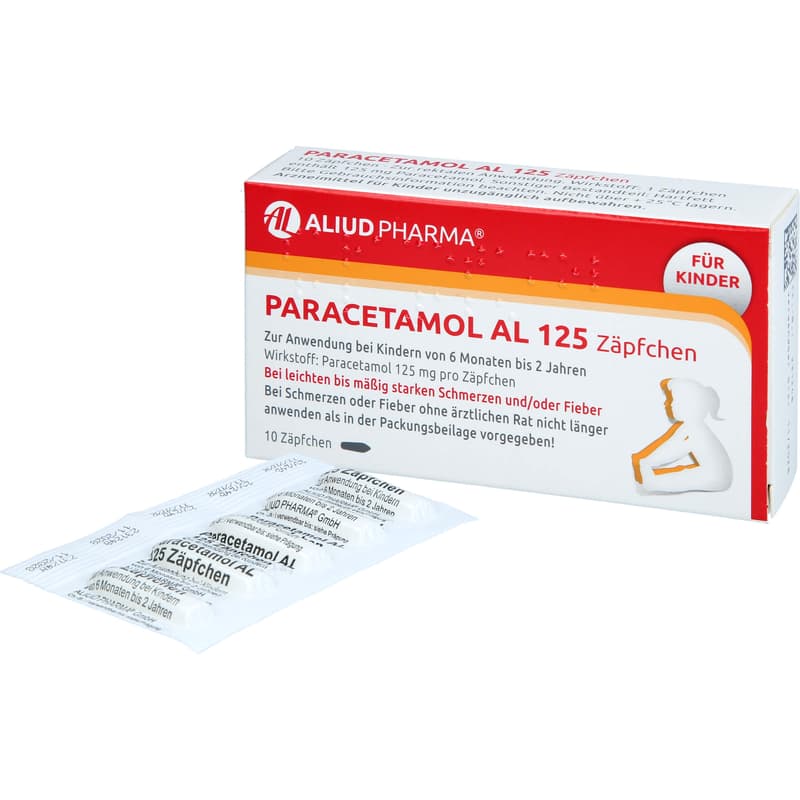
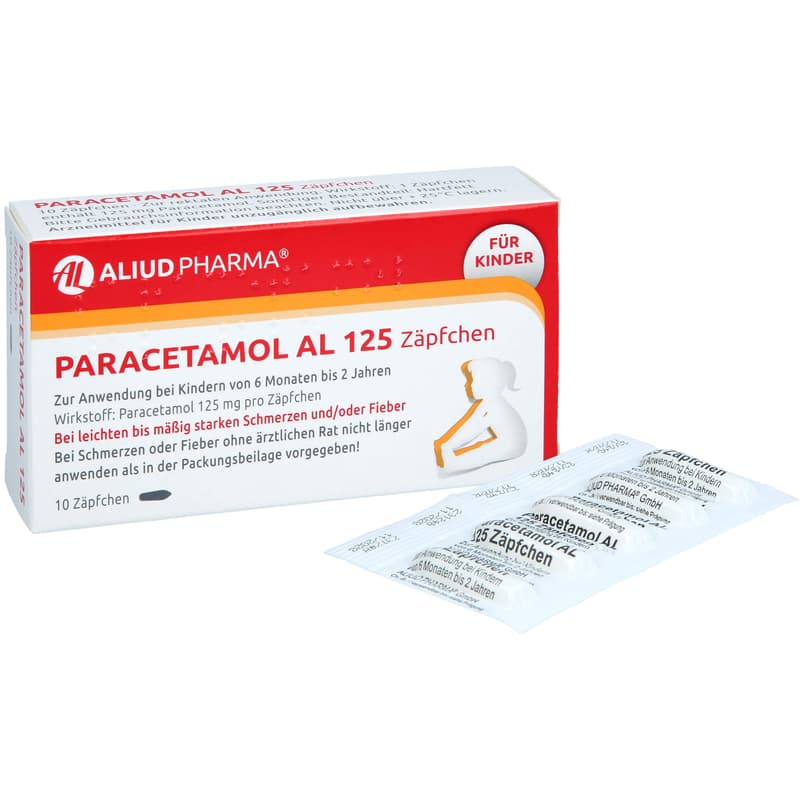
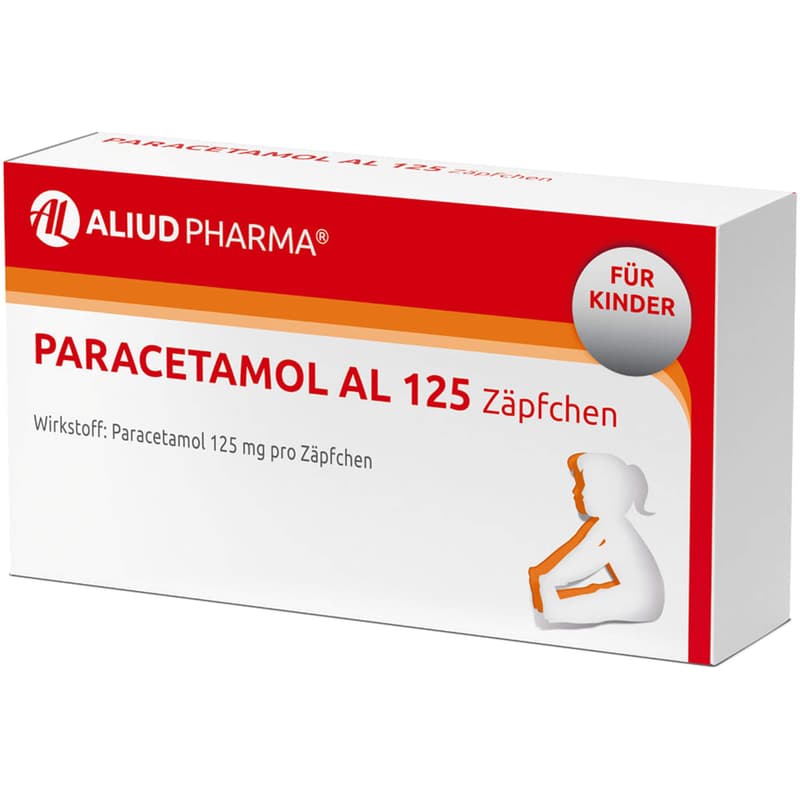
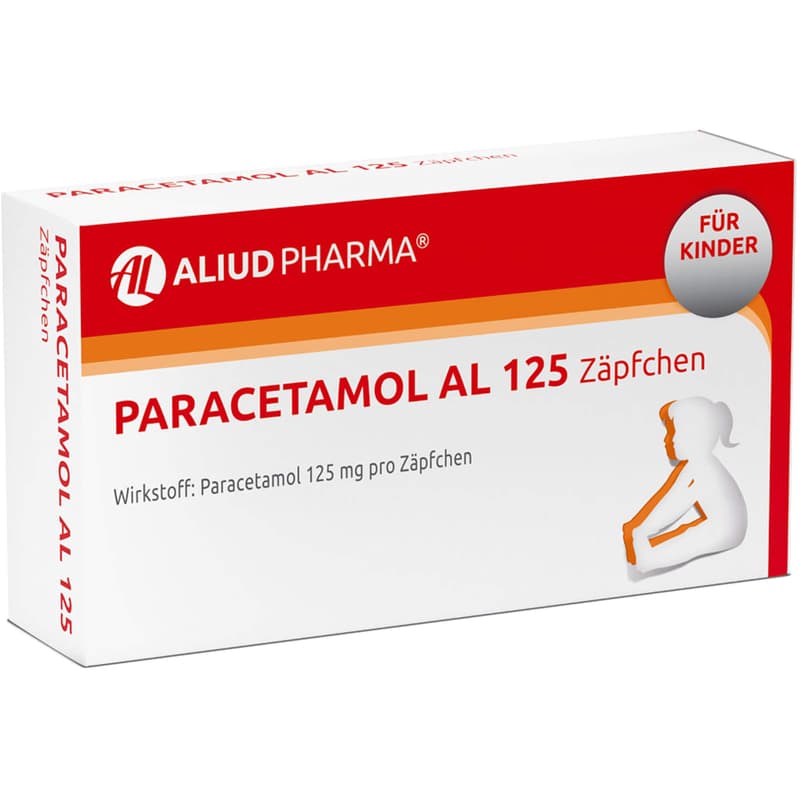
Die PARACETAMOL AL 125 Säuglings-Suppositorien bieten sanfte Hilfe für die Kleinsten. Diese Zäpfchen der Marke PARACETAMOL AL sind speziell für Babys und Kleinkinder von 6 Monaten bis 2 Jahren (7 bis 12 kg) geeignet. Sie lindern Fieber sowie leichte bis mäßig starke Schmerzen. Jedes Zäpfchen enthält 125 mg Paracetamol. Eine Packung enthält 10 Stück dieser elfenbeinfarbenen Zäpfchen, die sich dank Hartfett leicht verabreichen lassen.
Zu Risiken und Nebenwirkungen lesen Sie die Packungsbeilage und fragen Sie Ihre Ärztin, Ihren Arzt oder in Ihrer Apotheke.
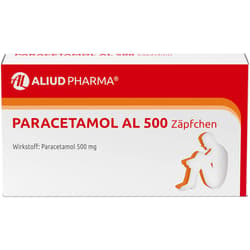
Beschreibung
Wichtige Hinweise (Pflichtangaben)
Paracetamol AL 125 Zäpfchen. Anwendungsgebiete: Zur symptomatischen Behandlung von leichten bis mäßig starken Schmerzen (wie Kopfschmerzen, Zahnschmerzen, Regelschmerzen) und/oder Fieber.Zu Risiken und Nebenwirkungen lesen Sie die Packungsbeilage und fragen Sie Ihre Ärztin, Ihren Arzt oder in Ihrer Apotheke.
GEBRAUCHSINFORMATION: INFORMATION FÜR DEN ANWENDER
Paracetamol AL 125 Zäpfchen, schmerzstillendes, fiebersenkendes Arzneimittel zur Anwendung bei Kindern von 6 Monaten bis 2 Jahren
Wirkstoffe: Paracetamol
Lesen Sie die gesamte Packungsbeilage sorgfältig durch, bevor Sie mit der Anwendung dieses Arzneimittels beginnen, denn sie enthält wichtige Informationen für Sie. Wenden Sie dieses Arzneimittel immer genau wie in dieser Packungsbeilage beschrieben bzw. genau nach Anweisung Ihres Arztes oder Apothekers an.
- Heben Sie die Packungsbeilage auf. Vielleicht möchten Sie diese später nochmals lesen.
- Fragen Sie Ihren Apotheker, wenn Sie weitere Informationen oder einen Rat benötigen.
- Wenn Sie Nebenwirkungen bemerken, wenden Sie sich an Ihren Arzt oder Apotheker. Dies gilt auch für Nebenwirkungen, die nicht in dieser Packungsbeilage angegeben sind.
- Wenn Sie sich nach 3 Tagen nicht besser oder gar schlechter fühlen, wenden Sie sich an Ihren Arzt.
Was in dieser Packungsbeilage steht
- WAS IST PARACETAMOL AL UND WOFÜR WIRD ES ANGEWENDET?
- WAS SOLLTEN SIE VOR DER ANWENDUNG VON PARACETAMOL AL BEACHTEN?
- WIE IST PARACETAMOL AL ANZUWENDEN?
- WELCHE NEBENWIRKUNGEN SIND MÖGLICH?
- WIE IST PARACETAMOL AL AUFZUBEWAHREN?
- INHALT DER PACKUNG UND WEITERE INFORMATIONEN.
Paracetamol AL ist ein schmerzstillendes, fiebersenkendes Arzneimittel (Analgetikum und Antipyretikum).
Paracetamol AL wird angewendet zur symptomatischen Behandlung von:
- leichten bis mäßig starken Schmerzen (wie Kopfschmerzen, Zahnschmerzen) und/oder
- Fieber.
Paracetamol AL darf nicht angewendet werden
o wenn Sie allergisch gegen Paracetamol oder den in Abschnitt 6. genannten sonstigen Bestandteil dieses Arzneimittels sind.Warnhinweise und Vorsichtsmaßnahmen
Bitte sprechen Sie mit Ihrem Arzt oder Apotheker, bevor Sie Paracetamol AL anwenden:- wenn Sie chronisch alkoholkrank sind.
- wenn Sie an einer Beeinträchtigung der Leberfunktion leiden (Leberentzündung, Gilbert-Syndrom).
- bei vorgeschädigter Niere.
- wenn Sie an schweren Krankheiten leiden, einschließlich schwerer Nierenfunktionsstörung oder Sepsis (wenn Bakterien und ihre Giftstoffe im Blut kreisen und zu Organschäden führen), oder wenn Sie an Mangelernährung oder chronischer Alkoholkrankheit leiden oder wenn Sie zusätzlich Flucloxacillin (ein Antibiotikum) einnehmen. Bei Patienten in diesen Situationen wurde über eine schwere Erkrankung berichtet, die als metabolische Azidose (eine Störung des Bluts und des Flüssigkeitshaushalts) bezeichnet wird. Sie trat auf, wenn Paracetamol in normalen Mengen über einen längeren Zeitraum angewendet wurde oder wenn Paracetamol zusammen mit Flucloxacillin angewendet wurde. Zu den Zeichen einer metabolischen Azidose können gehören: starke Atembeschwerden mit tiefer schneller Atmung, Benommenheit, Übelkeit und Erbrechen.
Um das Risiko einer Überdosierung zu verhindern, sollte sichergestellt werden, dass andere Arzneimittel, die gleichzeitig angewendet werden, kein Paracetamol enthalten.
Bei längerem hoch dosierten, nicht bestimmungsgemäßen Gebrauch von Schmerzmitteln können Kopfschmerzen auftreten, die nicht durch erhöhte Dosen des Arzneimittels behandelt werden dürfen.
Ganz allgemein kann die gewohnheitsmäßige Anwendung von Schmerzmitteln, insbesondere bei Kombination mehrerer schmerzstillender Wirkstoffe, zur dauerhaften Nierenschädigung mit dem Risiko eines Nierenversagens (Analgetika-Nephropathie) führen.
Bei abruptem Absetzen nach längerem hoch dosierten, nicht bestimmungsgemäßen Gebrauch von Schmerzmitteln können Kopfschmerzen sowie Müdigkeit, Muskelschmerzen, Nervosität und vegetative Symptome auftreten. Die Absetzsymptomatik klingt innerhalb weniger Tage ab. Bis dahin soll die Wiederanwendung von Schmerzmitteln unterbleiben und die erneute Anwendung soll nicht ohne ärztlichen Rat erfolgen.
Paracetamol AL nicht ohne ärztlichen oder zahnärztlichen Rat längere Zeit oder in höheren Dosen anwenden.
Anwendung von Paracetamol AL zusammen mit anderen Arzneimitteln
Informieren Sie Ihren Arzt oder Apotheker wenn Sie andere Arzneimittel anwenden, kürzlich andere Arzneimittel angewendet haben oder beabsichtigen andere Arzneimittel anzuwenden.Wechselwirkungen sind möglich mit
Arzneimitteln gegen Gicht wie Probenecid:Bei gleichzeitiger Anwendung von Probenecid sollte die Dosis von Paracetamol AL verringert werden, da der Abbau von Paracetamol verlangsamt sein kann.
Schlafmitteln wie Phenobarbital, Arzneimitteln gegen Epilepsie wie Phenytoin oder Carbamazepin, Arzneimitteln gegen Tuberkulose (Rifampicin) oder anderen möglicherweise die Leber schädigenden Arzneimitteln:
Unter Umständen kann es bei gleichzeitiger Anwendung mit Paracetamol AL zu Leberschäden kommen.
Arzneimitteln bei HIV-Infektionen (Zidovudin):
Die Neigung zur Verminderung weißer Blutkörperchen (Neutropenie) wird verstärkt. Paracetamol AL sollte daher nur nach ärztlichem Anraten gleichzeitig mit Zidovudin angewendet werden.
Mitteln zur Senkung erhöhter Blutfettwerte (Colestyramin):
Diese können die Aufnahme und damit die Wirksamkeit von Paracetamol AL verringern.
Flucloxacillin (Antibiotikum), wegen des schwerwiegenden Risikos für Störungen des Bluts und des Flüssigkeitshaushalts (sogenannte metabolische Azidose), die dringend behandelt werden müssen (siehe Abschnitt 2.).
Auswirkungen der Anwendung von Paracetamol AL auf Laboruntersuchungen Die Harnsäurebestimmung sowie die Blutzuckerbestimmung können beeinflusst werden.
Anwendung von Paracetamol AL zusammen mit Nahrungsmitteln und Getränken
Paracetamol AL darf nicht zusammen mit Alkohol verabreicht werden.Schwangerschaft und
Stillzeit
Wenn Sie schwanger sind oder stillen, oder wenn Sie vermuten, schwanger zu sein oder beabsichtigen, schwanger zu werden, fragen Sie vor der Anwendung dieses Arzneimittels Ihren Arzt oder Apotheker um Rat.Schwangerschaft
Falls erforderlich, kann Paracetamol AL nach strenger Abwägung des NutzenRisiko-Verhältnisses während der Schwangerschaft angewendet werden. Sie sollten die geringstmögliche Dosis für den kürzest möglichen Zeitraum anwenden. Wenden Sie sich an Ihren Arzt, falls die Schmerzen und/oder das Fieber nicht gelindert werden oder Sie das Arzneimittel häufiger anwenden müssen. Sie sollten Paracetamol AL während der Schwangerschaft nicht über längere Zeit, in hohen Dosen oder in Kombination mit anderen Arzneimitteln anwenden, da die Sicherheit der Anwendung für diese Fälle nicht belegt ist.Stillzeit
Paracetamol geht in die Muttermilch über. Da nachteilige Folgen für den Säugling bisher nicht bekannt geworden sind, wird eine Unterbrechung des Stillens in der Regel nicht erforderlich sein.Verkehrstüchtigkeit und Fähigkeit zum Bedienen von Maschinen Paracetamol AL hat keinen Einfluss auf die Verkehrstüchtigkeit und das Bedienen von Maschinen. Trotzdem ist nach Anwendung eines Schmerzmittels immer Vorsicht geboten.
3. WIE IST PARACETAMOL AL ANZUWENDEN?
Wenden Sie dieses Arzneimittel immer genau wie in dieser Packungsbeilage beschrieben bzw. genau nach der mit Ihrem Arzt oder Apotheker getroffenen Absprache an. Fragen Sie bei Ihrem Arzt oder Apotheker nach, wenn Sie sich nicht sicher sind.
Die empfohlene Dosis beträgt
Die Dosierung richtet sich nach den Angaben in der nachfolgenden Tabelle. Paracetamol wird in Abhängigkeit von Körpergewicht und Alter dosiert, in der Regel mit 10-15 mg Paracetamol pro kg Körpergewicht als Einzeldosis, bis maximal 60 mg/kg Körpergewicht als Tagesgesamtdosis.Das jeweilige Dosierungsintervall richtet sich nach der Symptomatik und der maximalen Tagesgesamtdosis. Es sollte 6 Stunden nicht unterschreiten. Die maximale Tagesdosis (24 Stunden) darf keinesfalls überschritten werden.
Bei Beschwerden, die länger als 3 Tage anhalten, sollte ein Arzt aufgesucht werden.
| Körpergewicht | Alter | Einzeldosis | Maximale Tagesdosis (24 Stunden) |
| 7 - 8 kg | Kinder: 6 -9 Monate | 1 Zäpfchen (entspr. 125 mg Paracetamol) | 3 Zäpfchen (entspr. 375 mg Paracetamol) |
| 9 - 12 kg | Kinder: 9 Monate - 2 Jahre | 1 Zäpfchen (entspr. 125 mg Paracetamol) | 4 Zäpfchen (entspr. 500 mg Paracetamol) |
Besondere Patientengruppen
Leberfunktionsstörungen und leichte Einschränkung der Nierenfunktion Bei Patienten mit Leber- oder Nierenfunktionsstörungen sowie Gilbert-Syndrom muss die Dosis vermindert bzw. das Dosisintervall verlängert werden.Schwere Niereninsuffizienz
Bei schwerer Niereninsuffizienz (Kreatinin-Clearance <10 ml/min) muss ein Dosisintervall von mindestens 8 Stunden eingehalten werden.Ältere Patienten
Es ist keine spezielle Dosisanpassung erforderlich.Kinder und Jugendliche mit geringem Körpergewicht
Eine Anwendung von Paracetamol AL bei Kindern unter 6 Monaten bzw. unter 7 kg Körpergewicht wird nicht empfohlen, da die Dosisstärke für diese Patientengruppe nicht geeignet ist. Es stehen jedoch für diese Patientengruppe geeignete Dosisstärken bzw. Darreichungsformen zur Verfügung.Art der Anwendung
Die Zäpfchen werden möglichst nach dem Stuhlgang tief in den After eingeführt. Zur Verbesserung der Gleitfähigkeit eventuell Zäpfchen in der Hand erwärmen oder kurz in warmes Wasser tauchen.Dauer der Anwendung
Wenden Sie Paracetamol AL ohne ärztlichen oder zahnärztlichen Rat nicht länger als 3 Tage an.Wenn Sie eine größere Menge von Paracetamol AL angewendet haben,
als Sie sollten
Die Gesamtdosis darf für Erwachsene und Jugendliche ab 12 Jahren bzw. ab 43 kg Körpergewicht 4000 mg Paracetamol täglich und für Kinder 60 mg/kg/Tag nicht übersteigen.Bei einer Überdosierung treten im Allgemeinen innerhalb von 24 Stunden Beschwerden auf, die Übelkeit, Erbrechen, Appetitlosigkeit, Blässe und Bauchschmerzen umfassen.
Wenn eine größere Menge Paracetamol AL angewendet wurde als empfohlen, rufen Sie den nächst erreichbaren Arzt zu Hilfe!
Wenn Sie die Anwendung von Paracetamol AL vergessen haben:
Wenden Sie nicht die doppelte Dosis an, wenn Sie die vorherige Anwendung vergessen haben.
Wenn Sie weitere Fragen zur Anwendung dieses Arzneimittels haben, wenden Sie sich an Ihren Arzt oder Apotheker.
4. WELCHE NEBENWIRKUNGEN SIND MÖGLICH?
Wie alle Arzneimittel kann auch dieses Arzneimittel Nebenwirkungen haben, die aber nicht bei jedem auftreten müssen.
Selten (kann bis zu 1 von 1.
000 Behandelten betreffen)
leichter Anstieg der Leberenzyme (Serumtransaminasen).Sehr selten (kann bis zu 1 von 10.
000 Behandelten betreffen)
- Veränderungen des Blutbildes wie Verminderung der Blutplättchen (Thrombozytopenie) oder eine starke Verminderung bestimmter weißer Blutkörperchen (Agranulozytose).
- allergische Reaktionen wie einfacher Hautausschlag oder Nesselausschlag (Urtikaria) bis hin zu einer Schockreaktion.
- Bei empfindlichen Personen kann sehr selten eine Verengung der Atemwege (Analgetika-Asthma) ausgelöst werden.
- Sehr selten wurden Fälle von schweren Hautreaktionen berichtet.
Nicht bekannt (Häufigkeit auf Grundlage der verfügbaren Daten nicht abschätzbar)
o Eine schwere Erkrankung, die das Blut saurer machen kann (sogenannte metabolische Azidose), bei Patienten mit schweren Erkrankungen, die Paracetamol anwenden (siehe Abschnitt 2.).Meldung von Nebenwirkungen
Wenn Sie Nebenwirkungen bemerken, wenden Sie sich an Ihren Arzt oder Apotheker. Dies gilt auch für Nebenwirkungen, die nicht in dieser Packungsbeilage angegeben sind. Sie können Nebenwirkungen auch direkt dem Bundesinstitut für Arzneimittel und Medizinprodukte, Abt. Pharmakovigilanz, Kurt-Georg-Kiesinger-Allee 3, D-53175 Bonn, Website: www.bfarm.de anzeigen. Indem Sie Nebenwirkungen melden, können Sie dazu beitragen, dass mehr Informationen über die Sicherheit dieses Arzneimittels zur Verfügung gestellt werden.5. WIE IST PARACETAMOL AL AUFZUBEWAHREN?
Bewahren Sie dieses Arzneimittel für Kinder unzugänglich auf.
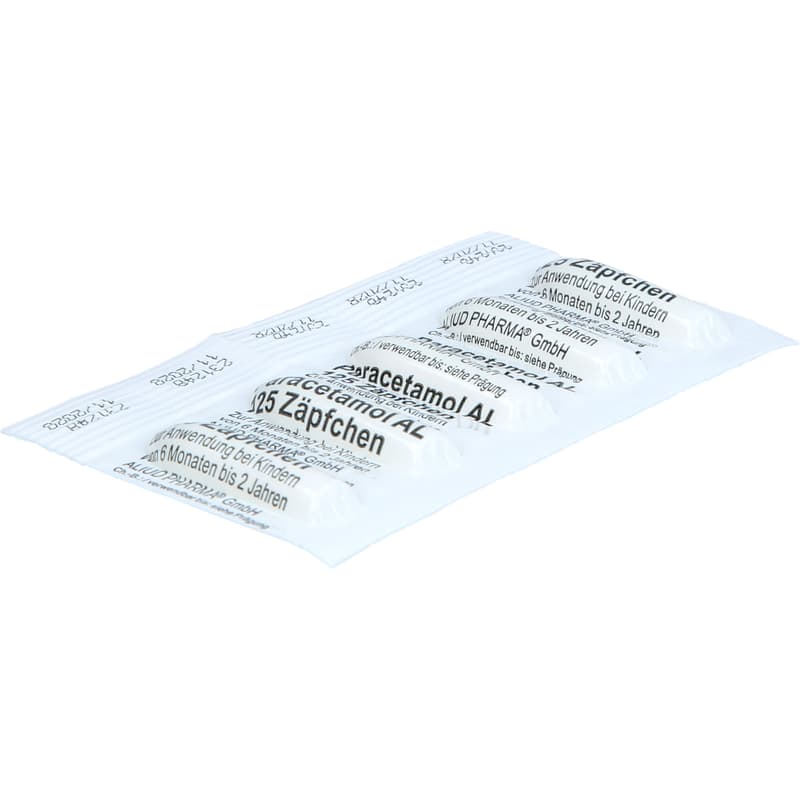
Sie dürfen dieses Arzneimittel nach dem auf dem Umkarton und dem Folienstreifen nach "verwendbar bis" oder "verw. bis" angegebenen Verfallsdatum nicht mehr verwenden. Das Verfallsdatum bezieht sich auf den letzten Tag des angegebenen Monats.
Nicht über 25°C lagern.
Entsorgen Sie Arzneimittel niemals über das Abwasser (z.B. nicht über die Toilette oder das Waschbecken). Fragen Sie in Ihrer Apotheke, wie das Arzneimittel zu entsorgen ist, wenn Sie es nicht mehr verwenden. Sie tragen damit zum Schutz der Umwelt bei. Weitere Informationen finden Sie unter: www.bfarm.de/arzneimittelentsorgung.
6. INHALT DER PACKUNG UND WEITERE INFORMATIONEN.
Was Paracetamol AL 125 Zäpfchen enthält
Der Wirkstoff ist:Paracetamol.
1 Zäpfchen enthält 125 mg Paracetamol.
Der sonstige Bestandteil ist
Hartfett.Wie Paracetamol AL 125 Zäpfchen aussieht und Inhalt der Packung
Weißes bis elfenbeinfarbenes Zäpfchen.Paracetamol AL 125 Zäpfchen ist in Packungen mit 10 Zäpfchen erhältlich.
Pharmazeutischer Unternehmer
ALIUD PHARMA GmbHGottlieb-Daimler-Straße 19
D-89150 Laichingen
info@aliud.de
Hersteller
STADA Arzneimittel AGStadastraße 2-18
61118 Bad Vilbel
Diese Gebrauchsinformation wurde zuletzt überarbeitet im Dezember 2019.
Quelle: Angaben der Packungsbeilage
Stand: 07/2026
Anwendungsgebiete: Zur symptomatischen Behandlung von leichten bis mäßig starken Schmerzen (wie Kopfschmerzen, Zahnschmerzen, Regelschmerzen) und/oder Fieber.
Info-Broschüre
Info-Broschüre herunterladenZusammensetzung & Allergene
Zusammensetzung
Wirkstoff: Paracetamol