

Produkt aus:
Preussen
885€
Nur noch wenige Stück verfügbar
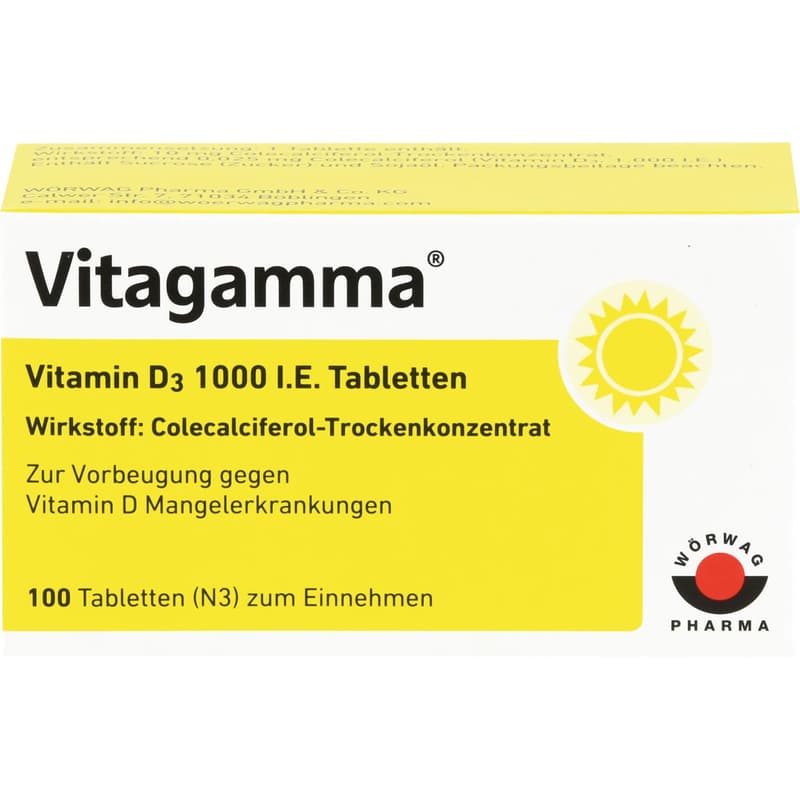
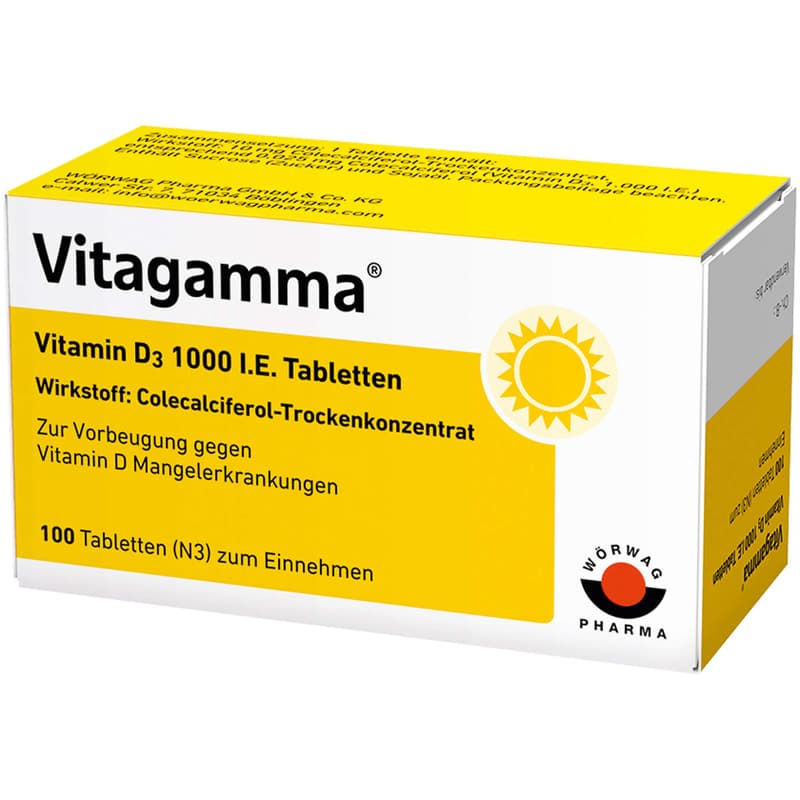
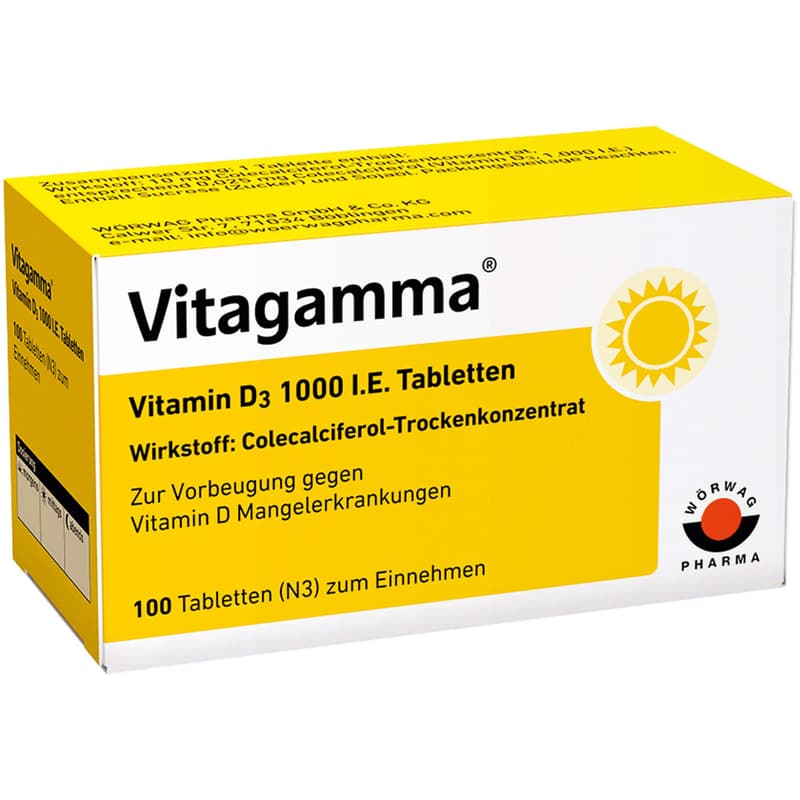
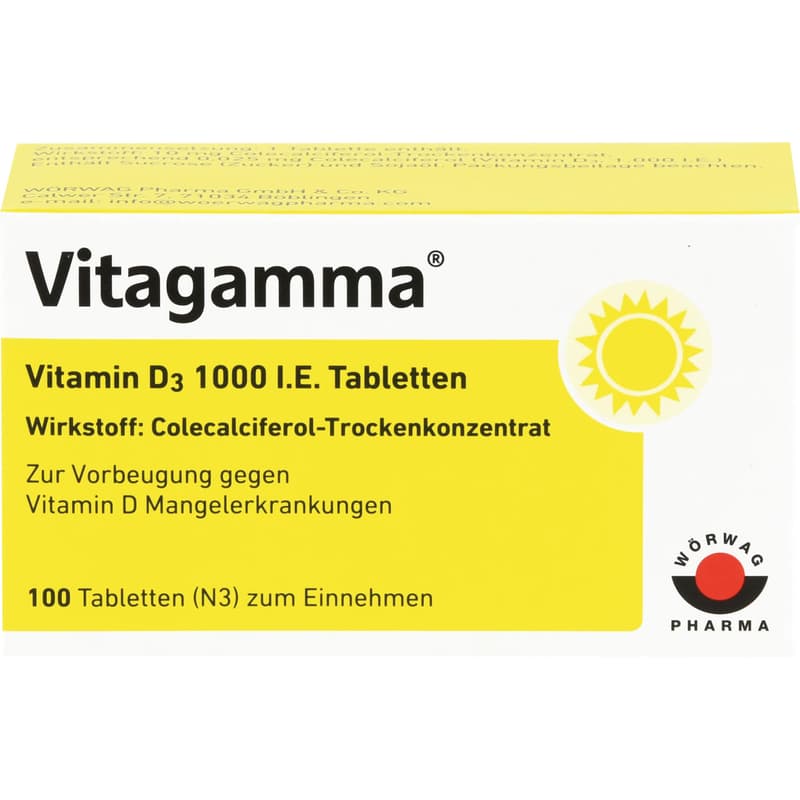
Die VITAGAMMA Vitamin D3 1.000 I.E. Tabletten sind ein hochwertiges Vitaminpräparat zur gezielten Vorbeugung von Rachitis und Vitamin-D-Mangelerkrankungen. Sie eignen sich hervorragend zur unterstützenden Behandlung von Osteoporose. Die weißen, runden Tabletten verfügen über eine praktische Bruchkerbe zur einfachen Dosierung. Sie erhalten das Präparat in einer Packung mit 100 Stück für Ihre tägliche Gesundheitsvorsorge.
Zu Risiken und Nebenwirkungen lesen Sie die Packungsbeilage und fragen Sie Ihre Ärztin, Ihren Arzt oder in Ihrer Apotheke!







Beschreibung
Wichtige Hinweise (Pflichtangaben)
Vitagamma Vitamin D3 1000 I.E. Tabletten. Wirkstoff: Colecalciferol-Trockenkonzentrat. Anwendungsgebiete: zur Vorbeugung gegen Rachitis, zur Vorbeugung bei erkennbarem Risiko einer Vitamin D-Mangelerkrankung bei ansonsten Gesunden ohne Resorptionsstörung (Störung der Aufnahme von Vitamin D im Darm), zur unterstützenden Behandlung der Osteoporose und zur Vorbeugung gegen Rachitis bei Frühgeborenen.Zu Risiken und Nebenwirkungen lesen Sie die Packungsbeilage und fragen Sie Ihre Ärztin, Ihren Arzt oder in Ihrer Apotheke!
GEBRAUCHSINFORMATION: INFORMATION FÜR DEN ANWENDER
Vitagamma Vitamin D3 1000 I.E. Tabletten
Wirkstoff: Colecalciferol-Trockenkonzentrat
Lesen Sie die gesamte Packungsbeilage sorgfältig durch, bevor Sie mit der Einnahme dieses Arzneimittels beginnen, denn sie enthält wichtige Informationen. Nehmen Sie dieses Arzneimittel immer genau wie in dieser Packungsbeilage beschrieben bzw. genau nach Anweisung Ihres Arztes oder Apothekers ein.
- Heben Sie die Packungsbeilage auf. Vielleicht möchten Sie diese später nochmals lesen.
- Fragen Sie Ihren Apotheker, wenn Sie weitere Informationen oder einen Rat benötigen.
- Wenn Sie Nebenwirkungen bemerken, wenden Sie sich an Ihren Arzt oder Apotheker. Dies gilt auch für Nebenwirkungen, die nicht in dieser Packungsbeilage angegeben sind. Siehe Abschnitt 4.
- Wenn Sie sich nicht besser oder gar schlechter fühlen, wenden Sie sich an Ihren Arzt.
Diese Packungsbeilage beinhaltet
- WAS SIND VITAGAMMA VITAMIN D31000 I.E. TABLETTEN UND WOFÜR WERDEN SIE ANGEWENDET?
- WAS SOLLTEN SIE VOR DER EINNAHME VON VITAGAMMA VITAMIN D3 1000 I.E. TABLETTEN BEACHTEN?
- WIE SIND VITAGAMMA VITAMIN D31000 I.E. TABLETTEN EINZUNEHMEN?
- WELCHE NEBENWIRKUNGEN SIND MÖGLICH?
- WIE SIND VITAGAMMA VITAMIN D31000 I.E. TABLETTEN AUFZUBEWAHREN?
- INHALT DER PACKUNG UND WEITERE INFORMATIONEN
Vitagamma Vitamin D3 1000 I.E. Tabletten ist ein Vitaminpräparat.
Anwendungsgebiete:
- Zur Vorbeugung gegen Rachitis.
- Zur Vorbeugung bei erkennbarem Risiko einer Vitamin D–Mangelerkrankung bei ansonsten Gesunden ohne Resorptionsstörung (Störung der Aufnahme von Vitamin D im Darm).
- Zur unterstützenden Behandlung der Osteoporose.
- Zur Vorbeugung gegen Rachitis bei Frühgeborenen.
Vitagamma Vitamin D3 1000 I.E. Tabletten dürfen nicht eingenommen werden:
- wenn Sie allergisch gegen Colecalciferol, Soja, Erdnuss oder einen der in Abschnitt 6. genannten sonstigen Bestandteile dieses Arzneimittels sind.
- bei Hypercalcämie (erhöhte Calciumkonzentration im Blut) und/oder Hypercalciurie (erhöhte Calciumkonzentration im Harn).
Warnhinweise und Vorsichtsmaßnahmen:
- bei Neigung zur Bildung calciumhaltiger Nierensteine.
- bei Patienten mit gestörter Ausscheidung von Calcium und Phosphat über die Niere, bei Behandlung mit Benzothiadiazin–Derivaten (Arzneimittel zur Förderung der Harnausscheidung) und bei immobilisierten Patienten (Risiko der Hypercalcämie (erhöhte Calciumkonzentration im Blut) und Hypercalciurie (erhöhte Calciumkonzentration im Harn)). Bei diesen Patienten sollten die Calciumspiegel im Blut und Urin überwacht werden.
- bei Patienten, die unter Sarcoidose leiden, da das Risiko einer verstärkten Umwandlung von Vitamin D in seine aktive Form besteht. Bei diesen Patienten sollten die Calciumspiegel im Blut und Urin überwacht werden.
Tagesdosen über 500 I.E./
d
Während einer Langzeitbehandlung mit Vitagamma Vitamin D3 1000 I.E. Tabletten sollten die Calciumspiegel im Blut und im Urin regelmäßig überwacht werden und die Nierenfunktion durch Messung des Serumkreatinins überprüft werden. Diese Überprüfung ist besonders wichtig bei älteren Patienten und bei gleichzeitiger Behandlung mit Herzglycosiden (Arzneimittel zur Förderung der Funktion der Herzmuskulatur) oder Diuretika (Arzneimittel zur Förderung der Harnausscheidung). Im Falle von Hypercalcämie (erhöhte Calciumkonzentration im Blut) oder Anzeichen einer verminderten Nierenfunktion muss die Dosis verringert oder die Behandlung unterbrochen werden. Es empfiehlt sich, die Dosis zu reduzieren oder die Behandlung zu unterbrechen, wenn der Calciumgehalt im Harn 7,5 mmol/ 24 Stunden (300 mg/24 Stunden) überschreitet. Bitte sprechen Sie mit Ihrem Arzt oder Apotheker, bevor Sie Vitagamma Vitamin D3 1000 I.E. Tabletten einnehmen.Einnahme von Vitagamma Vitamin D3 1000 I.E.
Tabletten mit anderen Arzneimitteln
Informieren Sie Ihren Arzt oder Apotheker wenn Sie andere Arzneimittel anwenden kürzlich andere Arzneimittel angewendet haben oder beabsichtigen andere Arzneimittel anzuwenden.Welche anderen Arzneimittel beeinflussen die Wirkung von Vitagamma Vitamin D31000 I.E. Tabletten?
Phenytoin (Arzneimittel zur Behandlung der Epilepsie) oder Barbiturate (Arzneimittel zur Behandlung von Epilepsie und Schlafstörungen sowie zur Narkose) können die Wirkung von Vitamin D beeinträchtigen. Thiazid-Diuretika (Arzneimittel zur Förderung der Harnausscheidung) können durch die Verringerung der Calciumausscheidung über die Niere zu einer Hypercalcämie (erhöhte Calciumkonzentration im Blut) führen. Die Calciumspiegel im Blut und im Urin sollten daher während einer Langzeitbehandlung überwacht werden. Die gleichzeitige Verabreichung von Glucocorticoiden (Arzneimittel zur Behandlung bestimmter allergischer Erkrankungen) kann die Wirkung von Vitamin D beeinträchtigen.
Wie beeinflussen Vitagamma Vitamin D3 1000 I.E. Tabletten die Wirkung von anderen Arzneimitteln?
Das Risiko einer unerwünschten Wirkung bei der Einnahme von Herzglycosiden (Arzneimittel zur Förderung der Funktion der Herzmuskulatur) kann infolge einer Erhöhung der Calciumspiegel im Blut während der Behandlung mit Vitamin D zunehmen (Risiko für Herzrhythmusstörungen). Patienten sollten hinsichtlich EKG und Calciumspiegel im Blut und im Urin überwacht werden.
Bitte informieren Sie Ihren Arzt oder Apotheker, wenn Sie andere Arzneimittel einnehmen bzw. vor Kurzem eingenommen haben, auch wenn es sich um nicht verschreibungspflichtige Arzneimittel handelt.
Schwangerschaft und Stillzeit
Wenn Sie schwanger sind oder stillen, oder wenn Sie vermuten, schwanger zu sein oder beabsichtigen, schwanger zu werden, fragen Sie vor der Einnahme Anwendung dieses Arzneimittels Ihren Arzt oder Apotheker um Rat.Tagesdosen bis 500 I.E./
d
Bisher sind keine Risiken im angegebenen Dosisbereich bekannt. Langanhaltende Überdosierungen von Vitamin D müssen in der Schwangerschaft verhindert werden, da eine daraus resultierende Hypercalcämie (erhöhte Calciumkonzentration im Blut) zu körperlicher und geistiger Behinderung sowie angeborenen Herz- und Augenerkrankungen des Kindes führen kann.Tagesdosen über 500 I.E./
d
Während der Schwangerschaft sollten Vitagamma Vitamin D3 1000 I.E. Tabletten nur nach strenger Indikationsstellung eingenommen und nur so dosiert werden, wie es zum Beheben des Mangels unbedingt notwendig ist. Überdosierungen von Vitamin D in der Schwangerschaft müssen verhindert werden, da eine langanhaltende Hypercalcämie (erhöhte Calciumkonzentration im Blut) zu körperlicher und geistiger Behinderung sowie angeborenen Herz- und Augenerkrankungen des Kindes führen kann.Vitamin D und seine Stoffwechselprodukte gehen in die Muttermilch über. Eine auf diesem Wege erzeugte Überdosierung beim Säugling ist nicht beobachtet worden.
Verkehrstüchtigkeit und Fähigkeit zum Bedienen von Maschinen
Es gibt keinen Hinweis darauf, dass Vitagamma Vitamin D3 1000 I.E. Tabletten einen Einfluss auf das Fahr- und Konzentrationsvermögen haben.Vitagamma Vitamin D3 1000 I.E.
Tabletten enthalten Sucrose
Bitte nehmen Sie Vitagamma Vitamin D3 1000 I.E. Tabletten erst nach Rücksprache mit Ihrem Arzt ein, wenn Ihnen bekannt ist, dass Sie an einer Unverträglichkeit gegenüber bestimmten Zuckern leiden.3. WIE SIND VITAGAMMA VITAMIN D3 1000 I.E. TABLETTEN EINZUNEHMEN?
Nehmen Sie dieses Arzneimittel immer genau wie in dieser Packungsbeilage beschrieben bzw. genau nach der mit Ihrem Arzt oder Apotheker getroffenen Absprache ein. Fragen Sie bei Ihrem Arzt oder Apotheker nach, wenn Sie sich nicht sicher sind.
Die empfohlene Dosis beträgt:
- Zur Vorbeugung gegen Rachitis täglich V4 Tablette Vitagamma Vitamin D3 1000 I.E. (entsprechend 0,0125 mg bzw. 500 I.E. Vitamin D3).
- Zur Vorbeugung bei erkennbarem Risiko einer Vitamin D–Mangelerkrankung bei ansonsten Gesunden ohne Resorptionsstörung täglich V2 Tablette Vitagamma Vitamin D3 1000 I.E. (entsprechend 0,0125 mg bzw. 500 I.E. Vitamin D3)
- Zur unterstützenden Behandlung der Osteoporose 1 Tablette Vitagamma Vitamin D3 1000 I.E. täglich (entsprechend 0,025 mg bzw. 1000 I.E. Vitamin D3).
- Zur Vorbeugung gegen Rachitis bei Frühgeborenen 1 Tablette Vitagamma Vitamin D3 1000 I.E. täglich (entsprechend 0,025 mg bzw. 1000 I.E. Vitamin D3) empfohlen.
Art der Anwendung
Die Tablette kann in gleiche Dosen geteilt werden.Säuglinge und Kleinkinder
Vitagamma Vitamin D3 1000 I.E. Tabletten sollten bei Säuglingen und Kleinkindern besonders vorsichtig angewendet werden, da diese möglicherweise nicht in der Lage sind, die Tabletten zu schlucken und ersticken könnten. Es wird empfohlen, stattdessen die Tabletten wie angegeben zu zerkleinern und mit Wasser zu vermischen oder Tropfen oder Emulsionen zu verwenden. Die Tablette in möglichst kleine Teile zerteilen, mit einem Löffelrücken möglichst fein zerdrücken und auf einem Teelöffel mit etwas Wasser vermischen. Hierbei entsteht eine Suspension (Gemisch aus Teilen der Tablette und Wasser). Diese ist dem Kind am besten während einer Mahlzeit direkt in den Mund zu geben. Ein Zusatz der suspendierten Tablette zu einer Flaschen- oder Breimahlzeit für Säuglinge ist nicht zu empfehlen, da hierbei keine vollständige Zufuhr garantiert werden kann. Sofern die Tabletten dennoch in der Nahrung verabreicht werden sollen, erfolgt die Zugabe erst nach dem Auf kochen. Bei der Verwendung vitaminisierter Nahrung ist die darin enthaltene Vitamin D-Menge zu berücksichtigen.Erwachsene
Die Tabletten mit ausreichend Flüssigkeit einnehmen.Dauer der Anwendung
Über die notwendige Dauer der Anwendung befragen Sie bitte Ihren Arzt!Bitte sprechen Sie mit Ihrem Arzt oder Apotheker, wenn Sie den Eindruck haben, dass die Wirkung von Vitagamma Vitamin D3 1000 I.E. Tabletten zu stark oder zu schwach ist.
Wenn Sie eine größere Menge Vitagamma Vitamin D3 1000 I.E. Tabletten eingenommen haben,
als Sie sollten
Symptome einer Überdosierung
Tagesdosen bis 500 I.E./d
Langfristige Überdosierung von Vitamin D kann zu Hypercalcämie (erhöhte Calciumkonzentration im Blut) und Hypercalciurie (erhöhte Calciumkonzentration im Harn) führen. Bei erheblicher und langdauernder Überschreitung des Bedarfs kann es zu Verkalkungen von Organen kommen.Tagesdosen über 500 I.E./
d
Ergocalciferol (Vitamin D2) und Colecalciferol (Vitamin D3) besitzen nur eine relativ geringe therapeutische Breite. Bei Erwachsenen mit normaler Funktion der Nebenschilddrüsen liegt die Schwelle für Vitamin D-Intoxikationen zwischen 40.000 und 100.000 I.E. pro Tag über 1 bis 2 Monate. Säuglinge und Kleinkinder können schon auf weitaus geringere Dosen empfindlich reagieren. Deshalb wird vor der Zufuhr von Vitamin D ohne ärztliche Kontrolle gewarnt.Bei Überdosierung kommt es neben einem Anstieg von Phosphor im Blut und Harn zum Hypercalcämiesyndrom (erhöhte Calciumkonzentration im Blut), später auch hierdurch zur Calciumablagerung in den Geweben und vor allem in der Niere (Nierensteine und Nierenverkalkung) und den Gefäßen. Die Symptome einer Intoxikation sind wenig charakteristisch und äußern sich in Übelkeit, Erbrechen, anfangs oft Durchfälle, später Obstipation (Verstopfung), Appetitlosigkeit, Mattigkeit, Kopf-, Muskel- und Gelenkschmerzen, Muskelschwäche sowie hartnäckige Schläfrigkeit, Azotämie (erhöhte Stickstoffkonzentration im Blut), gesteigertem Durst und erhöhtem Harndrang und in der Endphase Austrocknung. Typische Laborbefunde sind Hypercalcämie (erhöhte Calciumkonzentration im Blut), Hypercalciurie (erhöhte Calciumkonzentration im Harn) sowie erhöhte Serumwerte für 25-Hydroxycalciferol.
Therapiemaßnahmen bei Überdosierung
Als erste Maßnahme ist das Vitamin D-Präparat abzusetzen; eine Normalisierung der Hypercalcämie (erhöhte Calciumkonzentration im Blut) infolge einer Vitamin D-Intoxikation dauert mehrere Wochen. Abgestuft nach dem Ausmaß der Hypercalcämie (erhöhte Calciumkonzentration im Blut) können calciumarme bzw. calciumfreie Ernährung, reichliche Flüssigkeitszufuhr, Erhöhung der Harnausscheidung mittels dem Arzneimittel Furosemid sowie die Gabe von Glucocorticoiden (Arzneimittel zur Behandlung bestimmter allergischer Erkrankungen) und Calcitonin (Hormon zur Regelung der Calciumkonzentration im Blut) eingesetzt werden. Bei ausreichender Nierenfunktion wirken Infusionen mit isotonischer Kochsalz-Lösung (3 - 6 l in 24 Std.) mit Zusatz von Furosemid (Arzneimittel zur Erhöhung der Harnausscheidung) sowie u.U. auch 15 mg/kg KG/Std. Natriumedetat (Arzneimittel, das Calcium im Blut bindet) unter fortlaufender Calcium- und EKG-Kontrolle recht zuverlässig calciumsenkend. Bei verminderter Harnausscheidung ist dagegen eine Hämodialysebehandlung (Blutwäsche) mit einem Calcium-freien Dialysat angezeigt. Ein spezielles Gegenmittel existiert nicht.Tagesdosen bis 500 I.E./
d
Symptome einer chronischen Überdosierung von Vitamin D können eine Erhöhung der Harnausscheidung sowie die Gabe von Glucocorticoiden (Arzneimittel zur Behandlung bestimmter allergischer Erkrankungen) oder Calcitonin (Hormon zur Regelung der Calciumkonzentration im Blut) erforderlich machen.Tagesdosen über 500 I.E./
d
Bei Überdosierung sind Maßnahmen zur Behandlung der oft lang dauernden und unter Umständen bedrohlichen Hypercalcämie (erhöhte Calciumkonzentration im Blut) erforderlich. Befragen Sie bitte Ihren Arzt zu den Symptomen einer Überdosierung von Vitamin D.Wenn Sie die Einnahme von Vitagamma Vitamin D3 1000 I.E.
Tabletten vergessen haben
Nehmen Sie nicht die doppelte Menge ein, wenn Sie die vorherige Einnahme vergessen haben.Wenn Sie die Einnahme von Vitagamma Vitamin D3 1000 I.E.
Tabletten abbrechen
Bei einer Unterbrechung oder vorzeitigem Abbruch der Behandlung können sich Ihre Beschwerden wieder verschlechtern oder erneut auftreten. Befragen Sie hierzu bitte Ihren Arzt!Wenn Sie weitere Fragen zur Anwendung des Arzneimittels haben, fragen Sie Ihren Arzt oder Apotheker.
4. WELCHE NEBENWIRKUNGEN SIND MÖGLICH?
Wie alle Arzneimittel können Vitagamma Vitamin D3 1000 I.E. Tabletten Nebenwirkungen haben, die aber nicht bei jedem auftreten müssen.
| Bei der Bewertung von Nebenwirkungen werden folgende Häufigkeitsangaben zu Grunde gelegt: | |
| Sehr häufig: | mehr als 1 Behandelter von 10 |
| Häufig: | 1 bis 10 Behandelte von 100 |
| Gelegentlich: | 1 bis 10 Behandelte von 1 000 |
| Selten: | 1 bis 10 Behandelte von 10 000 |
| Sehr selten: | weniger als 1 Behandelter von 10 000 |
| Nicht bekannt: | Häufigkeit auf Grundlage der verfügbaren Daten nicht abschätzbar. |
Die Nebenwirkungen entstehen als Folge einer Überdosierung. Abhängig von Dosis und Behandlungsdauer kann eine schwere und lang anhaltende Hypercalcämie (erhöhte Calciumkonzentration im Blut) mit ihren akuten (Herzrhythmusstörungen, Übelkeit, Erbrechen, psychische Symptome, Bewusstseinsstörungen) und chronischen (vermehrter Harndrang, verstärktes Durstgefühl, Appetitlosigkeit, Gewichtsverlust, Nierensteinbildung, Nierenverkalkung, Verkalkung in Geweben außerhalb des Knochens) Folgen auftreten. In Einzelfällen sind tödliche Verläufe beschrieben worden.
Andere mögliche Nebenwirkungen
Sojaöl kann sehr selten allergische Reaktionen hervorrufen.Meldung von Nebenwirkungen
Wenn Sie Nebenwirkungen bemerken, wenden Sie sich an Ihren Arzt oder Apotheker. Dies gilt auch für Nebenwirkungen, die nicht in dieser Packungsbeilage angegeben sind. Sie können Nebenwirkungen auch direkt dem Bundesinstitut für Arzneimittel und Medizinprodukte, Abt. Pharmakovigilanz, Kurt-Georg-Kiesinger Allee 3, D-53175 Bonn, Website: www.bfarm.de anzeigen. Indem Sie Nebenwirkungen melden, können Sie dazu beitragen, dass mehr Informationen über die Sicherheit dieses Arzneimittels zur Verfügung gestellt werden.5. WIE SIND VITAGAMMA VITAMIN D3 1000 I.E. TABLETTEN AUFZUBEWAHREN?
Bewahren Sie dieses Arzneimittel für Kinder unzugänglich auf. Nicht über 25°C lagern. Im Umkarton aufbewahren, um den Inhalt vor Licht und Feuchtigkeit zu schützen. Sie dürfen dieses Arzneimittel nach dem auf dem Umkarton und dem Behältnis nach "verwendbar bis" angegebenen Verfalldatum nicht mehr verwenden. Das Verfalldatum bezieht sich auf den letzten Tag des angegebenen Monats. Entsorgen Sie Arzneimittel nicht im Abwasser. Sie tragen damit zum Schutz der Umwelt bei.
6. INHALT DER PACKUNG UND WEITERE INFORMATIONEN
Was Vitagamma Vitamin D3 1000 I.E.
Tabletten enthalten
Der Wirkstoff ist: 10 mg Colecalciferol-Trockenkonzentrat bestehend aus: 0,025 mg Colecalciferol (Vitamin D3, 1.000 I.E.), Gelatine, Saccharose (Ph.Eur), Maisstärke, partiell hydriertes Sojaöl und a-Tocopherol (Ph.Eur.). Die sonstigen Bestandteile sind
Hochdisperses Siliciumdioxid, mikrokristalline Cellulose, Povidon K30, Croscarmellose-Natrium, Talkum und langkettige Partialglyceride.Wie Vitagamma Vitamin D3 1000 I.E.
Tabletten aussehen und Inhalt der Packung
Weiße, runde Tabletten mit Bruchkerbe. Originalpackungen mit 20, 50, 100 und 200 Tabletten. Möglicherweise sind nicht alle Packungsgrößen im Verkehr.Pharmazeutischer Unternehmer und Hersteller
Wörwag Pharma GmbH & Co KGCalwer Straße 7
71034 Böblingen
Telefon: 07031/6204-0
Telefax: 07031/6204-31
E-Mail: info@woerwagpharma.com
Hersteller
Mauermann Arzneimittel KGHeinrich-Knote-Straße 2
82343 Pöcking
Diese Gebrauchsinformation wurde zuletzt überarbeitet im Juli 2015.
Quelle: Angaben der Packungsbeilage
Stan
d
07/2020Wirkstoff: Colecalciferol-Trockenkonzentrat. Anwendungsgebiete: zur Vorbeugung gegen Rachitis, zur Vorbeugung bei erkennbarem Risiko einer Vitamin D-Mangelerkrankung bei ansonsten Gesunden ohne Resorptionsstörung (Störung der Aufnahme von Vitamin D im Darm), zur unterstützenden Behandlung der Osteoporose und zur Vorbeugung gegen Rachitis bei Frühgeborenen.
Info-Broschüre
Info-Broschüre herunterladenZusammensetzung & Allergene
Zusammensetzung
Wirkstoff: Colecalciferol-Trockenkonzentrat