
Produkt aus:
Preussen
1171€
Nur noch wenige Stück verfügbar
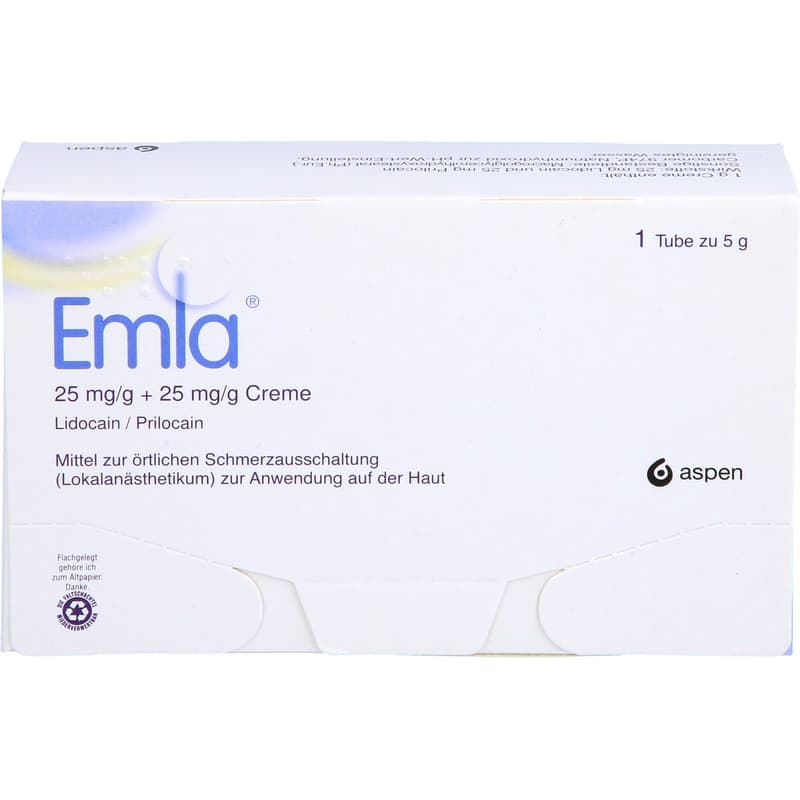
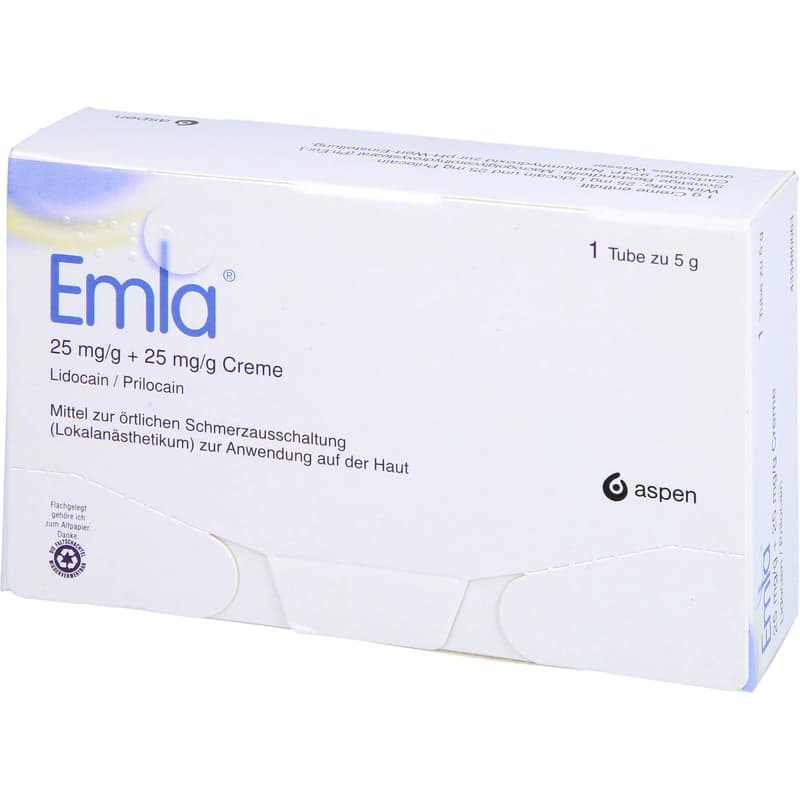
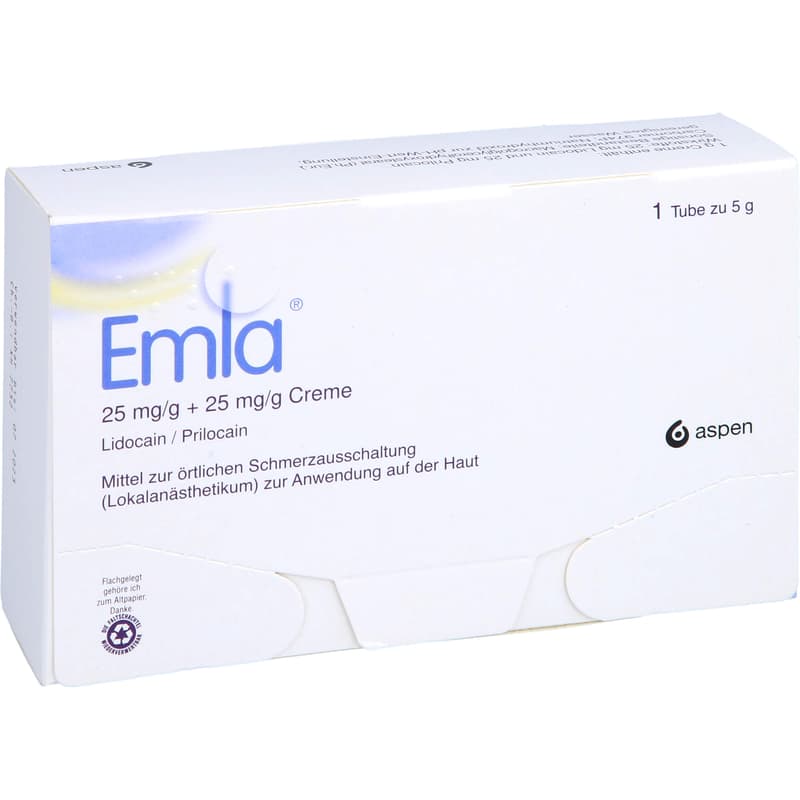
Die Emla Creme zur kurzzeitigen Betäubung der Hautoberfläche ist ideal vor medizinischen Eingriffen wie Nadelstichen oder kleineren Hautoperationen. Die Packung enthält eine 5 g Tube der wirksamen Creme mit den Wirkstoffen Lidocain und Prilocain sowie 2 praktische Tegaderm Pflaster zur optimalen Abdeckung. Ein zuverlässiger Helfer für eine schmerzarme Behandlung bei Erwachsenen und Kindern.
Zu Risiken und Nebenwirkungen lesen Sie die Packungsbeilage und fragen Sie Ihre Ärztin, Ihren Arzt oder in Ihrer Apotheke.




Beschreibung
Wichtige Hinweise (Pflichtangaben)
Emla 25 mg/g + 25 mg/g Creme. Anwendungsgebiete: Emla wirkt, indem es die Hautoberfläche kurzzeitig betäubt. Es wird vor bestimmten medizinischen Eingriffen auf die Haut aufgetragen.Zu Risiken und Nebenwirkungen lesen Sie die Packungsbeilage und fragen Sie Ihre Ärztin, Ihren Arzt oder in Ihrer Apotheke.
GEBRAUCHSINFORMATION: INFORMATION FÜR DEN ANWENDER
Emla 25 mg/g + 25 mg/g Creme
Wirkstoffe: Lidocain/Prilocain
Lesen Sie die gesamte Packungsbeilage sorgfältig durch, bevor Sie mit der Anwendung dieses Arzneimittels beginnen, denn sie enthält wichtige Informationen. Wenden Sie dieses Arzneimittel immer genau wie in dieser Packungsbeilage beschrieben bzw. genau nach Anweisung Ihres Arztes oder Apothekers an.
- Heben Sie die Packungsbeilage auf. Vielleicht möchten Sie diese später nochmals lesen.
- Fragen Sie Ihren Apotheker, wenn Sie weitere Informationen oder einen Rat benötigen.
- Wenn Sie Nebenwirkungen bemerken, wenden Sie sich an Ihren Arzt, Apotheker oder das medizinische Fachpersonal. Dies gilt auch für Nebenwirkungen, die nicht in dieser Packungsbeilage angegeben sind. Siehe Abschnitt 4.
- WAS IST EMLA UND WOFÜR WIRD ES ANGEWENDET?
- WAS SOLLTEN SIE VOR DER ANWENDUNG VON EMLA BEACHTEN?
- WIE IST EMLA ANZUWENDEN?
- WELCHE NEBENWIRKUNGEN SIND MÖGLICH?
- WIE IST EMLA AUFZUBEWAHREN?
- INHALT DER PACKUNG UND WEITERE INFORMATIONEN
Emla enthält zwei Wirkstoffe, die Lidocain und Prilocain heißen. Diese gehören zu einer Gruppe von Arzneimitteln, die Lokalanästhetika genannt werden. Emla wirkt, indem es die Hautoberfläche kurzzeitig betäubt. Es wird vor bestimmten medizinischen Eingriffen auf die Haut aufgetragen. Dies hilft, den Schmerz auf der Haut auszuschalten. Trotzdem kann es sein, dass Sie noch Druck oder Berührung spüren.
Erwachsene,
Jugendliche und Kinder
Es kann zur Betäubung der Haut angewendet werden vor:- einem Nadeleinstich (z.B. wenn Sie eine Injektion bekommen oder zur Blutabnahme).
- kleineren operativen Eingriffen an der Haut.
Erwachsene und Jugendliche
Es kann auch angewendet werden:- zur Betäubung der Genitalien vor:
- o einer Injektion.
- o medizinischen Eingriffen wie Warzenentfernung.
Erwachsene
Es kann auch zur Betäubung der Haut angewendet werden vor
Reinigung oder Entfernung von geschädigter Haut bei Beingeschwüren.Für alle anderen Anwendungen als das Aufträgen auf der intakten Haut, sollte das Arzneimittel nur auf Empfehlung des Arztes, des medizinischen Fachpersonals oder des Apothekers angewendet werden.
2. WAS SOLLTEN SIE VOR DER ANWENDUNG VON EMLA BEACHTEN?
Emla darf nicht angewendet werden, wenn Sie allergisch gegen Lidocain oder Prilocain, andere ähnliche Lokalanästhetika oder gegen einen der in Abschnitt 6 genannten sonstigen Bestandteile dieses Arzneimittels sind.
Warnhinweise und Vorsichtsmaßnahmen
Sprechen Sie mit Ihrem Arzt. Apotheker oder dem medizinischen Fachpersonal, bevor Sie Emla anwenden:- wenn Sie oder Ihr Kind eine seltene angeborene Krankheit haben, "Glukose–6–phosphat–Dehydrogenasemangel" genannt, die sich auf das Blut auswirkt.
- wenn Sie oder ihr Kind ein Problem mit der Blutkonzentration des Blutfarbstoffs Methämoglobin haben, "Methämoglobinämie" genannt.
- Mit Ausnahme von Beingeschwüren, wenden Sie Emla nicht auf Flächen mit Hautausschlag, Schnitten, Hautabschürfungen oder anderen offenen Wunden an. Wenn eines dieser Probleme auftritt, sprechen Sie mit Ihrem Arzt, Apotheker oder dem medizinischen Fachpersonal, bevor Sie die Creme anwenden.
- wenn Sie oder Ihr Kind eine juckende Hautkrankheit haben, "atopische Dermatitis" genannt, kann eine kürzere Einwirkdauer ausreichend sein. Eine Einwirkdauer länger als 30 Minuten kann zu einem vermehrten Auftreten von lokalen Gefäßreaktionen führen (siehe auch Abschnitt 4 "Welche Nebenwirkungen sind möglich?").
- wenn Sie spezielle Arzneimittel gegen Herzrhythmusstörungen ein nehmen (Antiarrhythmika der Klasse III, wie Amiodaron). In diesem Fall wird der Arzt Ihre Herzfunktion beobachten.
Kinder und Jugendliche
Bei Säuglingen/Neugeborenen jünger als 3 Monate wird bis zu 12 Stunden nach Aufträgen von Emla häufig ein vorübergehender, klinisch nicht bedeutender Anstieg der Konzentration des Blutfarbstoffes Methämoglobin im Blut beobachtet ("Methämoglobinämie"). Die Wirksamkeit von Emla bei der Blutentnahme an der Ferse von Neugeborenen oder hinsichtlich der Gewährleistung einer hinreichenden Analgesie bei einer Zirkumzision konnte in klinischen Studien nicht bestätigt werden. Aufgrund unzureichender Daten zur Wirkstoffaufnahme sollte Emla bei Kindern (unter 12 Jahren) nicht auf der genitalen Haut (z.B. Penis) und der genitalen Schleimhaut (z.B. in der Scheide) angewendet werden. Emla sollte nicht bei Kindern jünger als 12 Monate angewendet werden, die gleichzeitig mit anderen Arzneimitteln behandelt werden, die sich auf die Blutkonzentration des Blutfarbstoffes Methämoglobin ("Methämoglobinämie") auswirken (z.B. Sulfonamide, siehe auch im Abschnitt 2 "Anwendung von Emla zusammen mit anderen Arzneimitteln"). Emla sollte nicht bei Frühgeborenen angewendet werden.Anwendung von Emla zusammen mit anderen Arzneimitteln
Informieren Sie ihren Arzt oder Apotheker, wenn Sie andere Arzneimittel einnehmen/anwenden, kürzlich andere Arzneimittel eingenommen/angewendet haben oder beabsichtigen, andere Arzneimittel einzunehmen/anzuwenden. Dazu gehören auch rezeptfreie und pflanzliche Arzneimittel. Der Grund dafür ist, dass Emla die Wirkungsweise anderer Arzneimittel beeinflussen kann und andere Arzneimittel einen Einfluss auf Emla haben können. Teilen Sie Ihrem Arzt insbesondere mit, wenn Sie oder Ihr Kind kürzlich eines der folgenden Arzneimittel angewendet haben oder es Ihnen verabreicht wurde:- Arzneimittel, Sulfonamide genannt, die bei Infektionen angewendet werden, und Nitrofurantoin.
- Arzneimittel, Phenytoin und Phénobarbital genannt, die bei Epilepsie angewendet werden.
- Andere Lokalanästhetika.
- Arzneimittel zur Behandlung von unregelmäßigem Herzschlag, wie Amiodaron.
- Cimetidin oder Betablocker, die einen Anstieg der Lidocain–Konzentration im Blut verursachen können. Diese Wechselwirkung ist bei kurzzeitiger Behandlung mit Emla im Rahmen der empfohlenen Dosierungen klinisch nicht bedeutsam.
Gebärfähigkeit
Wenn Sie schwanger sind oder stillen, oder wenn Sie vermuten, schwanger zu sein oder beabsichtigen, schwanger zu werden, tragen Sie vor der Anwendung dieses Arzneimittels Ihren Arzt oder Apotheker um Rat. Es ist unwahrscheinlich, dass die gelegentliche Anwendung von Emla während der Schwangerschaft negative Auswirkungen auf das Ungeborene hat. Die Wirkstoffe in Emla (Lidocain und Prilocain) gehen in die Muttermilch über. Die Menge ist jedoch so gering, dass im Allgemeinen kein Risiko für das Kind besteht. Tierstudien zeigten keine Beeinträchtigung der männlichen oder weiblichen Zeugungs- bzw. Gebärfähigkeit.Verkehrstüchtigkeit und Fähigkeit zum Bedienen von Maschinen
Emla hat keinen oder einen zu vernachlässigenden Einfluss auf die Verkehrstüchtigkeit und die Fähigkeit zum Bedienen von Maschinen, wenn es in den empfohlenen Dosierungen angewendet wird.Emla enthält Macrogolglycerolhydroxystearat (Ph.Eur.
)
Macrogolglycerolhydroxystearat (Ph.Eur.). kann Hautreizungen hervorrufen.3. WIE IST EMLA ANZUWENDEN?
Wenden Sie dieses Arzneimittel immer genau wie in dieser Packungsbeilage beschrieben bzw. genau nach Absprache mit Ihrem Arzt, Apotheker oder dem medizinischen Fachpersonal an. Fragen Sie bei Ihrem Arzt, Apotheker oder dem medizinischen Fachpersonal nach, wenn Sie sich nicht sicher sind.
Anwendung von Emla:
- Wo die Creme aufgetragen wird, wie viel angewendet wird und wie lange sie auf der Haut verweilt, hängt davon ab, wofür sie benötigt wird. Eine halbe 5–g–Tube entspricht etwa 2 g Emla. Ein Gramm Emla Creme, das aus der Tube ausgepresst wird, ist etwa 3,5 cm lang.
- Emla sollte ausschließlich von einem Arzt oder dem medizinischen Fachpersonal auf Genitalien angewendet werden.
- Wird Emla auf Beingeschwüren angewendet, sollte ein Arzt oder das medizinische Fachpersonal die Anwendung überwachen.
- Schnitte, Hautabschürfungen oder Wunden, mit Ausnahme von Beingeschwüren.
- an Stellen mit Hautausschlag oder Ekzemen.
- an oder in der Nähe der Augen.
- in der Nase, dem Ohr oder dem Mund.
- In der Afterregion (Anus).
- an den Genitalien von Kindern.
Anwendung auf der Haut vor kleineren Eingriffen (wie bei einem Nadeleinstich oder kleineren Hautoperationen
)
- Eine dicke Schicht Creme wird aul die Haut aufgetragen. Folgen Sie den Anweisungen in der Packungsbeilage oder denen des medizinischen Fachpersonals. In bestimmten Fällen muss das medizinische Fachpersonal die Creme auftragen.
- Die Creme wird dann mit einem Pflaster abgedeckt (Plastikfolie). Dieses wird kurz vor Beginn des Eingriffs entfernt. Wenn Sie die Creme selbst auftragen, stellen Sie sicher, dass Ihnen von Ihrem Arzt, Apotheker oder dem medizinischen Fachpersonal Pflaster ausgehändigt wurden.
- Die übliche Dosis für Erwachsene und Jugendliche über 12 Jahre beträgt 2 g.
- Bei Erwachsenen und Jugendlichen über 12 Jahren wird die Creme mindestens 60 Minuten vor dem Eingriff aufgetragen (es sei denn, die Creme wird im Genitalbereich angewendet). Tragen Sie sie jedoch nicht mehr als 5 Stunden vor dem Eingriff auf.
Kinder
Anwendung auf der Haut vor kleineren Eingriffen (wie bei einem Nadeleinstich oder kleineren Hautoperationen)
Einwirkdauer: ca. 1 Stunde.Neugeborene und Säuglinge von 0 bis 2 Monaten
Bis zu 1 g Creme auf einer Hautfläche, die nicht größer als 10 cm2 (10 Quadratzentimeter) ist. Einwirkdauer: höchstens 1 Stunde. Es darf nur eine Einzeldosis innerhalb eines Zeitraumes von 24 Stunden angewendet werden.Säuglinge von 3 bis 11 Monaten
Bis zu 2 g Creme auf einer Hautfläche, die insgesamt nicht größer als 20 cm2 (20 Quadratzentimeter) ist. Einwirkdauer: ca. 1 Stunde, maximal 4 Stunden.Kinder von 1 bis 5 Jahren
Bis zu 10 g Creme auf einer Hautfläche, die insgesamt nicht größer als 100 cm2 (100 Quadratzentimeter) ist. Einwirkdauer: ca. 1 Stunde, maximal 5 Stunden.Kinder von 6 bis 11 Jahren
Bis zu 20 g Creme auf einer Hautfläche, die insgesamt nicht größer als 200 cm2 (200 Quadratzentimeter) ist. Einwirkdauer: ca. 1 Stunde, maximal 5 Stunden.Bei Kindern über 3 Monaten dürfen maximal 2 Dosen jeweils im Abstand von 12 Stunden innerhalb eines Zeitraumes von 24 Stunden angewendet werden. Emla Creme kann bei Kindern mit einer Hauterkrankung, die "atopische Dermatitis" genannt wird, angewendet werden, allerdings beträgt die Einwirkdauer dann nicht mehr als 30 Minuten.
Wenn Sie die Creme auftragen, ist es wichtig,
dass Sie exakt den folgenden Anweisungen folgen
- Drücken Sie ein Cremehäufchen aus der Tube an der Stelle aus, an der sie benötigt wird (zum Beispiel dort, wo der Nadeleinstich erfolgen soll). Eine halbe 5–g–Tube entspricht etwa 2 g Emla. Ein Gramm Emla Creme, das aus der Tube ausgepresst wird, ist etwa 3,5 cm lang. Massieren Sie die Creme nicht ein.
- Ziehen Sie die Papierschicht aus dem mittleren Ausschnitt des Pflasters auf der nicht klebenden Seite ab (es bleibt ein Rahmen aus Papier übrig).
- Ziehen Sie den Überzug auf der klebenden Seite des Pflasters ab.
- Legen Sie das Pflaster vorsichtig über das Cremehäufchen. Verteilen Sie die Creme unter dem Pflaster nicht.
- Entfernen Sie die Rückseite aus Papier. Drücken Sie die Ecken des Pflasters sorgfältig an. Dann belassen Sie es so für mindestens 60 Minuten.
- Ihr Arzt oder das medizinische Fachpersonal wird das Pflaster abnehmen und die Creme entfernen, direkt bevor sie den medizinischen Eingriff vornehmen (z.B. direkt vor dem Nadeleinstich).
)
Befolgen Sie hierbei die Anweisungen Ihres medizinischen Fachpersonals. Die übliche Dosis beträgt 1 g Creme für jede Hautfläche in der Größe von 10 cm2 (zehn Quadratzentimetern), für 1 bis 5 Stunden unter einem Pflaster aufgetragen. Emla sollte nicht auf einer frisch rasierten Hautfläche angewendet werden, die größer als 600 cm2 (600 Quadratzentimeter, z. B. 30 cm mal 20 cm) Ist, Die Maximaldosis beträgt 60 g.Anwendung auf der Haut vor stationären Eingriffen (z.B. Spalthauttransplantationen), die eine stärkere Betäubung der Haut erfordern:
- Emla kann auf diese Weise bei Erwachsenen und Jugendlichen über 12 Jahren angewendet werden, aber nur unter Aufsicht eines Arztes oder dem medizinischen Fachpersonal.
- Die übliche Dosis beträgt 1,5 g bis 2 g Creme für jede Hautfläche In der Größe von 10 cm2 (zehn Quadratzentimetern).
- Die Creme wird unter einem Pflaster für 2 bis 5 Stunden aufgetragen.
- Emla kann bei Kindern und Jugendlichen mit einer Hauterkrankung angewendet werden, die "atopische Dermatitis" genannt wird.
- Die übliche Dosis hängt von dem Alter des Kindes ab. Sie wird für 30 bis 60 Minuten (30 Minuten, wenn der Patient atopische Dermatitis hat) angewendet, ihr Arzt, das medizinische Fachpersonal oder der Apotheker wird Ihnen sagen, wie viel Creme Sie anwenden sollen.
- Emla kann auf diese Weise bei Erwachsenen und Jugendlichen über 12 Jahren nur von medizinischem Fachpersonal angewendet werden.
- Die übliche Dosis beträgt 1 g Creme (1 g bis 2 g auf der weiblichen Genitalhaut) für jede Hautfläche in der Größe von 10 cm2 (10 Quadratzentimeter).
- Die Creme wird aufgetragen und mit einem Pflaster abgedeckt. Dies geschieht für 15 Minuten auf der männlichen Genitalhaut und für 60 Minuten auf der weiblichen Genitalhaut.
)
- Emla kann auf diese Weise bei Erwachsenen und Jugendlichen über 12 Jahren nur von medizinischem Fachpersonal angewendet werden.
- Die übliche Dosis beträgt 5 g bis 10 g Creme für 10 Minuten. Es wird kein Pflaster verwendet. Der medizinische Eingriff sollte danach sofort beginnen.
Anwendung auf Beingeschwüren vor der Reinigung oder dem Entfernen von geschädigter Haut
Emla kann auf diese Weise bei Erwachsenen angewendet werden, aber nur unter Aufsicht eines Arztes oder von medizinischem Fachpersonal.- Die übliche Dosis beträgt 1 g bis 2 g Creme für jede Hautfläche in der Größe von 10 cm2 bis zu einer Gesamtdosis von 10 g.
- Die Creme wird unter einem luftdichten Pflaster, wie z. B. einer Plastikfolie, aufgetragen. Dies geschieht für 30 bis 60 Minuten, bevor das Geschwür gereinigt werden soll. Entfernen Sie die Creme mit Verbandmull und beginnen Sie ohne Verzögerung mit der Reinigung.
- Emla kann vor der Reinigung von Beingeschwüren bis zu 15 Mal über einen Zeitraum von 1 bis 2 Monaten angewendet werden.
- Emla ist für die Anwendung auf Beingeschwüren nur zum Einmalgebrauch vorgesehen. Entsorgen Sie die Tube mit dem restlichen Inhalt nach jeder Behandlung.
als Sie sollten
Wenn Sie eine größere Menge von Emla angewendet haben, als In dieser Packungsbeilage angegeben ist, oder eine größere Menge, als Ihr Arzt, Apotheker oder das medizinische Fachpersonal Ihnen gesagt hat, informieren Sie diese unverzüglich, auch wenn Sie keine Krankheitsanzeichen bemerken. Beschwerden nach der Anwendung einer zu großen Menge Emla sind unten aufgeführt. Es ist unwahrscheinlich, dass die Beschwerden auftreten, wenn Emla wie empfohlen angewendet wird.- Gefühl von Benommenheit oder Schwindel.
- Kribbeln um den Mund und Taubheit der Zunge.
- Ungewöhnlicher Geschmack.
- Verschwommenes Sehen.
- Klingeln im Ohr.
- Es besteht auch das Risiko einer "akuten Methämoglobinämie" (ein Problem mit der Blutfarbstoff–Konzentration). Dies ist wahrscheinlicher, wenn bestimmte Arzneimittel gleichzeitig genommen wurden. Wenn dies auftritt, wird die Haut aufgrund von Sauerstoffmangel bläulich–grau.
Wenn Sie weitere Fragen zur Anwendung dieses Arzneimittels haben, wenden Sie sich an Ihren Arzt, Apotheker oder das medizinische Fachpersonal.
4. WELCHE NEBENWIRKUNGEN SIND MÖGLICH?
Wie alle Arzneimittel kann auch dieses Arzneimittel Nebenwirkungen haben, die aber nicht bei jedem auftreten müssen. Wenn eine der aufgeführten Nebenwirkungen Sie beeinträchtigt oder Sie den Eindruck haben, dass sie nicht Weggehen, wenden Sie sich bitte an Ihren Arzt oder Apotheker. Informieren Sie Ihren Arzt über alles Weitere, was dazu führt, dass Sie sich unwohl fühlen, während Sie Emla anwenden. Eine leichte Reaktion (Blässe oder Rötung der Haut, leichte Schwellungen, anfängliches Brennen oder Jucken) kann auf der Fläche, auf der Emla angewendet wird, auftreten. Dies sind normale Reaktionen auf die Creme und die Anästhetika, die nach kurzer Zeit verschwinden, ohne dass Maßnahmen nötig sind. Wenn Sie unangenehme oder ungewöhnliche Wirkungen bemerken, während Sie Emla anwenden, beenden Sie die Anwendung und informieren Sie Ihren Arzt oder Apotheker so schnell wie möglich.
Häufig (kann bis zu 1 von 10 Behandelten betreffen
)
- Vorübergehende lokale Hautreaktionen (Blässe, Rötung, Schwellung) an der behandelten Fläche während der Behandlung der Haut, der Genitalschleimhaut oder von Beingeschwüren.
- Ein anfängliches leichtes Brennen, Jucken oder Wärmegefühl an der behandelten Fläche während der Behandlung der Genitalschleimhaut oder von Beingeschwüren.
)
- Ein anfängliches leichtes Brennen, Jucken oder Wärmegefühl an der behandelten Fläche während der Behandlung der Haut.
- Taubheit (Kribbeln) an der behandelten Fläche während der Behandlung der Genitalschleimhaut.
- Reizung der behandelten Haut während der Behandlung von Beingeschwüren.
)
- Allergische Reaktionen, die in seltenen Fällen zu einem anaphylaktischen Schock führen können (Hautausschlag, Schwellung, Fieber, Atembeschwerden und Ohnmacht) während der Behandlung der Haut, der Genitalschleimhaut oder von Beingeschwüren.
- Methämoglobinämie (Störung des Blutes) während der Behandlung der Haut.
- Kleine, punktförmige Blutung an der behandelten Fläche (besonders bei Kindern mit Ekzem nach längerer Einwirkdauer) während der Behandlung der Haut.
- Reizung der Augen, wenn Emla versehentlich während der Behandlung der Haut mit ihnen in Kontakt kommt.
Zusätzliche Nebenwirkungen bei Kindern
Methämoglobinämie, eine Störung des Blutes, die häufiger beobachtet wird, oft in Zusammenhang mit einer Überdosierung bei Neugeborenen und Säuglingen im Alter von 0 bis 12 Monaten.Meldung von Nebenwirkungen
Wenn Sie Nebenwirkungen bemerken, wenden Sie sich an Ihren Arzt oder Apotheker. Dies gilt auch für Nebenwirkungen, die nicht in dieser Packungsbeilage angegeben sind. Sie können Nebenwirkungen auch direkt dem Bundesinstitut für Arzneimittel und Medizinprodukte, Abt. Pharmakovigilanz, Kurt-Georg-Kiesinger Allee 3, D-53175 Bonn, Website: www.bfarm.de anzeigen. Indem Sie Nebenwirkungen melden, können Sie dazu beitragen, dass mehr Informationen über die Sicherheit dieses Arzneimittels zur Verfügung gestellt werden.5. WIE IST EMLA AUFZUBEWAHREN?
Bewahren Sie dieses Arzneimittel für Kinder unzugänglich auf. Sie dürfen dieses Arzneimittel nach dem auf dem Umkarton und der Tube nach "Verwendbar bis" angegebenen Verfalldatum nicht mehr verwenden. Das Verfalldatum bezieht sich auf den letzten Tag des angegebenen Monats. Bei Anwendung auf Beingeschwüren ist die Creme nur zum Einmalgebrauch vorgesehen. Entsorgen Sie die Tube mit dem restlichen Inhalt nach jeder Behandlung. Aufbewahrungsbedingungen: Nicht einfrieren. Entsorgen Sie Arzneimittel nicht im Abwasser oder Haushaltsabfall. Fragen Sie Ihren Apotheker, wie das Arzneimittel zu entsorgen ist, wenn Sie es nicht mehr verwenden. Sie tragen damit zum Schutz der Umwelt bei.
6. INHALT DER PACKUNG UND WEITERE INFORMATIONEN
Was Emla enthält
Die Wirkstoffe sind: Lidocain und Prilocain. 1 g Creme enthält: 25 mg Lidocain und 25 mg Prilocain. Die sonstigen Bestandteile sind: Macrogolglycerolhydroxystearat (Ph.Eur.)., Carbomer 974P, Natriumhydroxid zur pH-Wert-Einstellung, gereinigtes Wasser.Wie Emla aussieht und Inhalt der Packung
Emla ist eine ÖI-in-Wasser-Emulsion. Sie ist in Aluminiumtuben verpackt. Emla ist in Packungen mit 1 Tube zu 5 g Creme + 2 Tegaderm, 5 Tuben zu je 5 g Creme + 12 Tegaderm und 1 Tube zu 30 g Creme erhältlich. Es werden möglicherweise nicht alle Packungsgrößen in den Verkehr gebracht.Pharmazeutischer Unternehmer
Aspen Pharma Trading Limited3016 Lake Drive
City west Business Campus
Dublin 24
Irland
Tel.:0049 3056796862
Mitvertrieb
Aspen Germany GmbHMontgelasstraße 14
81679 München
Deutschland
Hersteller
AstraZeneca GmbH22876 Wedel
Hersteller Tegaderm
AstraZeneca AB15185 Södertälje
Schweden
Diese Gebrauchsinformation wurde zuletzt überarbeitet im November 2017.
Quelle: Angaben der Packungsbeilage
Stand: 10/2019
Anwendungsgebiete: Emla wirkt, indem es die Hautoberfläche kurzzeitig betäubt. Es wird vor bestimmten medizinischen Eingriffen auf die Haut aufgetragen.
Info-Broschüre
Info-Broschüre herunterladenZusammensetzung & Allergene
Zusammensetzung
Wirkstoff: Lidocain/Prilocain