

Max. 3 Stk.
Produkt aus:
Preussen
848€
Nur noch 7 Stück verfügbar
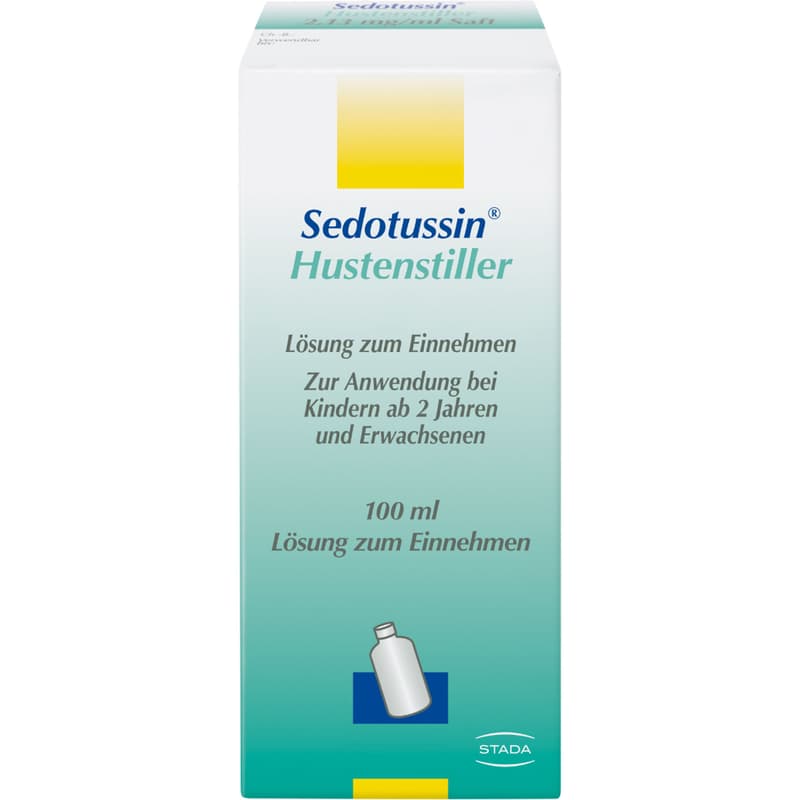
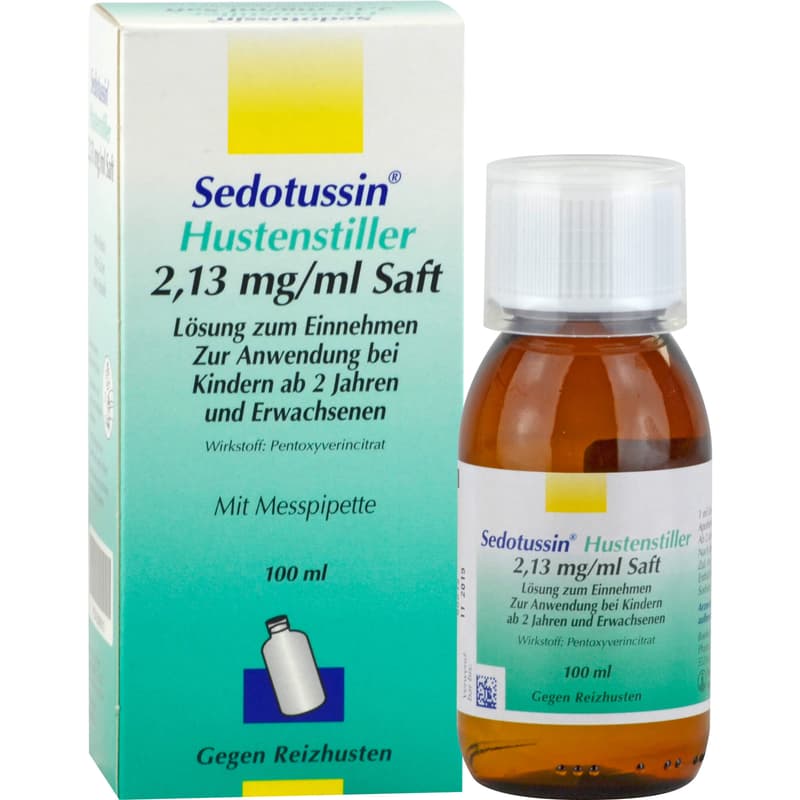
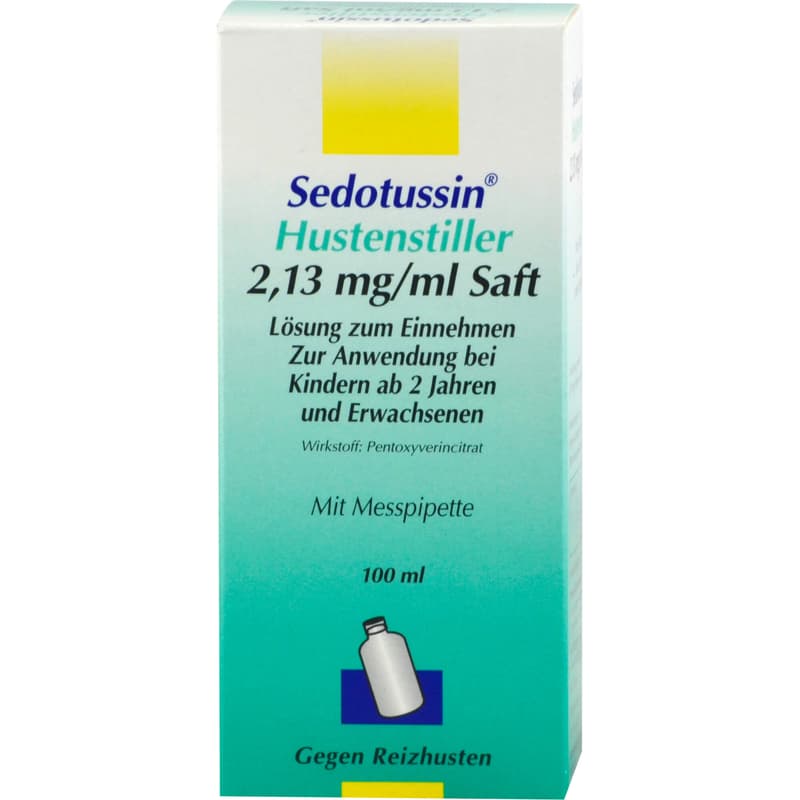
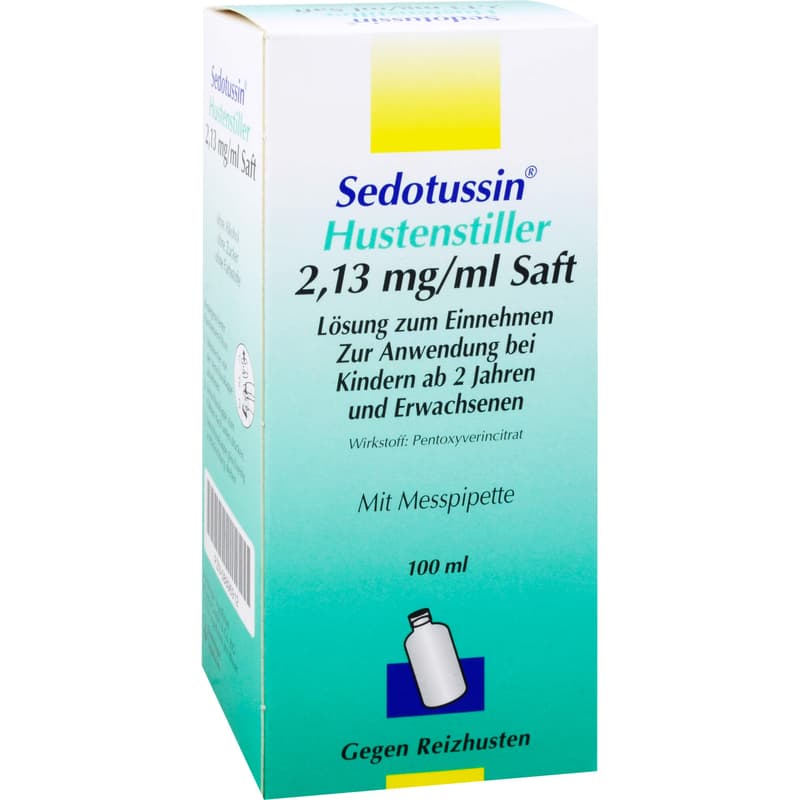
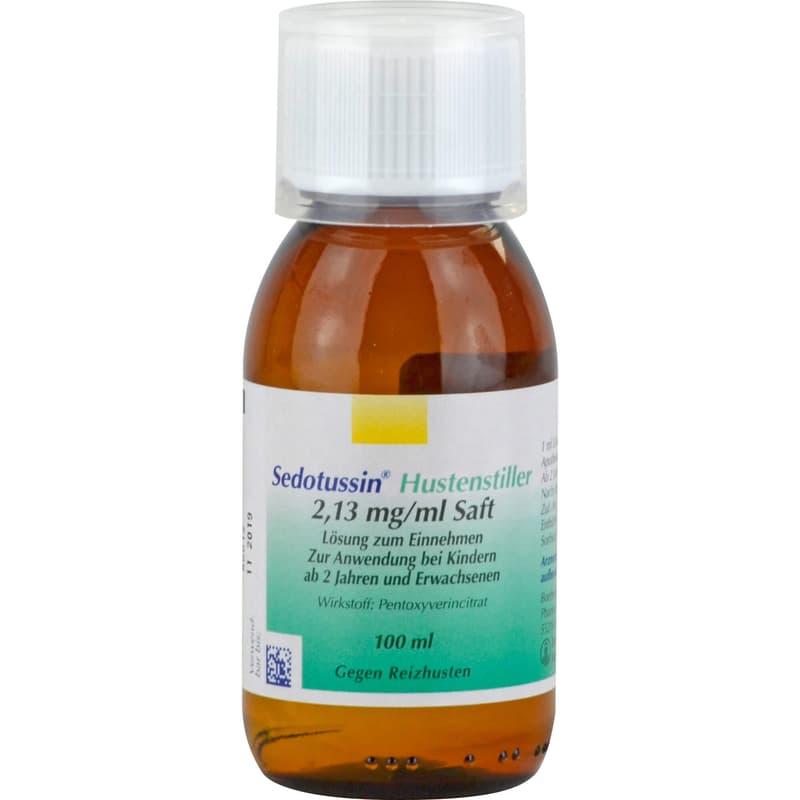
Der SEDOTUSSIN Hustenstiller Saft ist ein bewährtes Arzneimittel zur symptomatischen Behandlung von trockenem Reizhusten. Der Saft enthält den Wirkstoff Pentoxyverincitrat und ist für Erwachsene sowie Kinder ab 2 Jahren geeignet. Die praktische 100 ml Flasche kommt mit einer Messpipette und einem Messbecher für die präzise Dosierung. Bitte beachten Sie, dass dieses Produkt Sorbitol enthält.
Zu Risiken und Nebenwirkungen lesen Sie die Packungsbeilage und fragen Sie Ihre Ärztin, Ihren Arzt oder in Ihrer Apotheke.

Beschreibung
Wichtige Hinweise (Pflichtangaben)
Sedotussin Hustenstiller Saft. Wirkstoff: Pentoxyverincitrat. Anwendungsgebiete: zur symptomatischen Behandlung des Reizhustens (Antitussivum). Warnhinweis: enthält SorbitolZu Risiken und Nebenwirkungen lesen Sie die Packungsbeilage und fragen Sie Ihre Ärztin, Ihren Arzt oder in Ihrer Apotheke.
GEBRAUCHSINFORMATION: INFORMATION FÜR DEN ANWENDER
Sedotussin Hustenstiller 2,13 mg/ml Saft, Lösung zum Einnehmen zur Anwendung bei Kindern ab 2 Jahren und Erwachsenen
Wirkstoff: Pentoxyverincitrat
Lesen Sie die gesamte Packungsbeilage sorgfältig durch, bevor Sie mit der Einnahme dieses Arzneimittels beginnen, denn sie enthält wichtige Informationen. Nehmen Sie dieses Arzneimittel immer genau wie in dieser Packungsbeilage beschrieben bzw. genau nach Anweisung Ihres Arztes oder Apothekers ein.
- Heben Sie die Packungsbeilage auf. Vielleicht möchten Sie diese später nochmals lesen.
- Fragen Sie Ihren Apotheker, wenn Sie weitere Informationen oder einen Rat benötigen.
- Wenn Sie Nebenwirkungen bemerken, wenden Sie sich an Ihren Arzt oder Apotheker. Dies gilt auch für Nebenwirkungen, die nicht in dieser Packungsbeilage angegeben sind. Siehe Abschnitt 4.
- Wenn Sie sich innerhalb von 2 Wochen nicht besser oder gar schlechter fühlen, wenden Sie sich an Ihren Arzt.
Was in dieser Packungsbeilage steht
- WAS IST SEDOTUSSIN HUSTENSTILLER SAFT UND WOFÜR WIRD ER ANGEWENDET?
- WAS MÜSSEN SIE VOR DER EINNAHME VON SEDOTUSSIN HUSTENSTILLER SAFT BEACHTEN?
- WIE IST SEDOTUSSIN HUSTENSTILLER SAFT EINZUNEHMEN?
- WELCHE NEBENWIRKUNGEN SIND MÖGLICH?
- WIE IST SEDOTUSSIN HUSTENSTILLER SAFT AUFZUBEWAHREN?
- INHALT DER PACKUNG UND WEITERE INFORMATIONEN
Sedotussin Hustenstiller Saft ist ein Arzneimittel zur symptomatischen Behandlung des Reizhustens (Antitussivum).
2. WAS MÜSSEN SIE VOR DER EINNAHME VON SEDOTUSSIN HUSTENSTILLER SAFT BEACHTEN?
Sedotussin Hustenstiller Saft darf nicht eingenommen werden,
- wenn Sie überempfindlich (allergisch) gegen Pentoxyverin, Methyl-4-hydroxybenzoat, Propyl-4-hydroxybenzoat oder einen der in Abschnitt 6. genannten sonstigen Bestandteile dieses Arzneimittels sind.
- von Kindern unter 2 Jahren.
- bei gestörter Atmung (Ateminsuffizienz) oder Dämpfung des zentralen Nervensystems.
- bei Funktionsstörungen der Leber (Leberinsuffizienz).
- während der Schwangerschaft.
- während der Stillzeit.
Warnhinweise und Vorsichtsmaßnahmen
Bitte sprechen Sie mit Ihrem Arzt oder Apotheker, bevor Sie dieses Arzneimittel einnehmen.Besondere Vorsicht bei der Einnahme von Sedotussin Hustenstiller Saft ist in folgenden Fällen erforderlich:
- Eine kombinierte Anwendung von Präparaten mit schleimlösender und hustenstillender Wirkung kann die Therapie des produktiven Hustens (Husten mit Auswurf) verbessern, wobei tagsüber die Schleimlösung und nachts die Hustenstillung empfohlen wird. Bei einem Husten mit erheblicher Schleimproduktion sollten Sie jedoch nur nach Rücksprache mit Ihrem Arzt oder Apotheker ein hustenstillendes Mittel wie Sedotussin Hustenstiller Saft anwenden, da unter diesen Umständen eine geringere Empfindlichkeit gegenüber Hustenreizen mit Abnahme der Hustenhäufigkeit unerwünscht sein kann.
- Patienten, die trotz ärztlich verordneter Standardtherapie weiterhin unter einem trockenen asthmatischen Husten leiden, können auf Anraten des Arztes zusätzlich kurzfristig Sedotussin Hustenstiller Sah zur Symptomlinderung anwenden.
- Bei Patienten mit Funktionsstörungen der Nieren (Niereninsuffizienz) sowie bei älteren Patienten, da für diese Patientengruppen keine ausreichenden Daten zur Anwendung vorliegen.
- Wenn Sie an erhöhtem Augeninnendruck (Glaukom) oder gutartiger Vergrößerung der Prostata (Prostatahyperplasie) leiden.
Kinder
Sedotussin Hustenstiller Saft darf bei Kindern in den ersten zwei Lebensjahren nicht angewendet werden. In Einzelfällen wurden insbesondere bei Kleinkindern Krampfanfälle und eine Verminderung der Atemtätigkeit gesehen, weshalb Kleinkinder nach der Einnahme von Sedotussin Hustenstiller Saft sorgfältig zu beobachten sind.Einnahme von Sedotussin Hustenstiller Saft zusammen mit anderen Arzneimitteln
Informieren Sie Ihren Arzt oder Apotheker, wenn Sie andere Arzneimittel einnehmen/anwenden, kürzlich andere Arzneimittel eingenommen/angewendet haben oder beabsichtigen andere Arzneimittel einzunehmen/anzuwenden. Es sollen zusammen mit Sedotussin Hustenstiller Saft keine Arzneimittel angewendet werden, die dämpfend auf Gehirn und Psyche wirken (z.B. Beruhigungs- und Schlafmittel), da es zu einer Verstärkung der bewusstseinsvermindernden (sedierenden) und atmungsvermindernden (atemdepressiven) Wirkung von Sedotussin Hustenstiller Saft kommen kann. Wechselwirkungen mit Arzneimitteln, die wie Pentoxyverin hauptsächlich über das Enzymsystem Cytochrom P450-2D6 verstoffwechselt werden, sind möglich. Zu diesen Substanzen zählen u.a. Wirkstoffe aus der Gruppe der Antidepressiva (z.B. Paroxetin, Fluoxetin) und der Antiarrhythmika (z.B. Propafenon). Bitte fragen Sie Ihren Arzt, wenn Sie sich nicht sicher sind, ob Sie zur Zeit eines der Medikamente dieser Gruppe einnehmen.Einnahme von Sedotussin Hustenstiller Saft zusammen mit Nahrungsmitteln und Getränken
Nehmen Sie keinen Alkohol zu sich, da Alkohol in Verbindung mit Sedotussin Hustenstiller Saft das Reaktionsvermögen erheblich beeinträchtigt.Schwangerschaft,
Stillzeit und Zeugungs- und Gebärfähigkeit
Wenn Sie schwanger sind oder stillen, oder wenn Sie vermuten, schwanger zu sein oder beabsichtigen, schwanger zu werden, fragen Sie vor der Einnahme dieses Arzneimittels Ihren Arzt oder Apotheker um Rat.Schwangerschaft
Sedotussin Hustenstiller Saft darf in der Schwangerschaft nicht eingenommen werden, weil hierfür keine genügenden Erfahrungen vorliegen. Bei versehentlicher Einnahme in der Schwangerschaft sind keine schädigenden Einflüsse auf das Ungeborene zu erwarten. Trotzdem sollte die Behandlung sofort abgebrochen werden.Stillzeit
Der Wirkstoff von Sedotussin Hustenstiller Saft geht in die Muttermilch über. Wegen des Risikos unerwünschter Wirkungen beim Säugling darf Sedotussin Hustenstiller Saft daher in der Stillzeit nicht eingenommen werden.Zeugungs- und Gebärfähigkeit
Tierexperimentelle Studien mit Pentoxyverin im Hinblick auf die Fruchtbarkeit wurden nicht durchgeführt. Der Effekt auf die Zeugungs- oder Gebärfähigkeit beim Menschen wurde nicht in Studien untersucht.Verkehrstüchtigkeit und das Bedienen von Maschinen
Dieses Arzneimittel kann auch bei bestimmungsgemäßem Gebrauch gelegentlich zu Müdigkeit führen. Da Müdigkeit das Reaktionsvermögen verändern kann, besteht die Möglichkeit, dass die Fähigkeit zur aktiven Teilnahme am Straßenverkehr oder zum Bedienen von Maschinen beeinträchtigt ist.Sedotussin Hustenstiller Saft enthält Sorbitol
Bitte nehmen Sie Sedotussin Hustenstiller Saft daher erst nach Rücksprache mit Ihrem Arzt ein, wenn Ihnen bekannt ist, dass Sie unter einer Unverträglichkeit gegenüber bestimmten Zuckern leiden. Der Kalorienwert beträgt 2,6 kcal/g Sorbitol. Sorbitol kann eine leicht abführende Wirkung haben. Hinweis für Diabetiker: 10 ml Lösung enthalten 2,1 g Sorbitol (=0,18 BE).3. WIE IST SEDOTUSSIN HUSTENSTILLER SAFT EINZUNEHMEN?
Nehmen Sie dieses Arzneimittel immer genau wie in dieser Packungsbeilage beschrieben bzw. genau nach der mit Ihrem Arzt oder Apotheker getroffenen Absprache ein. Fragen Sie bei Ihrem Arzt oder Apotheker nach, wenn Sie sich nicht sicher sind.
Die empfohlene Dosis beträgt
Kinder im Alter von 2 bis 5 Jahren nehmen Sedotussin Hustenstiller Saft gemäß ihrem Körpergewicht ein. Die Einzelgaben sind dabei gleichmäßig über den Tag zu verteilen.| Körpergewicht des Kindes | Tägliche Einnahmemenge von Sedotussin Hustenstiller Saft |
| 11 bis 13 kg | 4-mal täglich 1,25 bis 2 ml |
| 13 bis 15 kg | 3 - 4-mal täglich 2 bis 2,5 ml |
| 15 bis 17 kg | 4-mal täglich 1,75 bis 2,75 ml |
| 17 b is 19 kg | 3 - 4-mal täglich 2,5 bis 3 ml |
| 19 bis 21 kg | 4-mal täglich 2 bis 3,5 ml |
| 21 bis 23 kg | 3-mal täglich 3 bis 5 ml |
| 23 bis 25 kg | 4-mal täglich 2,5 bis 4,25 ml |
Kinder im Alter von 6 bis 13 Jahren nehmen Sedotussin Hustenstiller Saft gemäß ihrem Körpergewicht ein. Die Einzelgaben sind dabei gleichmäßig über den Tag zu verteilen. Bei einem Körpergewicht unter 25 kg ist die Dosierungstabelle der 2 - 5-jährigen anzuwenden.
| Körpergewicht des Kindes | Tägliche Einnahmemenge von Sedotussin Hustenstiller Saft | |
| Angabe in ml Lösung (Saft) | Abmessung im Messbecher | |
| 25 bis 30 kg | 5-mal täglich je 5 ml, bei Bedarf 3-mal täglich je 10 ml | Messbecher jeweils bis zur 5-ml oder 10-ml-Marke füllen |
| 30 bis 35 kg | 3-mal täglich je 10 ml, bei Bedarf 4-mal täglich je 10 ml | Messbecher jeweils bis zur 10-ml-Marke füllen |
| 35 bis 40 kg | 3-mal täglich je 10 ml, bei Bedarf 5-mal täglich je 10 ml | Messbecher jeweils bis zur 10-ml-Marke füllen |
| 40 bis 45 kg | 4-mal täglich je 10 ml, bei Bedarf 5-mal täglich je 10 ml | Messbecher jeweils bis zur 10-ml-Marke füllen |
| 45 bis 50 kg | 4-mal täglich je 10 ml, bei Bedarf 4-mal täglich je 15 ml | Messbecher jeweils bis zur 10-ml-Marke oder 15-ml-Marke füllen |
| 50 bis 55 kg | 3-mal täglich je 15 ml, bei Bedarf 4-mal täglich je 15 ml | Messbecher jeweils bis zur 15-ml-Marke füllen |
| 55 bis 60 kg | 3-mal täglich je 15 ml, bei Bedarf 5-mal täglich je 15 ml | Messbecher jeweils bis zur 15-ml-Marke füllen |
| über 60 kg | Einnahme wie bei Erwachsenen |
Erwachsene und Jugendliche ab 14 Jahren
nehmen 3-mal bis 4-mal täglich je 15 ml Saft (jeweils 1 Messbecher bis zur 15-ml-Marke t) (entsprechend 60 bis 80 mg Pentoxyverin täglich). Bei Bedarf kann die Einnahmemenge insgesamt auf bis zu 90 ml täglich (bis zu 6 Messbecher, bis zur 15-ml-Marke gefüllt) (entsprechend 120 mg Pentoxyverin täglich) - über den Tag verteilt - gesteigert werden.Sedotussin Hustenstiller Saft wird mit Hilfe der beiliegenden Messpipette (für Dosierungen bis 5 ml) oder des beigefügten Messbechers (für Dosierungen ab 5 ml) unverdünnt oder mit etwas Flüssigkeit eingenommen.
Anwendung der Pipette
- Nach Öffnen der Flasche die Pipette mit dem unteren Ende ca. 2 cm in die Flüssigkeit tauchen.
- Dann den inneren Teil der Pipette nach oben ziehen, bis die gewünschte ml-Menge oberhalb des Ringes erscheint. Die erforderliche Menge entnehmen Sie bitte dem Dosierungsschema.
- Die abgemessene Dosis kann jetzt durch Herunterdrücken des inneren Teils der Pipette verabreicht werden.
Sedotussin Hustenstiller Saft darf ohne Zustimmung Ihres Arztes nicht länger als 2 Wochen eingenommen werden. Wenn der Husten länger als 2 Wochen anhält, ist eine genaue Abklärung der Krankheitsursache durch Ihren Arzt erforderlich. Bitte sprechen Sie mit Ihrem Arzt oder Apotheker, wenn Sie den Eindruck haben, dass die Wirkung von Sedotussin Hustenstiller Saft zu stark oder zu schwach ist.
Wenn Sie eine größere Menge Sedotussin Hustenstiller Saft eingenommen haben,
als sollten
Bei Einnahme erheblich zu hoher Arzneimengen kommt es zu Symptomen des zentralen Nervensystems und des Magen-Darm-Traktes wie z.B. Verminderung des Atemantriebs, Benommenheit und Erbrechen sowie anticholinergen Effekten wie Harnverhalt, erhöhtem Augeninnendruck, beschleunigtem Herzschlag, Verschwommensehen, Erregtheit, Halluzinationen. Rufen Sie in solch einem Fall den nächst erreichbaren Arzt zu Hilfe, der über die weiteren dänischen Maßnahmen entscheiden wird.Wenn Sie die Einnahme von Sedotussin Hustenstiller Saft vergessen haben
Wenn Sie einmal vergessen haben Sedotussin Hustenstiller Saft einzunehmen, oder zu wenig eingenommen haben, setzen Sie bitte zum nächsten Zeitpunkt die Einnahme von Sedotussin Hustenstiller Saft fort, wie in der Dosierungsanleitung beschrieben.4. WELCHE NEBENWIRKUNGEN SIND MÖGLICH?
Wie alle Arzneimittel kann Sedotussin Hustenstiller Saft Nebenwirkungen haben, die aber nicht bei jedem auftreten müssen.
| Bei den Häufigkeitsangaben zu Nebenwirkungen Werden folgende Kategorien zugrunde gelegt: | |
| Sehr häufig: | mehr als 1 Behandelter von 10 |
| Häufig: | 1 bis 10 Behandelte von 100 |
| Gelegentlich: | 1 bis 10 Behandelte von 1 000 |
| Selten: | 1 bis 10 Behandelte von 10 000 |
| Sehr selten: | weniger als 1 Behandelter von 10 000 |
| Nicht bekannt: | Häufigkeit auf Grundlage der verfügbaren Daten nicht abschätzbar. |
Erkrankungen des Nervensystems:
- Gelegentlich: Schläfrigkeit
- Sehr selten: Krampfanfälle (insbesondere bei Kleinkindern)
- Sehr selten: Atemnot (meistens berichtet im Zusammenhang mit allergischen Reaktionen), Verminderung der Atemtätigkeit (insbesondere bei Kleinkindern)
- Häufig: Oberbauchschmerzen, Durchfall, Übelkeit, Erbrechen
- Sehr selten: Schwellungen im Kopf–Hals–Bereich (angioneurotisches Ödem), Ausschlag (Exanthem), Nesselsucht
- Gelegentlich: Müdigkeit mit Erschöpfung
- Sehr selten: Überempfindlichkeitsreaktionen, auch schwere Formen (anaphylaktische Reaktionen)
Meldung von Nebenwirkungen
Wenn Sie Nebenwirkungen bemerken, wenden Sie sich an Ihren Arzt oder Apotheker. Dies gilt auch für Nebenwirkungen, die nicht in dieser Packungsbeilage angegeben sind. Sie können Nebenwirkungen auch direkt dem Bundesinstitut für Arzneimittel und Medizinprodukte, Abt. Pharmakovigilanz, Kurt-Georg-Kiesinger-Allee 3, D-53175 Bonn, Website: www.bfarm.de anzeigen. Indem Sie Nebenwirkungen melden, können Sie dazu beitragen, dass mehr Informationen über die Sicherheit dieses Arzneimittels zur Verfügung gestellt werden.5. WIE IST SEDOTUSSIN HUSTENSTILLER SAFT AUFZUBEWAHREN?
Bewahren Sie dieses Arzneimittel für Kinder unzugänglich auf. Sie dürfen dieses Arzneimittel nach dem auf dem Etikett und dem Umkarton nach "Verwendbar bis" angegebenen Verfalldatum nicht mehr verwenden. Das Verfalldatum bezieht sich auf den letzten Tag des angegebenen Monats. Aufbewahrungsbedingungen: Für dieses Arzneimittel sind keine besonderen Lagerungsbedingungen erforderlich. Hinweis auf die Haltbarkeit nach Anbruch: Die Haltbarkeit nach dem ersten Öffnen der Flasche beträgt 6 Monate. Entsorgen Sie dieses Arzneimittel nicht im Abwasser. Fragen Sie Ihren Apotheker wie das Arzneimittel zu entsorgen ist, wenn Sie es nicht mehr benötigen. Sie tragen damit zum Schutz der Umwelt bei.
6. INHALT DER PACKUNG UND WEITERE INFORMATIONEN
Sedotussin Hustenstiller Saft enthält
Der Wirkstoff ist Pentoxyverin (als Pentoxyverincitrat). 10 ml Lösung zum Einnehmen (Saft) enthalten 21,3 mg Pentoxyverincitrat (entsprechend 13,5 mg Pentoxyverin). 5 ml Lösung zum Einnehmen (Saft) enthalten 10,65 mg Pentoxyverincitrat (entsprechend 6,75 mg Pentoxyverin). Die sonstigen Bestandteile sind: Citronensäure-Monohydrat, Natriumcitrat-Dihydrat, Glycerol 85%, Propylenglycol, Sorbitol-Lösung 70% (nicht kristallisierend), Saccharin-Natrium, Methyl-4-hydroxybenzoat, Propyl-4-hydroxybenzoat, Aromastoffe, gereinigtes Wasser.Wie Sedotussin Hustenstiller Saft aussieht und Inhalt der Packung
Sedotussin Hustenstiller Saft ist eine klare, farblose Flüssigkeit in einer Braunglasflasche mit kindergesichertem Schraubverschluss. Packung mit 100 ml Lösung zum Einnehmen.- Der beigefügte Messbecher ist ein Medizinprodukt und trägt die Kennzeichnung 0373. Hersteller des Messbechers: Bormioli Rocco B.U. Plastica, Strada Nazionale, Via Emilia 58, I–43010 Castelguelfo.
- Die beiliegende Messpipette ist ein Medizinprodukt und trägt die Kennzeichnung 0459. Hersteller der Messpipette: Rovipharm, Z.A. de Lucinges, F–01370 Treffort–Cuisiat.
Kindergesicherter Flaschenverschluss
- Messbecher von der Verschlusskappe abnehmen.
- Verschlusskappe zum Öffnen nach unten drücken.
- Verschlusskappe gleichzeitig in Pfeilrichtung drehen.
Pharmazeutischer Unternehmer und Hersteller
Pharmazeutischer Unternehmer
Sanofi-Aventis Deutschland GmbH65926 Frankfurt am Main
Postanschrift
Postfach 80 08 6065908 Frankfurt am Main
Telefon: 0800 56 56 010
Telefax: 0800 56 56 011
Hersteller
Next Pharma SAS 17Route de Meulan
78520 Limay
Frankreich
Diese Gebrauchsinformation wurde zuletzt überarbeitet im Juni 2017.
Quelle: Angaben der Packungsbeilage
Stand: 11/2017
Wirkstoff: Pentoxyverincitrat. Anwendungsgebiete: zur symptomatischen Behandlung des Reizhustens (Antitussivum). Warnhinweis: enthält Sorbitol
Info-Broschüre
Info-Broschüre herunterladenZusammensetzung & Allergene
Zusammensetzung
Wirkstoff: Pentoxyverincitrat