

Produkt aus:
Preussen
1999€
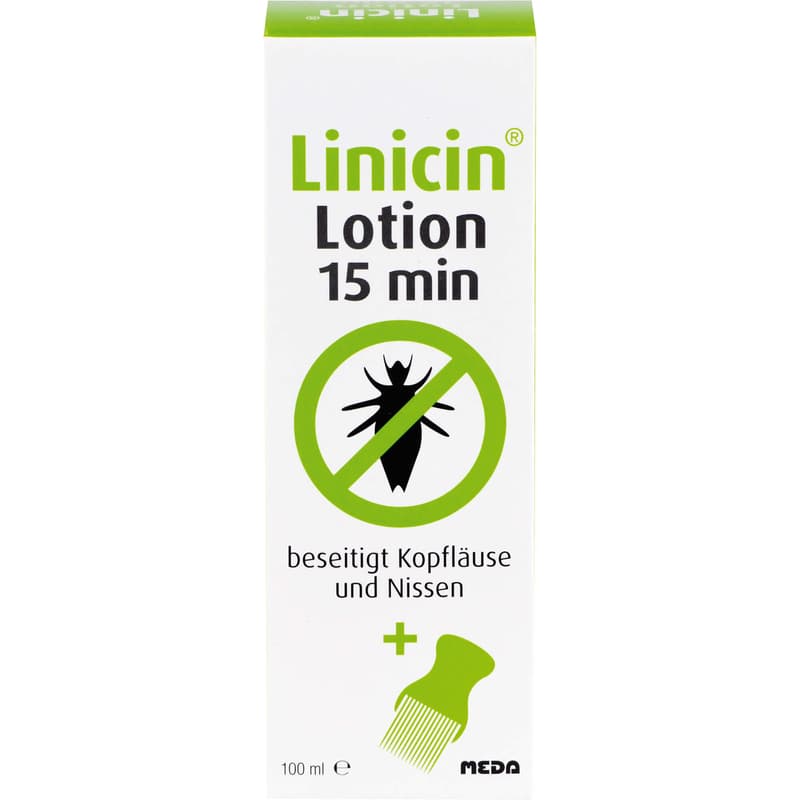
Die LINICIN Lotion ist eine schnelle und effektive Lösung gegen Kopfläuse, die bereits nach 15 Minuten wirkt. Diese milde, ungiftige Lotion erstickt Läuse ohne Insektizide und verhindert die Entwicklung von Nissen. Sie ist sicher für Erwachsene und Kinder ab 6 Monaten, auch während Schwangerschaft und Stillzeit. Die 100 ml Packung enthält zudem einen feinzinkigen Kamm für eine gründliche Anwendung. Ideal für eine sanfte und doch kraftvolle Behandlung.
Beschreibung
Produkteigenschaften
Lesen Sie die gesamte Packungsbeilage sorgfältig durch, bevor Sie Linicin Lotion anwenden.
Was ist Linicin Lotion?
Linicin Lotion beseitigt Kopfläuse und verhindert die Entstehung von Nissen (Läuseeier). Es kann bei Erwachsenen und Kindern ab 6 Monaten angewendet werden. Ebenso kann es während der Schwangerschaft und Stillzeit verwendet werden. Linicin Lotion ist leicht anzuwenden und wirkt innerhalb von 15 Minuten. Es ist eine ungiftige und sehr milde Lotion mit Inhaltsstoffen wie sie in Kosmetika und Salben auch bei Kindern verwendet werden. Linicin Lotion wurde nicht an Tieren getestet. Kopfläuse können gegen Linicin Lotion keine Resistenz entwickeln, da Linicin Lotion keine Insektizide enthält, sondern die Läuse erstickt werden.
Linicin Lotion enthält
1. Linicin Lotion 100 ml Fläschchen: Inhaltsstoffe (INCI):Dimethicone, tocopheryl acetate (Vitamin E), prunus dulcis (Mandelöl), prunus armeniaca (Aprikosenkernöl).
2. Schmal gezähnter rostfreier Stahlkamm.
3. Gebrauchsanweisung mit Informationen über Kopfläuse und Hinweise zur Anwendung.
Heben Sie die Packungsbeilage auf. Vielleicht möchten Sie diese später nochmals lesen.
Was sind Kopfläuse?
Kopfläuse sind flügellose, Blut saugende Insekten. Diese Parasiten ernähren sich von menschlichem Blut. Kopfläuse und Nissen (Läuseeier) befinden sich oftmals hinter den Ohren, entlang des Haaransatzes und im Nacken, da diese Bereiche warm und dunkel sind. Die Farbe einer Laus kann von sandfarben bis nahezu schwarz variieren. Nachdem sie Blut gesaugt haben, werden sie dunkelrot. Eine erwachsene Laus ist 24 mm lang. Die Nissen erreichen kaum 1 mm und sind weiß. Sie können Sandkörnern oder Schuppen ähneln und finden sich oft am Haaransatz. Es gibt 3 Stadien im Leben einer Kopflaus: Die Nisse, die Nymphe und das erwachsene Tier. Die erwachsene weibliche Laus legt die Nissen mittels eines Klebstoffes nicht mehr als 1 mm von der Kopfhaut entfernt am Haar ab. Die Nissen bleiben am Haar kleben. Das heißt, je länger das Haar, desto weiter entfernt von der Kopfhaut befindet sich die Laus. Nach maximal 10 Tagen schlüpft die Nymphe aus der Nisse. Nach weiteren maximal 12 Tagen wird aus der Nymphe eine erwachsene Laus. Der gesamte Lebenszyklus von der Nisse bis zur erwachsenen Laus dauert ungefähr 3 Wochen. Der Befall mit Kopfläusen geschieht über direkten Kontakt und wird üblicherweise unter Kindern beim Spielen weiter gegeben. Kappen, Tücher, Bürsten und ähnliche Utensilien können ebenso zur Verbreitung beitragen, wenn sie von verschiedenen Kindern innerhalb kurzer Zeit benutzt werden.
Wie wird Linicin Lotion angewendet?
Folgen Sie den Anweisungen sorgfältig, um den Läusebefall sicher loszuwerden.
1. Behandeln Sie nur trockene Haare mit Linicin Lotion
Zuvor legen Sie ein helles Handtuch über die Schulter der zu behandelnden Person. Schrauben Sie den kleinen Schraubverschluss von der Spitze der Applikationsflasche ab. Streichen Sie mit der Flaschenspitze gleichmäßig die Lotion über die gesamte Kopfhaut. Arbeiten Sie von der Stirn bis zum Scheitel. Fahren Sie so fort, indem Sie vom Scheitel bis zu den Ohren und vom Scheitel bis zum Nacken streichen. Reiben Sie die Linicin Lotion sorgfältig in die Kopfhaut und das gesamte Haar ein. Verwenden Sie reichlich Linicin Lotion, um das gesamte Haar von der Kopfhaut bis zu den Haarspitzen zu bedecken. Die benötigte Menge hängt dabei vom Haartyp und der Haarlänge ab. Die Behandlung eines durchschnittlichen schulterlangen Haares benötigt etwa 3050 ml der Lotion.
2. Lassen Sie die Linicin Lotion im Haar 15 Minuten einwirken.
Während dieser Zeit sterben die Läuse. Die Nissen werden in Ihrer Entstehung gehemmt, so dass die meisten nicht mehr ausschlüpfen. Die toten Nissen bleiben am Haar kleben.
3. Waschen Sie die Linicin Lotion mit handelsüblichem Shampoo aus
Verwenden Sie ausreichend Shampoo ohne Wasser und verreiben es im Haar. Danach spülen Sie die Haare gründlich mit Wasser aus. Falls notwendig, wiederholen Sie diesen Schritt nochmals, um den Eindruck fetten Haares zu vermeiden. Bei langem Haar empfiehlt sich der Einsatz einer Haarspülung, um das Kämmen zu erleichtern.
4. Kämmen Sie das feuchte Haar sorg fältig
Verwenden Sie den beigepackten Läusekamm, um die toten Läuse auszukämmen. Kämmen Sie jede Sektion des Haares systematisch. Achten Sie beim Kämmen auf gute Beleuchtung, z.B. Tageslicht. Spülen oder wischen Sie den Kamm nach jedem Kammstrich gut ab, um die toten Läuse und Nissen zu entfernen. Die toten Nissen sollten mit der Hand aus dem Haar entfernt werden.
5. Wiederholen Sie die Behandlung nach 9-10 Tagen
Wiederholen Sie Schritt 1 - 4 nach 9 - 10 Tagen, um frisch geschlüpfte Läuse zu entfernen. Dies ermöglicht den Lebenszyklus der Kopfläuse vollständig zu unterbrechen, was wiederum für eine erfolgreiche Behandlung sehr wichtig ist. Linicin Lotion verhindert die Entstehung von Nissen.
Wichtige Hinweise
o Wenn ein Befall mit Kopfläusen bei anderen Familienmitgliedern vorliegt, sollten auch diese am gleichen Tag mit Linicin Lotion behandelt werden, um einen Wiederbefall zu verhindern. Verwenden Sie den Läusekamm zur Läusekontrolle am Haar anderer Familienmitglieder.
o Wenn ein Wiederbefall zwischen der ersten und der zweiten Behandlung stattfindet (z. B. durch direkten Kontakt mit Personen, die von Läusen befallen sind), führen Sie sofort eine Behandlung mit Linicin Lotion durch. Wiederholen Sie diese nach 9 - 10 Tagen. Das Produkt kann sicher mehrmals angewendet werden.
o Linicin Lotion kann von Erwachsenen und Kindern ab einem Alter von 6 Monaten sowie während der Schwangerschaft und Stillzeit verwendet werden
o Linicin Lotion kann leichte Augenentzündungen hervorrufen. Vermeiden Sie daher jeglichen Augenkontakt. Falls dies doch geschehen ist, spülen Sie gut mit Wasser.
o Linicin Lotion darf nicht von Personen verwendet werden, die auf einen der Inhaltsstoffe überempfindlich reagieren. Wenn Sie nicht sicher sind, probieren Sie vor der ersten Anwendung eine kleine Menge Linicin Lotion an einer kleinen Hautfläche aus.
o Falls Sie eine Überempfindlichkeits- oder allergische Reaktion, oder eine unvorhergesehene Nebenwirkung bemerken, setzen Sie die Anwendung sofort ab und wenden Sie sich an einen Arzt.
o Halten Sie die Haare von offenen Flammen, Zigaretten oder anderen Brandquellen fern.
o Falls Linicin Lotion auf dem Fußboden oder anderen Oberflächen verschüttet wird, besteht Rutschgefahr.
o Nur zur äußerlichen Anwendung.
o Verwenden Sie Linicin Lotion nicht nach dem Ablaufdatum.
Aufbewahrung
Heben Sie dieses Produkt bei Raumtemperatur an einem sicheren Ort außerhalb der Reichweite von Kindern auf. Nach Gebrauch schrauben Sie die kleine Kappe auf die Spitze der Applikationsflasche auf und heben diese in der Originalverpackung mit der Gebrauchsanweisung auf.
Quelle: Angaben der Packungsbeilage
Stand: 08/2015